
An art installation that deals with addiction, recovery and the different ways people experience time has won David Brognon and Stéphanie Rollin €35,000 Marcel Duchamp Prize in 2026.
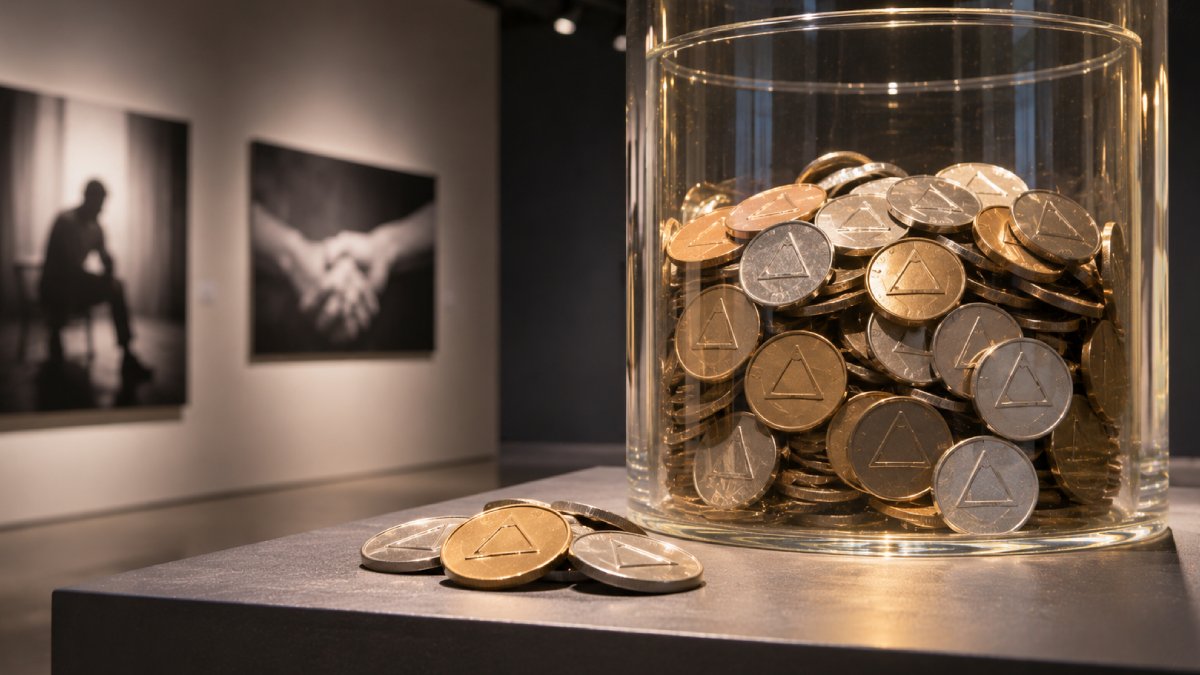
The Luxembourg-Belgian artist duo won for their work 5,376 Years, 1,892 Months, 1,110 Days, 1,201 Hours. More than 1,000 sobriety tokens collected from people around the world are used in the installation to illustrate the personal stories behind addiction and recovery.
Rather than showing addiction through statistics or medical jargon the artwork brings together objects related to individual journeys and asks visitors to think about vulnerability, resilience and empathy.
An Installation Built Around 1,033 Sobriety Tokens
The installation consists of 1,033 sobriety tokens collected from Canada, the U.S., Britain, Switzerland, France, Russia, Denmark and Mexico among others.
These tokens represent sobriety periods for different forms of dependency (alcohol, narcotics, nicotine, gambling and food).
Some were donated or sold by people entering a new chapter in their lives, some were bought by the artists. Each token has a personal history — it’s not just a measurement of time but a period of someone’s life.
The objects are spread out on four glass-enclosed stands that look like coin-operated arcade machines. Every now and then the machines kick in and move the tokens around so there’s movement, chance and reflection in the installation.
The title of the work brings together all the different durations that are represented by the tokens collected.
A Personal Connection Behind the Artwork
Brognon and Rollin started working on the project almost five years ago. They were interested partly because people close to them struggled with addiction.
The artists wanted to show how time can feel differently for different people. Addiction, searching for substances, illness or living in prison are just some examples of what someone might be going through and the experience of time will be very different to someone who is living an ordinary routine.
The installation attempts to communicate these experiences without reducing people to their struggles.
For the artists the tokens stand for hope, sadness, resilience, failure and courage. They want visitors to think about the human stories behind objects that might otherwise look ordinary.
A Remote Light Installation Adds Another Human Dimension
The artwork also features three illuminated wall fixtures that are controlled remotely by a volunteer named Kate who has been sober for eight years.
Kate changes the intensity of the lights according to her mood. Visitors can see these fluctuations but they don’t know exactly what each change means.
This element ties the physical exhibition to a person who lives outside the museum. It gives it an unpredictable personal dimension as well.
The exhibition opened at Musée d’Art Moderne in Paris in October 2026 and will run until February 2027.
Earlier Projects Also Explored Human Vulnerability
The artists have previously made installations about loss, disability, collective memory and the experiences of people who are marginalised.
One of their most famous projects was Le Phare (The Light House) created in Marseille, France: The beam of an old lighthouse was connected to the eye movements of French hip hop producer Pone who has amyotrophic lateral sclerosis (ALS) and uses eye tracking technology for communication.
By translating his eye movements into the changing beam of the lighthouse, the installation gave form to his communication in a visible way.
Another project replaced music in a jukebox with recorded silences observed around the world. Visitors could choose recordings (ambient sounds from locations where the silences occurred) to play on jukeboxes.
Both projects show the duo’s interest in how to connect individual experiences with larger human stories.
Two Artists Working Together for Two Decades
David Brognon and Stéphanie Rollin met at the Mudam Museum of Modern Art in Luxembourg. Brognon had been a graffiti artist and Rollin had studied art school in Luxembourg.
They started working together in 2006 and eventually quit their jobs to devote themselves completely to their artistic practice.
They have a strict creative process: both artists must be on the same page before they start working on anything. If one thinks an idea isn’t strong enough then they abandon it.
Often their work begins with things that are uncomfortable or hard to talk about. They feel that gently presenting painful experiences can make people listen and understand rather than turn away.
A New Project Planned for the Belgian Coast
They are working on a large scale sculpture for Beaufort Triennial on the Belgian coast at present. The project should be exhibited from late March 2027.
Although they haven’t shared any further details, they say it’s one of their most ambitious projects yet.
Brognon and Rollin have been awarded the Marcel Duchamp Prize for an artistic practice which puts human experiences at its core. The award winning installation shows how everyday objects can be powerful reminders of lives, struggles and resilience around the world.






Comments