
India and Singapore are exploring the possibility of developing a major cross-border electricity transmission corridor that would bridge Imphal in northeast India to Singapore through Myanmar, Thailand and Malaysia, which would be supported by all countries in Southeast Asia. It would open up a new route, at least 3,000 kilometres long, to regional electricity cooperation and energy integration in South Asia.
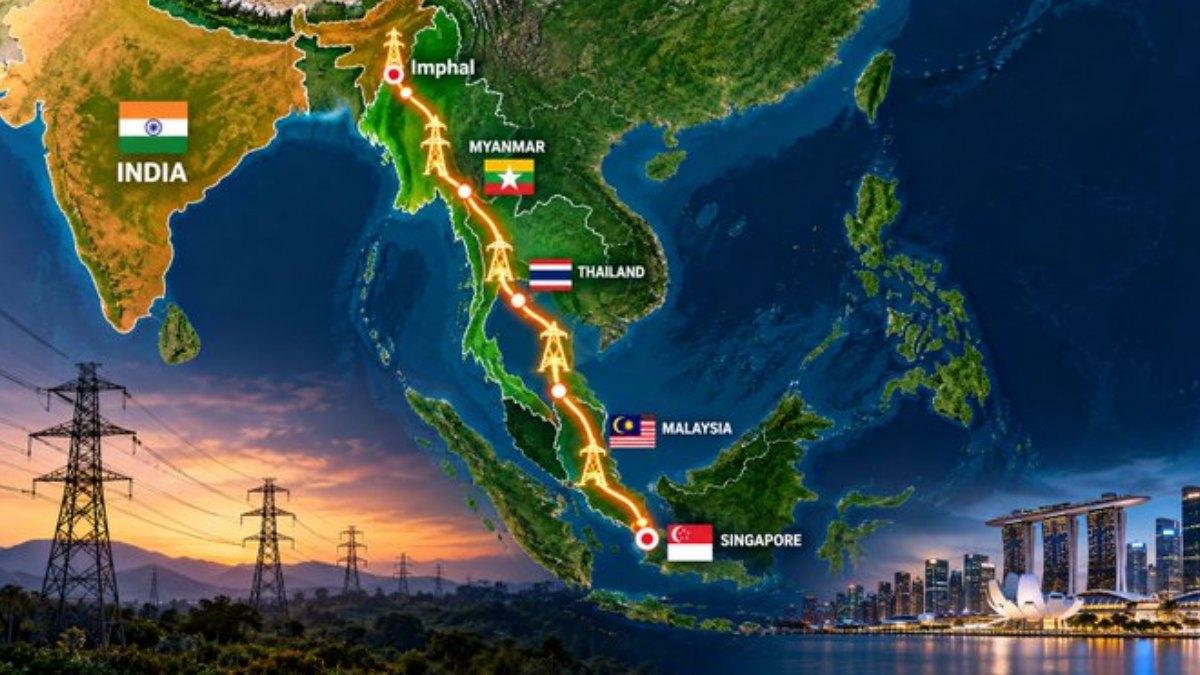
The idea goes down the path of being a real project it will promote cross-border power trade, develop regional energy integration and allow countries involved to better coordinate their electricity infrastructure. However, the proposal is still in the exploratory phase based on current data, and its route, capacity, investment requirements and implementation schedule would be subject to further discussions between technical, commercial and diplomatic parties.
The proposed corridor is important as it would connect regions with different electricity demand patterns, energy resources and infrastructure requirements. Imphal, the capital of Manipur, could serve as the Indian starting point for the transmission route, while Singapore would be the intended destination. The corridor would travel among Myanmar, Thailand and Malaysia. Coordinated planning, cross-border infrastructure agreements and technical standards will be necessary for electricity to move safely and reliably through multiple national power systems in order to connect these countries.
One of the benefits of such a project would be to expand regional electricity trading. Countries may have different electricity demand cycles, generation capacity and energy resource profiles. A connected transmission network may create opportunities for surplus electricity in one market to serve demand in another, provided that proper generation, transmission capacity and commercial agreements are in place. Therefore, a corridor of this scale could allow for discussions around how countries throughout the region share electricity resources and strengthen their energy systems.
For India, the initiative could strengthen the strategic importance of the Northeast as a gateway to Southeast Asia. The region occupies a key geographical position between the Indian mainland and neighbouring countries, making cross-border transport, trade and energy infrastructure important elements of regional connectivity. A power transmission line that will originate in Imphal can also help in the wider development of India’s economic and strategic relationship with Southeast Asian countries.
Singapore might also want more diversified electricity sources to access in order to achieve its longer-term energy and decarbonisation objectives. The city-state is highly dependent on imported energy and has limited domestic energy resources. Cross-border electricity imports may be one way to diversify the supply but any imported electricity would have to meet Singapore’s technical, regulatory, commercial and environmental needs. The proposed corridor could provide another possibility for regional electricity cooperation if it is technically and economically feasible.
The route through Myanmar, Thailand and Malaysia presents several challenges. Building or upgrading transmission lines over thousands of kilometres would require significant investment, land and route planning, substations, grid connections and advanced systems to manage power flows. Different countries have different laws and electricity market systems. There are also agreements to be signed on transmission access, pricing, operating duties, maintenance, emergency response and cost allocation. So the international coordination is as important as the engineering work to carry out these requirements.
There would also be political and security challenges to the project's prospects. Cross-border energy infrastructure is only possible with long-term cooperation and access to the transmission line. The project may be delayed so that political uncertainty, financing risks, environmental permits and local community issues are in place and the countries will be able to weigh those factors carefully before the construction is done. The economic case would also come down to whether the delivered cost of electricity would be competitive after accounting for transmission losses, infrastructure costs and so on.
Environmental considerations would be a key part of the planning process. A project of this scale would need to assess the impact of transmission infrastructure on forests, biodiversity, settlements and other sensitive areas along the route. Careful planning might minimize environmental disturbance and ensure that the corridor is technically appropriate for today's electricity network.
🚨 India and Singapore are exploring a 3,000 km power transmission corridor connecting Imphal in Northeast India to Singapore through Myanmar, Thailand, and Malaysia. https://t.co/bgrMp5CaO8
— Indian Tech & Infra (@IndianTechGuide) October 10, 2026
At this stage, the proposed India-Singapore power transmission corridor should be seen as an exploration project and not a construction project. Details such as electricity transfer capacity, total cost, funding structure, final alignment and completion date have not been established in the supplied information. Official announcements and feasibility studies will be necessary to decide whether the proposal advances to the next stage.
The proposed 3,000-kilometre corridor between Imphal and Singapore is thus a major step towards more electricity cooperation across South and Southeast Asia. If it is developed successfully, it will open up new paths for regional power trading and strengthen the linkages between participating energy markets. It will eventually be successful if it is technically feasible, commercially viable as well as politically friendly and if there is an agreement between the countries involved.






Comments
Leave a Comment