
A major glitch at JPMorgan Chase Bank on Monday, Nov. 16, knocked out banking services across the United States, and thousands of customers couldn’t log in to their accounts or complete financial transactions. The software-related problem delayed banks such as Bank of America, Wells Fargo, US Bank and others in networks across the country.
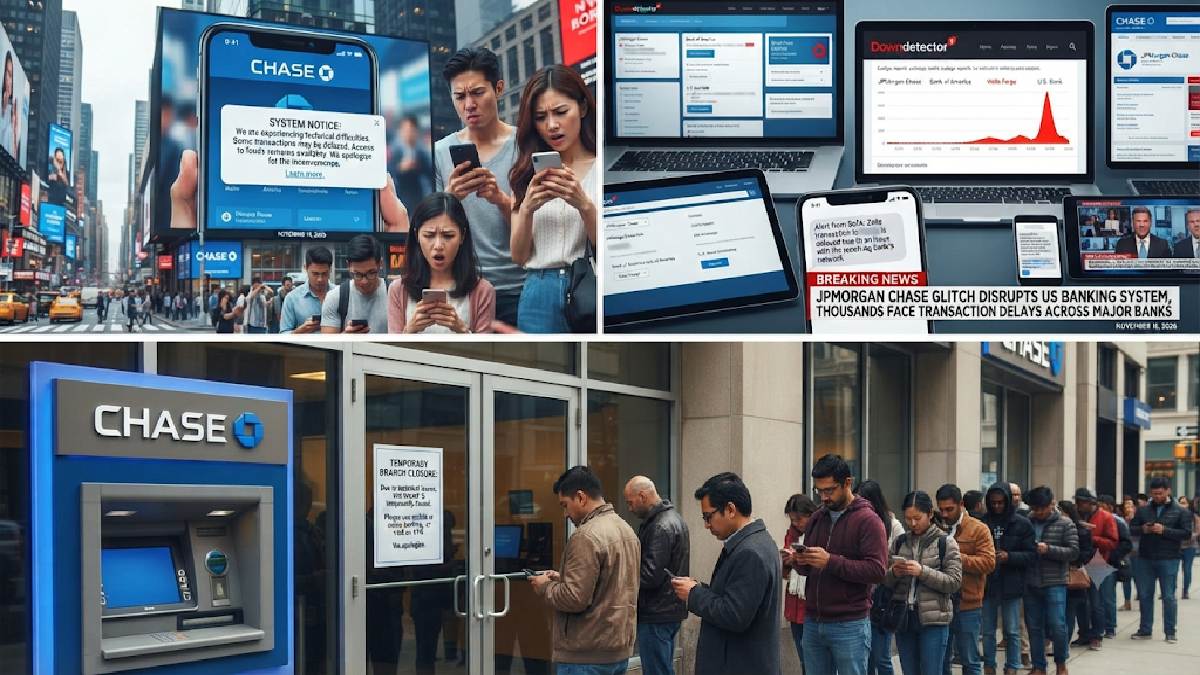
Customers were having trouble logging into online banking sites, checking account balances, transferring money and making payments. Some Zelle transactions, one of the most widely used digital payment services in the country, were also affected. It highlighted how the American banking system is dependent on interconnected digital infrastructure when a technical problem at one major financial institution can create operational difficulties for customers of other banks.
The largest bank in the U.S. by total assets, JPMorgan Chase, said that the problem was caused by a software bug on its internal hardware systems and not a cyberattack or malicious activity. The company said in a statement that technical problems slowed down transaction processing, so some payments and banking services took longer than usual to complete.
JPMorgan Chase also said the problem was temporary and its technical teams were working to fix it as soon as possible. Customers still had access to their accounts and money, the bank added. It also stressed that the incident was not a banking failure but a technical issue on its own infrastructure.
The impact wasn’t just on Chase customers because transactions between banks depend on interconnected banking systems. JPMorgan Chase said other banks could also be delayed if they were part of a transaction processed through its system. Bank of America, Citigroup, Wells Fargo and US Bank customers had problems with some banking services; some users couldn’t log into their accounts, others complained about fund transfers taking longer than normal or viewing account balances not working properly.
Downdetector (an online service that tracks user complaints of service disruptions) saw complaints surge on several major banking websites and applications Monday afternoon at around 2 pm Eastern Time; nearly 4,800 users were complaining of problems with Chase alone.
Digital payment services also saw more customer complaints during the disruption. Zelle, which lets customers move money between bank accounts held at participating banks, reported delayed payments from affected financial institutions but said its own systems were working fine.
Early Warning Services (the organisation behind Zelle) said some payments might take longer because individual banks had technical problems and that customers use Zelle through participating banks and credit unions (“who hold their funds”). So a disruption at a participating financial institution could slow down transactions but not necessarily indicate failure of Zelle network itself.
Some banks responded to customer complaints by explaining what services were available. US Bank said its systems had not been directly impacted by the JPMorgan Chase technical problem but that customers sending or receiving Zelle payments involving another financial institution may run into delays.
Capital One also said its banking services were working normally and it had not been affected by the outage; other financial institutions said their internal systems were operating as expected, although customers could still have problems when transactions involved JPMorgan Chase. Customers of Bank of America complained that online banking and ATMs were down, but the bank said its systems had been operating normally.
The disruption caused uncertainty for customers who use digital banking for everyday financial activities. People trying to make an urgent payment, move money between accounts, pay bills or do business transactions ran into delays; some customers also had trouble accessing banking services at physical branches.
In one reported incident in Texas, a customer was attempting to deposit a cheque at a Chase branch but couldn’t because of the technical problem. This showed how digital infrastructure failures don’t just affect mobile applications and online platforms but certain services available at physical banks as well.
JPMorgan Chase later said the technical issue had been resolved and that transactions were flowing back normally again. The bank had initially said it was working to get services up and running by the end of Monday; customers who had been delayed all day rejoiced when this happened. But it also showed how vulnerable financial systems are if they are dependent on interconnected technology systems: A software glitch could affect thousands of transactions across many institutions, but that’s not enough for a big problem.
The banking outage also came on the heels of several other major technology failures in the U.S.: Microsoft had a service outage affecting Outlook and Teams platforms; another technical problem with the FAA’s air traffic control communications infrastructure caused air travel to grind to a halt; United Airlines reported a widespread technology outage that affected flight departures on Monday. All were small incidents, but none was connected or caused by a coordinated cyberattack; each organisation blamed separate technical problems for the disruptions.
The JPMorgan Chase incident has once again made clear the need for reliable technology infrastructure in financial services: Millions of people rely on mobile banking, instant transfers and online payment systems, so banks need to make sure their systems can cope with technical failures without disrupting core customer services.
This outage also shows that backup mechanisms have to be stronger, fault detection faster and coordination between institutions better coordinated. Banking services have now returned to normal, but this is a reminder that one software bug at one major bank can have ripple effects across the wider financial network.






Comments