
Union Commerce and Industry Minister Piyush Goyal met Egypt’s Minister of Planning and Economic Development Dr Ahmed Rostom in a reported bilateral meeting on Monday November 16, 2026 when he was on an official visit to Egypt. India and Egypt are strengthening economic ties with increasing focus on expanding bilateral trade and attracting investments.
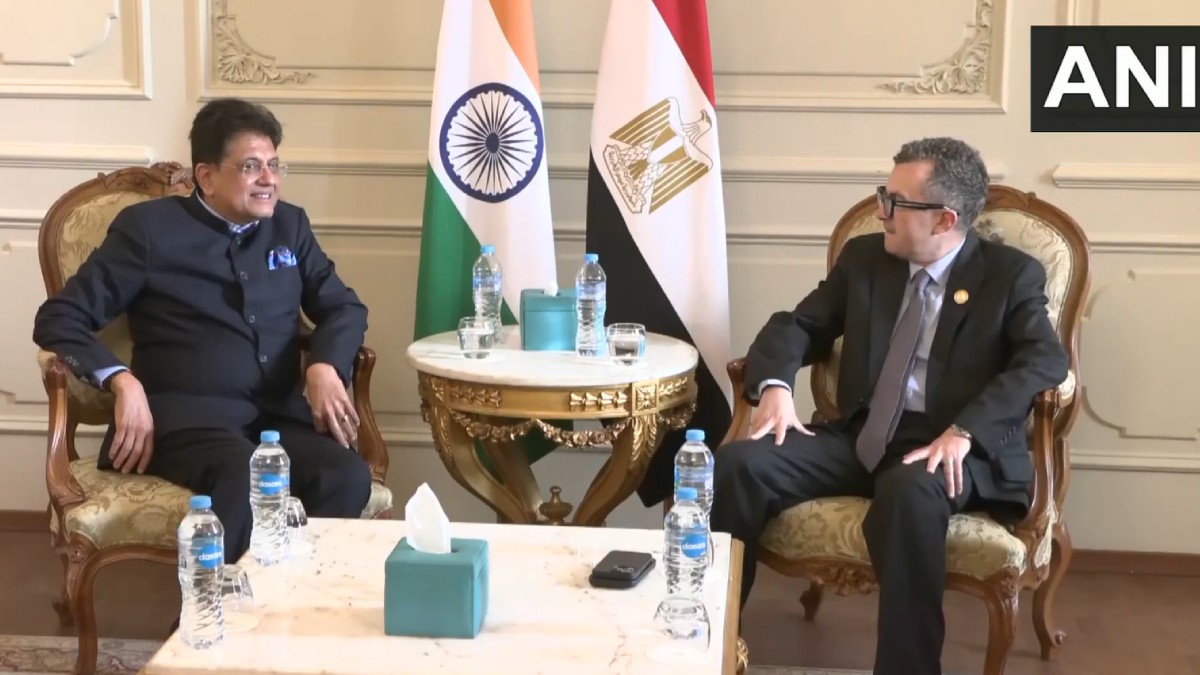
The meeting in Cairo is part of Goyal’s two-day official visit to Egypt from November 15 to 16 during which he will strengthen the India-Egypt Strategic Partnership through trade, investment, industrial development and business collaboration.
Piyush Goyal and Ahmed Rostom Discuss Economic Cooperation
The discussions with Ahmed Rostom were about how to increase economic cooperation between the two countries. Economic planning, development priorities, investment opportunities and closer institutional engagement are areas where collaboration can be fostered.
India and Egypt have complementary economic strengths that could drive stronger partnerships. India’s experience in manufacturing, digital infrastructure, financial technology and industrial development can be shared with Egypt.
The discussions also come against the backdrop of India’s Viksit Bharat 2047 vision and Egypt’s Vision 2030 that provide long-term development frameworks for both countries.
India-Egypt Trade Relations Gain Momentum
Goyal’s visit comes at an opportune time for bilateral economic ties. The Ministry of Commerce and Industry reported that merchandise trade between India and Egypt was about $6.5 billion in 2025-26 financial year (MoCI, 2026).
Trade between the two countries also grew strongly during April-September 2026 ($5.04 billion vs $3.08 billion in the same period of 2025).
Both countries have indicated interest in increasing bilateral trade to $12 billion. The two governments are also looking at the possibility of a Preferential Trade Agreement or Free Trade Agreement (FTA) to increase market access and investment.
More Than 130 Indian Business Leaders Join the Visit
An important feature of Goyal’s Egypt visit is that a high level Indian business delegation comprising more than 130 business leaders and start-up representatives is accompanying him.
The programme includes the seventh India-Egypt Joint Trade Committee meeting, the India-Egypt Joint Business Council meeting and the India-Egypt Business Forum.
The business engagements are designed to bring companies from both countries together and find joint ventures, technology partnerships and manufacturing collaborations.
More than 300 Indian and Egyptian companies also took part in the India-Egypt Business Forum — a clear sign of interest in strengthening commercial ties.
#WATCH | Cairo, Egypt | Union Minister for Commerce & Industry Piyush Goyal holds bilateral meeting with Dr. Ahmed Rostom, Egypt's Minister of Planning & Economic Development https://t.co/UWso4Jx41Y
— ANI (@ANI) November 16, 2026
Opportunities in Manufacturing, Pharmaceuticals and Infrastructure
India and Egypt are looking for opportunities in pharmaceuticals, healthcare, engineering, automobiles, textiles, renewable energy, food processing and logistics.
Egypt’s geographical location makes it an important gateway to African, European and Arab markets. The Suez Canal Economic Zone also provides opportunities for Indian companies interested in manufacturing, exports and regional supply chains.
Indian businesses could benefit from deeper cooperation in infrastructure development, ports, transportation and industrial projects.
India-Egypt Partnership Looks Towards Long-Term Growth
The latest diplomatic and business engagement highlight the growing importance of India-Egypt economic relations.
The raising of the Joint Trade Committee to ministerial level and discussions on a potential trade agreement show that both countries want to go beyond mere trade into deeper industrial and investment partnerships.
Goyal’s official visit will give fresh impetus to these efforts as both sides seek new opportunities for businesses, market access and economic cooperation.
As India and Egypt work towards their long-term development goals stronger collaboration could be an important way to expand trade and build sustainable economic partnerships.




Comments