
Ahead of the 2027 Uttar Pradesh Assembly elections, AIMIM chief Asaduddin Owaisi has indicated that his party intends to expand its presence in the state and provide young Muslims with greater political opportunities.
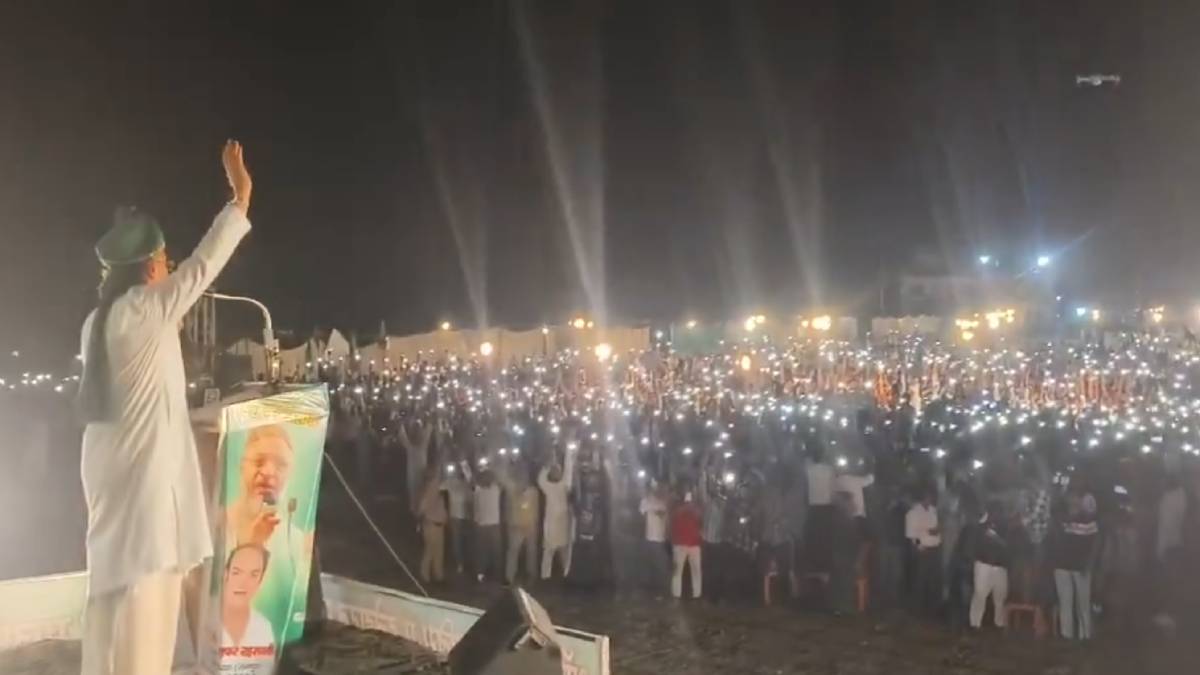
While addressing a public meeting in Rampur, Owaisi took a jab at dynasty politics and said that AIMIM would not make any Nehru, Gandhi or Yadav its leader. Instead, he said, the party intends to give Muslim men and women an opportunity to lead, arguing that they have the same potential as their peers but are often not given similar opportunities.
His remarks have once again brought the debate over Muslim political representation and AIMIM’s role in Uttar Pradesh politics into focus.
Is Owaisi Right About Muslim Representation?
While the discussion can be a bit nuanced, we can look at the numbers instead.
Muslims constitute roughly one-fifth of Uttar Pradesh’s population, according to the 2011 Census. Following the 2022 Assembly elections, 34 Muslim MLAs entered the state Assembly, showcasing the gap between the community’s share of the population and its representation in the legislature.
Across party lines, we can also look at the number of Muslim candidates who received tickets from major parties in the 2022 Uttar Pradesh elections. The Samajwadi Party (SP) gave approximately 13% of its tickets to Muslim candidates, the Bahujan Samaj Party (BSP) around 16%, and the Congress around 10%.
The BJP, meanwhile, did not field a single Muslim candidate in the 2022 Assembly elections.
This means that, in the current political landscape, Muslim candidates have largely been represented through opposition parties and their allies rather than the ruling BJP.
So, somewhere, Owaisi has a point. Muslim candidates do not always get enough opportunities to represent their communities, especially when it comes to the ruling party.
Is Owaisi the BJP’s ‘B-Team’?
It is widely known that every political party tries to win elections by consolidating votes among different groups. In the past, the Samajwadi Party has been associated with the M-Y alliance, also known as the Muslim-Yadav alliance.
In a different way, the BJP has sought to consolidate Hindu votes across caste lines. Critics argue that this strategy can also involve appeals to nationalism and patriotism, alongside identifying perceived threats to the majority community. The BJP, however, does not accept the characterisation that its electoral strategy is based on dividing people along religious lines. Although their base might say otherwise.
Owaisi, on the other hand, claims to be a voice for Muslims and Dalits. In that sense, AIMIM’s approach resembles the broader identity-based politics practised by several parties across India, which seek to represent communities they believe have been inadequately represented.
However, AIMIM is still a growing party in Uttar Pradesh. It has often contested elections in constituencies with substantial Muslim populations, including areas where opposition parties have traditionally sought Muslim votes.
As a result, AIMIM has repeatedly faced accusations that it divides votes that might otherwise go to the opposition, potentially helping the BJP win in closely contested constituencies.
This has led to the allegation that Owaisi is secretly working with, or is otherwise in league with, the BJP.
Can the ‘B-Team’ Allegation Be Proven?
These accusations are not new. AIMIM has faced them in several state elections, particularly when it contests seats where opposition parties are trying to defeat the BJP.
Owaisi has also offered to join hands with opposition parties to challenge the BJP. However, opposition leaders have expressed reservations about working with AIMIM, citing concerns over electoral calculations and trust. Ahead of the 2027 Uttar Pradesh elections, Owaisi has again indicated a willingness to work with opposition parties, while the Samajwadi Party has signalled that it intends to continue with its existing alliance partners.
The accusations can become cyclical. AIMIM is accused of splitting opposition votes, while the party argues that established opposition parties refuse to give it a chance to work with them. Neither the allegation of a secret alliance with the BJP nor the argument that AIMIM is solely responsible for electoral defeats can be established simply by looking at which party benefits from a particular result.
AIMIM’s electoral impact needs to be examined constituency by constituency, including vote shares, margins of victory, candidate profiles and the choices made by voters.
If the opposition has realised that its old and trusted ways of winning elections are not working, why not try changing the strategy?
Why not speak about issues that matter locally and unite people beyond the politics of religion and caste, while still addressing the problems people face because of their caste or religion?
Rahul Gandhi, for instance, has tried to bring attention to a range of social and political issues. But the opposition needs to offer more than a few prominent voices and repeated accusations against AIMIM. It needs a broader strategy that addresses local concerns, political representation, employment, education and public services.
Perhaps then, voters will have more reasons to reject candidates facing serious allegations of criminality and consider new political voices.
The Bigger Question: Does AIMIM Offer a New Voice?
Whether AIMIM is secretly in league with the BJP cannot be established merely through repeated political accusations. Equally, the claim that AIMIM’s presence never affects opposition prospects would be difficult to sustain without examining individual constituencies and election results.
But the point Owaisi raised about political representation deserves to be discussed on its own merits.
Young Muslim men and women, like young people from other communities, need opportunities to enter politics, contest elections and become leaders rather than remain confined to the role of voters.
The question is not simply whether AIMIM helps or hurts the opposition. It is also whether established parties are willing to create meaningful opportunities for communities whose representation remains limited.
Ahead of the 2027 Uttar Pradesh Assembly elections, voters will have to decide whether AIMIM offers a credible alternative or whether its electoral strategy will further fragment the opposition.
Until then, the debate over Owaisi, Muslim representation and the BJP ‘B-team’ allegation is likely to continue. But the demand for greater political representation deserves serious consideration, regardless of which party raises it.


Comments
Leave a Comment