Kartavya tries to break the usual Bollywood cop-drama formula, which features slow-motion heroism, loud punch dialogues and exaggerated action.
It is a tale of realism, emotional fatigue and moral conflict, one that Pulkit has taken, having previously wowed us with Bhakshak, over cinematic spectacle. Kartavya is both a strong and insufficient experience, as the film lacks the same sincerity and freshness behind-the-scenes, as does the execution.
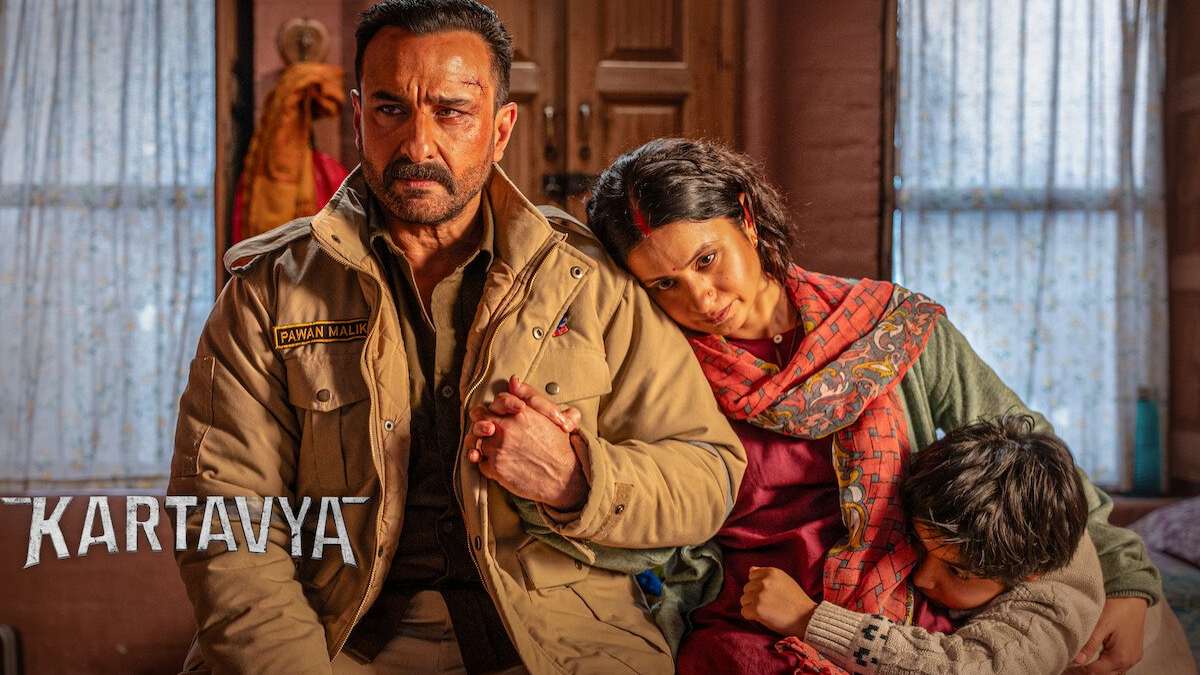
The film tells of SHO Pawan Malik, played by Saif Ali Khan, as a police officer who had a collapsing professional life and emotionally draining family issues. Centred around that investigation into a journalist’s murder, which gradually reveals corruption, betrayal and the ugly realities buried inside the system, the story follows the story of one of its many officers.
The emotional toll for Pawan at home is heavy. His relationship with his orthodox father is strained, while his disobedient younger brother will only add to the chaos of an already fractious home. His only stable relationship among them all seems to be with Rasika Dugal.
Their bond becomes one of the softer and more believable parts of his life. The more intense the investigation becomes, the more Kartavya layers up aspects of spirituality, manipulation, and a mysterious godman figure into his characters. But here is also where the film starts to tip.
The screenplay gets trapped in too many themes: corruption, family conflict, emotional trauma, faith and institutional failure at the same time, so several subplots feel underdeveloped. Director Pulkit deserves praise for avoiding overstated heroism. Pawan Malik is shown not as a superhuman cop but as a profoundly imperfect man who buckles beneath pressure.
But he also messes up, loses his cool and gets burned out, and the character feels much more human than standard commercially engaged cop heroes. His restrained and emotionally intricate portrayal gives Saif Ali Khan one of the film’s greatest achievements. Rather than fight and act, he performs with real emotional fatigue.
Saif continues to hold the audience’s interest even as the screenplay declines, relying on subtle expressions, grounded acting and more. Rasika Dugal is a strong presence even at a reduced screen, lending warmth and emotional anchor to the story. Sanjay Mishra is a brilliant veteran performer, and the actor delivers again, performing organically.
There, characters like Yudhvir Ahlawat and Zakir Hussain, Manish Chaudhari, and Durgesh Kumar were perfect, given the movie’s realistic setting. But Saurabh Dwivedi is the weakest link. His godman does not project menace, unpredictability and intensity: the antagonist seems flat, rather than menacing.
At a technical level, the film endures. The cinematography captures the rawness of a small-town India, police stations and emotionally tense interiors effectively without superfluous visual glamour. The background score nicely goes with the emotional scenes, although the editing tends to slow down in the second half, where people’s sense of the story lags in the narrative, making it feel a bit stretched.
Kartavya does succeed in capturing the emotions that are a part of being a police officer and gets praise for humanising its hero. In spite of this ambition, however, the film’s struggle to deal with too many themes dilutes the influence overall. If realistic, emotional and sincere, Kartavya can also be frustratingly incomplete in spots. All in all, Kartavya is a daring exercise in down-to-earth storytelling that ultimately doesn't quite shine as a movie that will be unforgettable as a cop drama. The film gets 2.5 out of 5 stars.