A statement from Pakistan's Director General of Inter-Services Public Relations (DG ISPR) has led to criticism and fears of the use of religious and identity-based rhetoric by senior state and military representatives.
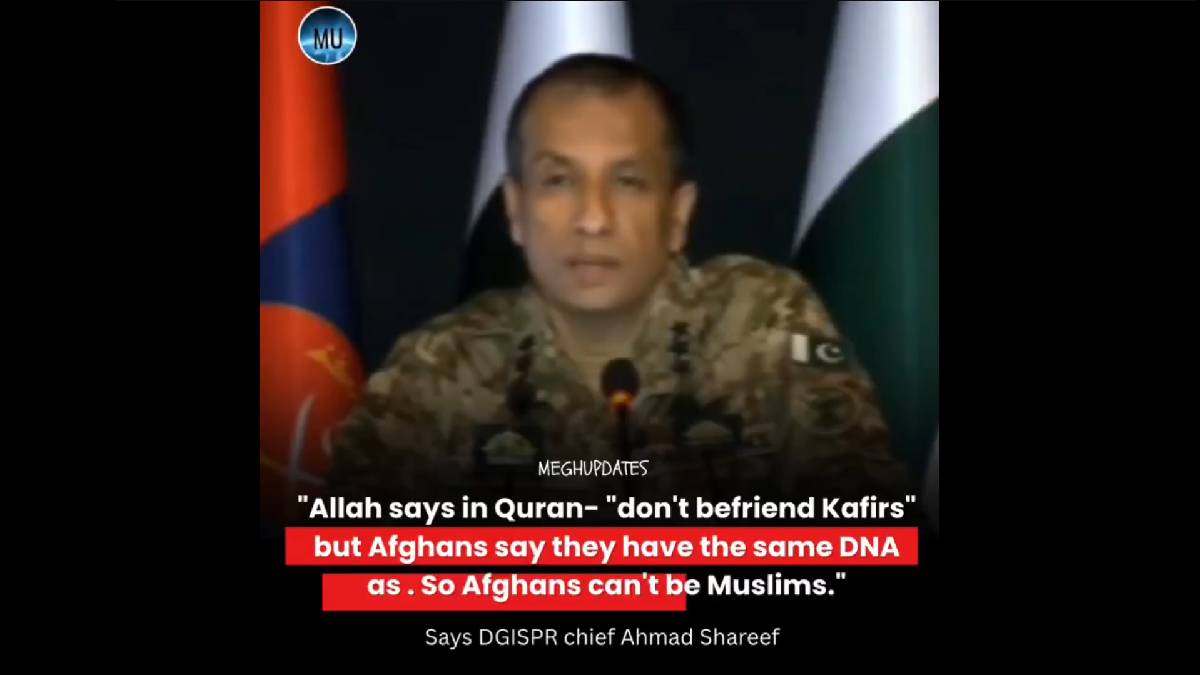
According to some sources on social media, the remarks were based on a Quranic instruction in relation to friendship with non-Muslims and linked Afghan identity to claims of shared ancestry with Hindus or Indians. The statement said that if Afghans claimed to have the same DNA as Hindus, their Muslim identity could be questioned.
Pakistan, DG ISPR:
— Megh Updates 🚨™ (@MeghUpdates) August 1, 2026
"Allah says in Quran- "don't befriend Kafirs" but Afghans say they have the same DNA as Hindus (Indians). So Afghans can't be Muslims."
When such rhetoric comes from an official Pakistani military spokesperson, concerns about the safety and treatment of… pic.twitter.com/krlN581jIT
The exact wording and context of the alleged remarks could not be independently verified at the time of publication. Consequently, the claim should be considered as a reported statement, not as a verbatim quote, until a full official recording, transcript or clarification has been made available.
But the controversy has drawn a greater understanding about the impact of religious rhetoric when it is coming from an official military spokesman.
Critics say that framing religious identity through ancestry or ethnicity can create harmful and divisive narratives. Religion, ethnicity, nationality and genetic ancestry are different concepts, and testing one as a test of another may only serve to further exacerbate social divisions.
The comments raised questions of the possible impact on Pakistan’s religious minorities, especially Hindus. Human rights activists have repeatedly voiced concerns about discrimination, forced conversions, attacks on places of worship and unequal treatment of minorities in Pakistan.
If public figures speak of Hindus or non-Muslims as being inherently different, inferior or politically suspect, critics say, it can contribute to an environment in which minority communities feel increasingly vulnerable.
The controversy is especially sensitive as the statement has been attributed to the DG ISPR, the official spokesperson of Pakistan’s military. The position is very much institutional, and public comments made by the office are well-known to the media and public.
The public’s perception of communities is affected by official rhetoric. That is why critics say the state’s powerful institutions should not use words that can re-enflame religious hostility or create suspicion of minority groups.
At the same time, it is important to distinguish between an unverified social media claim and an officially authenticated statement. The whole context of the comments, including the original language, the event at which they were made and whether the comments were accurately translated, would be necessary for a full assessment.
Pakistan’s official media has previously quoted the DG ISPR as saying that followers of all religions are equal citizens and enjoy constitutional rights. He has also spoken about national unity, equality and harmony among citizens.
The difference between those earlier responses and what is being called the "new" claim has raised questions.
The situation comes amid increasing tension between Pakistan and Afghanistan, where the Pakistani military is constantly accusing Afghan-based groups of involvement in attacks inside Pakistan. The DG ISPR has publicly urged the Afghan Taliban to choose between Pakistan and groups that it calls terrorist groups.
But critics say political or security disputes should not be framed through broad religious or ethnic generalisations. They say disputes with governments, armed groups or political organisations should not be extended to entire populations or used to question the religious identity of ordinary people.
The debate has raised questions about the impacts of divisive public rhetoric on social security and equal citizenship for Pakistan’s Hindu minority.
We believe the matter may require an official explanation as to whether or not the words reported were correctly attributed and what had been intended to mean. To that end, we think that the alleged quote should not be given as fact.
The controversy also reflects a larger principle: when senior officials talk about religion, ethnicity and national identity, their words can have consequences beyond political or security discussions. Public institutions need to uphold equal citizenship and ensure that minority communities are not made to feel unsafe or excluded.