It has gotten popular online, where the phrase that Mars is in a fire storm is said to be a reality, but the term is misleading. As far as wildfires are concerned, Mars cannot sustain conventional fire because its atmosphere is extremely thin, about 95% carbon dioxide-rich, and has very little oxygen to support combustion.
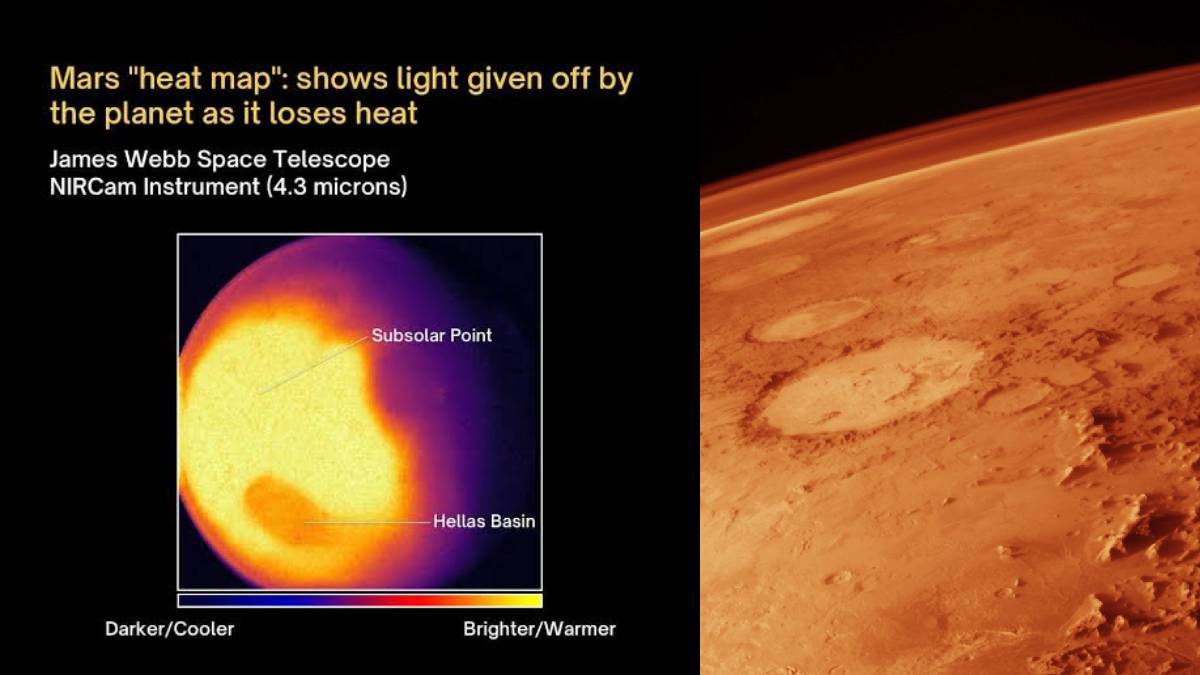
Instead, what scientists are describing is an incredibly dramatic atmospheric phenomenon of dust storms, heat, and sunlight that can make parts of the Martian surface appear as though they are engulfed in flames.
Breaking. 🟠 MARS IS HAVING A FIRE STORM 🔥
— Amazing Physics (@amazing_physics) July 15, 2026
This isn’t lava.
It’s a planet-wide dust storm.
Winds: 100km/h
Dust: Covers the entire planet for months
Color: That deep fire-red
Rovers on Mars literally go to sleep during this.
The Sun disappears.
Would you survive on Mars?… pic.twitter.com/RxVc6m7Y6h
Mars has some of the largest dust storms in the solar system. They can reach the size of continents and, in some cases, cover the entire planet. Strong winds lift fine, iron-rich dust high into the atmosphere, where it reflects sunlight and gives the sky a glowing reddish-orange appearance.
When sunlight shines through the dense dust clouds, the illuminated particles can produce a fiery glow, a phenomenon that is called a fire storm, and so the event is also called a fire storm. But there are no fires, burning vegetation, or wildfire-like processes on Mars.
Dust storms on Mars are fueled by solar heating. When the Sun heats the planet’s surface, warm air rises above the planet in warmer seasons, and dust storms can form, and these dust storms develop. Winds can take the dust thousands of meters away from the planet and get high. When dust is up there, it absorbs more light, so it is still warm and grows more and more, and then winds build up in the atmosphere, heating the storm.
These massive dust events pose substantial challenges to robotic missions. The lack of light on landers and rovers may reduce the power of solar panels, even though dust in the air makes them less visible and makes a science mission difficult. NASA’s Opportunity rover, for instance, halted its mission after a planet-wide dust storm in 2018 prevented sunlight from reaching its solar panels for an extended period.
Despite their impressive appearance, Martian dust storms are much weaker than hurricanes on Earth in terms of wind pressure, because the atmosphere is only about 1% as dense as Earth's. While wind speeds can be high, the thin air exerts relatively little force.
Researchers are still studying these storms using orbiters and rovers to better understand Mars' climate, seasonal weather patterns, and atmospheric dynamics. Future robotic and human missions can be made to work on the Red Planet if engineers can learn from these observations.
As space agencies work towards the eventual crewed missions on Mars, dust storms have become more and more important for all of us and future crews to understand and monitor them for future land and space exploration, as they begin to prepare for the crew to go to Mars. Dust can affect habitats, solar power systems, communications, scientific tools, and astronaut safety, so weather forecasting will be an important factor for future spacecraft.
So while headlines describing Mars as having a "fire storm" draw attention, the phenomenon is not an actual fire. It is a striking combination of dust, sunlight, and atmospheric activity that has made it one of the most visually striking weather events in our Solar System.