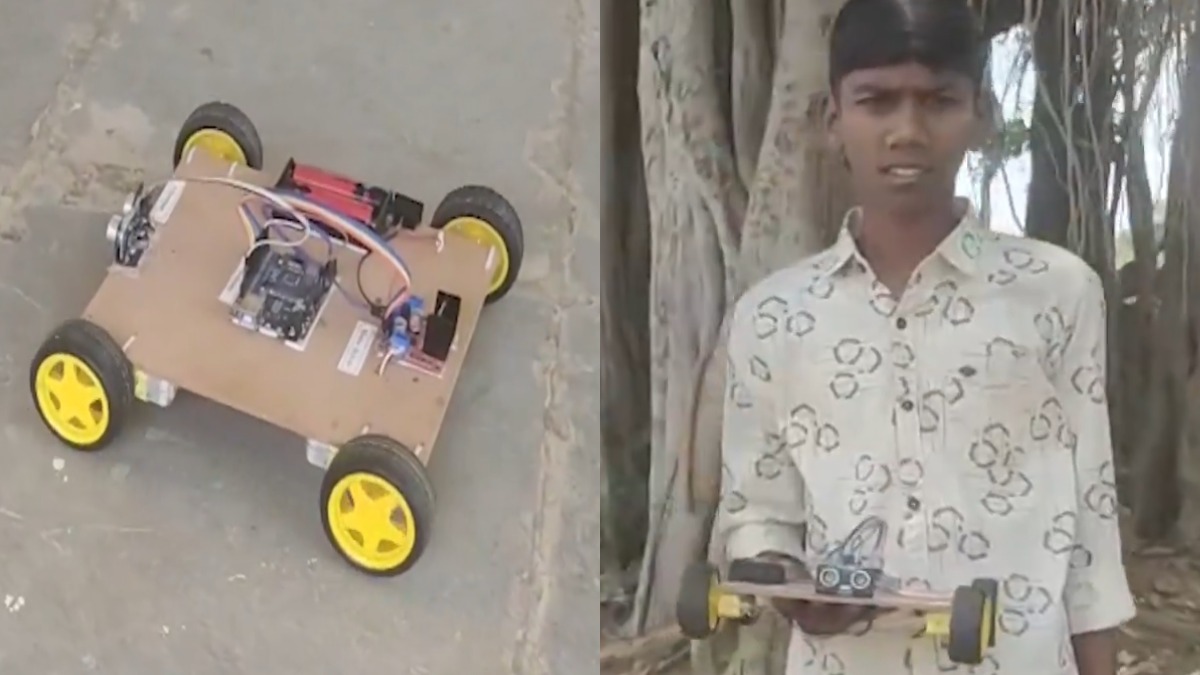
In an inspiring example of innovation driven by real-life challenges, a Class 10 student named Ashrith from Bejjur Mandal in Asifabad district has developed a robot designed to detect wild animals. His invention is not just a school project but a practical solution inspired by his father’s risky job in the Forest Department.
తండ్రి అటవీశాఖలో విధులు..వన్యప్రాణుల నుంచి క్షణక్షణం భయం భయం
— BIG TV Breaking News (@bigtvtelugu) April 10, 2026
ఈ క్రమంలో వన్యప్రాణుల జాడను గుర్తించే రోబోను తయారు చేసిన ఆశ్రిత్
రూ.7,500 వెచ్చించి అల్ట్రా సోనిక్ సెన్సర్లతో పనిచేసే రోబో రూపకల్పన
ఆసిఫాబాద్ జిల్లా బెజ్జూర్ మండల కేంద్రంలో పదో తరగతి చదువుతున్న ఆశ్రిత్
ఏఐ… pic.twitter.com/SjpvPbGJF4
Ashrith’s father works in forest areas where encounters with wild animals are a constant threat. Living with the reality of this danger, Ashrith grew increasingly concerned about the safety of forest personnel who often operate in unpredictable and hazardous conditions. Determined to make a difference, he decided to use his interest in technology to create a solution that could help detect wildlife presence and reduce risks.
With limited resources but strong determination, Ashrith built the robot at a cost of approximately ₹7,500. The device operates using ultrasonic sensors, which can detect movement and obstacles, making it suitable for identifying animals in forest environments. The robot can alert users when it senses movement nearby, potentially giving forest officials crucial time to react and stay safe.
Despite being just a school student, Ashrith demonstrated remarkable technical understanding and creativity in designing the robot. He reportedly worked on the project independently, learning and experimenting with electronic components and sensor technology. His innovation highlights how young minds can contribute meaningfully to solving real world problems when given the opportunity and motivation.
The robot, while still in its early stages, has already gained attention for its practical application. Forest areas often lack advanced monitoring systems, and a low-cost device like this could prove useful, especially in remote regions where resources are limited. Ashrith’s effort shows that effective solutions do not always require expensive technology but can be built with simple tools and smart thinking.
Looking ahead, Ashrith has ambitious plans to improve his invention. He has expressed interest in integrating artificial intelligence into the robot to make it more efficient and capable. With AI, the robot could potentially differentiate between types of animals, predict movement patterns, and provide more accurate alerts. Such advancements could significantly enhance safety measures for forest workers.
Local community members and educators have praised Ashrith’s initiative, calling it a proud moment for the region. His story serves as an inspiration to other students, demonstrating that innovation is not limited by age or resources but driven by curiosity and purpose.
Experts believe that with proper guidance and support, young innovators like Ashrith can contribute to important sectors such as wildlife conservation and human safety. His project also highlights the importance of encouraging STEM education at the grassroots level.
Ashrith’s journey from observing his father’s challenges to creating a technological solution is a powerful reminder of how personal experiences can inspire meaningful innovation. As he continues to develop his robot, there is hope that his work could one day be implemented on a larger scale, making forest environments safer for those who protect them.