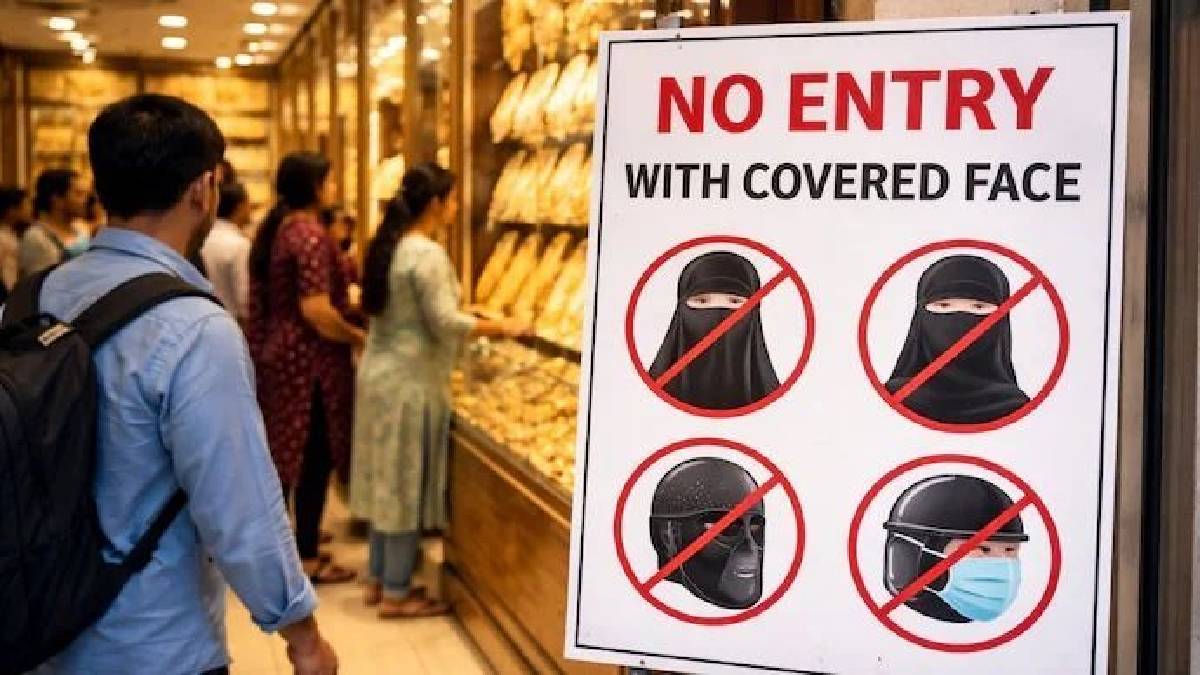
In an unexpected step, the jewellery store community in Bihar has announced that people donning hijabs, niqabs, burqas, face masks, helmets or any other veil, will not be allowed entry. The statement made by the All India Jewellers and Gold Federation's Bihar chapter is intended to prevent thefts and robberies. But over time the ban has turned into a far-reaching political and social storm. Critics said those who criticize it consider their own freedoms and religious liberty as compromised.
Why the Ban Was Introduced:
Robbers typically target jewellery stores because gold and silver are the most valuable commodities in jewellery shops. Men who are thieves often wear helmets, masks or veils or cover their faces with masks or veils as they enter shops, meaning the criminal is hard to recognize, some say that they also hide behind a helmet, masks or veil around their faces before they enter a store. Increasing gold prices have increasingly raised the chance of theft. To address those concerns, shop owners opted to apply a hard-and-fast rule: no one to be allowed in, especially whose face is partially or wholly hidden. Notices in many shops in Patna and other sections have been posted, clearly stating that customers must reveal their face before being allowed in.
Security vs Religion Fears:
While many traders insist that the ban is merely a matter of security, hijabs, niqabs and burqas, among other options, have stirred up outrage. These are religious garments for many Muslim women, not just clothes. Detractors of the ban say it targets religious wear without respect and violates constitutional rights. Maulana Khalid Rasheed Farangi Mahli, Chairman of the Islamic Centre of India, described the move as “against the law of the country.” He added that covering the head or face is not exclusive to Muslim women, as many Hindu women in villages wear ghoonghats as well. He emphasized that practicing one’s religion is a basic right.
Political Reactions:
It has ignited a controversy in Bihar. The state’s main opposition, the Rashtriya Janata Dal (RJD), harshly condemned the ban and requested its withdrawal. Party leaders charged that the government and traders had conspired to strip away freedom of religion and basic rights. They said such rules would discriminate against certain communities, and could raise social tensions. It’s only the safety that supporters of the ban say needs to be prioritized, at whatever price. They say that having customers reveal their faces is a reasonable precaution in an area susceptible to crime.
Public Response:
Public opinion has been bitterly divided. But some citizens support the ban, saying that doing so will prevent robberies and protect shopkeepers. Others have considered it discriminatory and unnecessary, particularly given that CCTV cameras and other security measures are already in place. Debates have spread on social media, with hashtags in support – and opposition – trending in Bihar.
The Bigger Picture:
This saga reflects a conflict in India over the tension between security concerns and religious freedom. On balance, shop owners have a legitimate reason for protecting their businesses, but blanket bans on religious uniforms could alienate communities and infringe on constitutional rights. The question too is one of how India achieves the balance between law and order and diversity and inclusion. As a result, experts have said that instead of altogether eliminating face coverings, such as in a policy-making proposal that criminalizes face coverings, shops should use the following: more intrusive surveillance, stricter identity verification or control over entrance. This enables businesses to protect and continue to keep themselves from being violated at the same time as they observe the faith.
The prohibition of face coverings in jewelry shops in Bihar is a bold yet controversial first step. The critics say the practice is discriminatory and is unfair, and violates basic human rights while traders insist it is critical in order to deter robberies. The debate mirrors broader challenges of India’s state, how to create safety while also respecting cultural and religious pluralism. The government and the traders will need to come to a compromise on what will protect both security and liberty. For now, Bihar is the first state to implement the rule, and the effects of it will be front and center nationwide.