The long dry spell and lack of rain in Karnataka’s Chikkaballapur district have caused farmers to struggle to protect their crops. The water crisis is now one of the biggest problems, and flower growers are suffering the most from the heat and drying borewells.
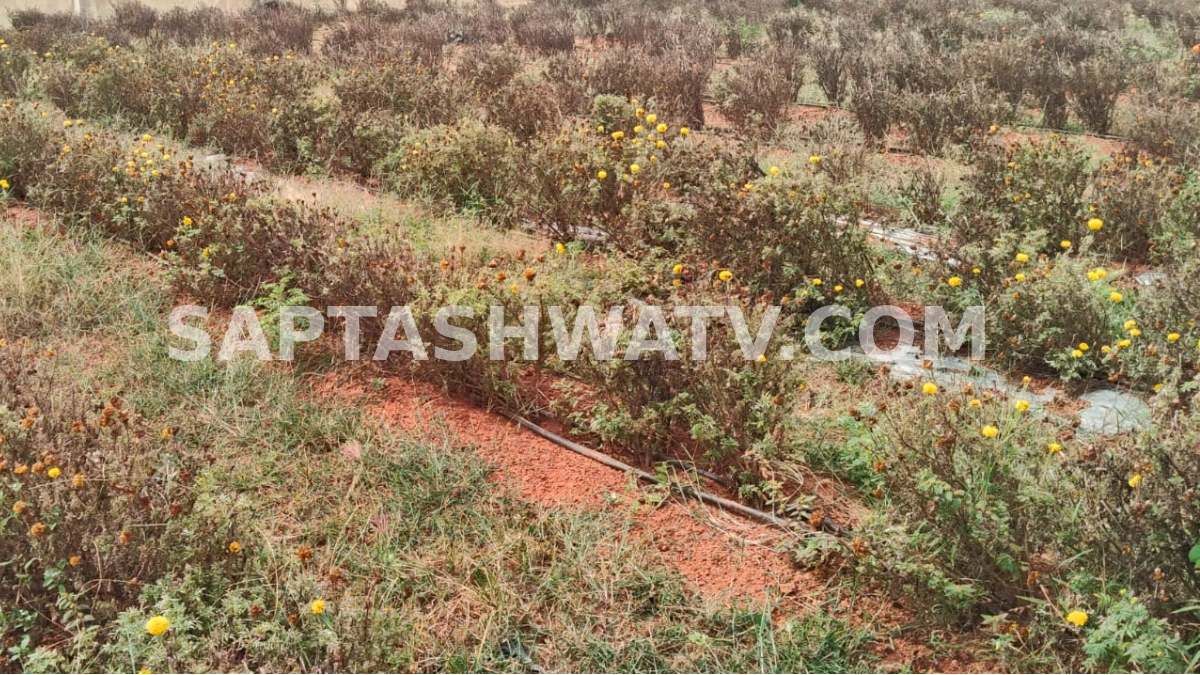
One such distressing case is from Kanitahalli village in Chikkaballapur taluk, where farmer Munikrishnappa is suffering heavy financial loss due to the lack of irrigation that has resulted in his flower crops withering, as the farmer begins to grow too weak.
Munikrishnappa grew marigold flowers on nearly an acre of farmland and was optimistic of a good harvest during the festive season when demand for flowers is usually high. But that has all been shattered for him, as the crop has dried up after the only borewell that supplied water to the field failed.
The borewell, the farmer's only source of irrigation, has completely run dry due to the continuing drought. With no other water source available, the farmer is left helpless as the once-healthy marigold plants slowly wilt and die under the scorching sun.
Flower cultivation depends on regular water supply and not just in the flowering stage. The plants cannot survive without adequate irrigation, and the crop is destroyed. Farmers say that despite investing heavily in seeds, fertilisers, labour and irrigation, lack of rainfall has wiped out months of hard work.
Munikrishnappa's losses could be in the range of lakhs of rupees as there is no way to salvage the damaged crop. The incident shows the increasing difficulties faced by farmers in Chikkaballapur where groundwater levels have fallen sharply after consecutive weeks of inadequate rainfall.
Drought has not only impacted flower growers but also farmers who grow vegetables, fruits and other commercial crops. In addition, many borewells in the district are dry and very little water is flowing in, and irrigation is hard. So many farmers are now forced to abandon crops midway through the season.
If rain doesn’t stop soon, crop losses could escalate further, and farm incomes and agricultural supply in local markets could be affected, agricultural experts say. Flower growers are especially worried since marigolds and chrysanthemums are prevalent at festivals, religious ceremonies and weddings, and crop failures could lead to decreased supplies and higher prices to market.
Local farmers are approaching the state government for immediate assistance: drought relief, compensation for crop losses and water access. They have also asked to see to it that watershed development projects, groundwater recharge programs and irrigation solutions are developed, and support for farmers to cope with recurring drought conditions.
It is this situation in Kanitahalli, in fact, that is emblematic of the larger crisis in many parts of Karnataka, and how erratic monsoon conditions and water supplies are putting pressure on agriculture. Long-term solutions such as rainwater harvesting, efficient irrigation systems and sustainable groundwater management are expected to be essential to prevent future droughts.
And farmers, who are waiting for rainfall to really come, fear that if the drought is not addressed quickly, the economic impact in rural communities that rely on agriculture will be long-term.