The Karnataka government has expanded the jurisdiction of the Bengaluru Water Supply and Sewerage Board (BWSSB) to the entire Bengaluru Urban district, including localities outside of the Greater Bengaluru Authority (GBA). This is an attempt to develop integrated planning for drinking water supply, sewerage networks and sewage treatment infrastructure in areas undergoing fast urbanisation.
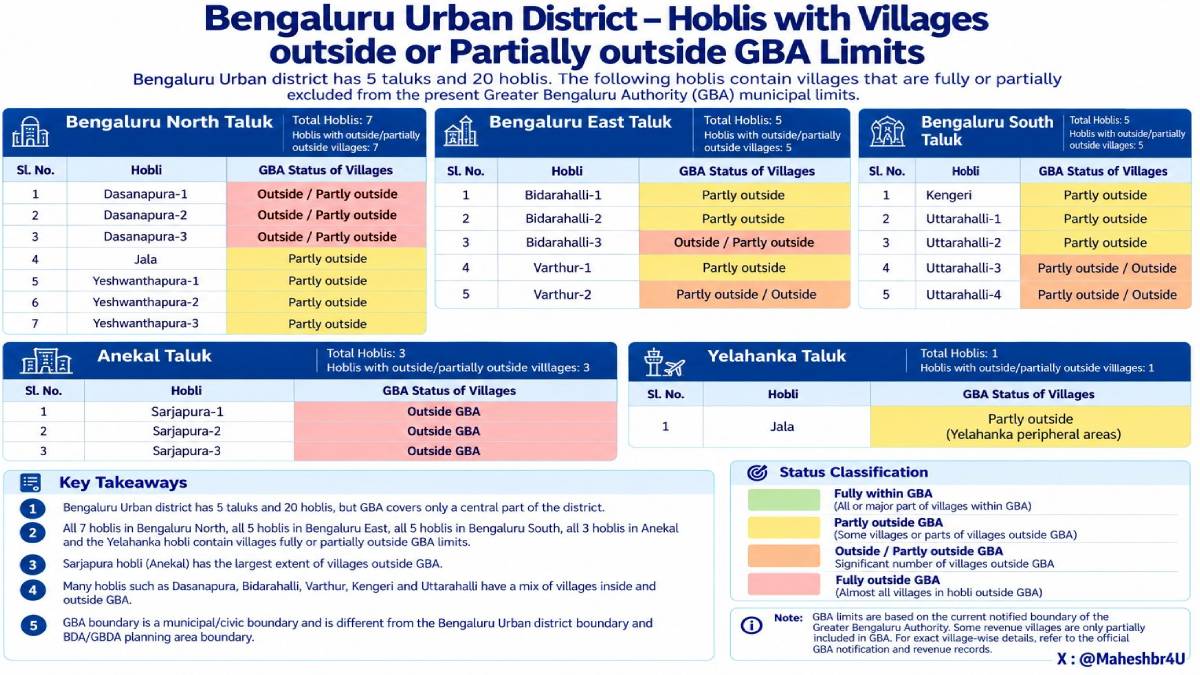
The expanded jurisdiction covers Bengaluru Urban district in its entirety. The district currently has five taluks - Bengaluru North, Bengaluru North (Additional), Bengaluru South, Bengaluru East and Anekal - according to the district administration.
Under the new arrangement, BWSSB will have a wider role in planning and implementing water and sewerage infrastructure in areas beyond the GBA limits. Long-term infrastructure needs are also under discussion as Bengaluru’s urban expansion increasingly spreads out to peripheral areas.
The expansion is significant because many villages and developing localities on the outskirts of Bengaluru are not part of the Greater Bengaluru Authority's civic system. While the GBA was set up to create a new governance structure for the metropolitan area, the BWSSB decision extends water and sewerage planning to a wider Bengaluru Urban district. Government records show that the GBA currently has five city corporations in its notified Greater Bengaluru area.
The government’s approach also involves sewage treatment plant development and the use of treated wastewater for processes like lake rejuvenation and groundwater recharge. This could become more significant as peripheral areas are rapidly constructed and populations grow.
The development has also spurred calls for the administrative integration of Bengaluru’s urbanising villages. Proponents of including more peripheral localities in the GBA say that the fragmented administration can make it difficult to coordinate roads, drainage, waste management, water supply, sewage infrastructure and enforcement of development regulations.
A request has been made to Karnataka Chief Minister D.K. Shivakumar and Minister Krishna Byre Gowda to bring all the villages in the Bengaluru Urban district under the GBA jurisdiction. A consolidated metropolitan governance structure would be beneficial for bridging infrastructure gaps and addressing issues such as unauthorised development and encroachments.
Bengaluru Urban district continues to have a large number of villages and local administrative units outside the core metropolitan governance structure. District data lists multiple gram panchayats and hundreds of villages in its administrative divisions.
However, the BWSSB expansion is specifically concerned with water supply and sewerage and is not in itself meant to mean that all areas of Bengaluru Urban district have been placed under the GBA civic administration. The difference is important: the BWSSB mandate extends infrastructure planning and service responsibilities, and the jurisdiction under the GBA is governed separately under the Greater Bengaluru Governance framework.
As Bengaluru expands outside its established city centre, coordination between GBA, BWSSB, local bodies and district administration will continue to be a major issue. The recent decision is part of a drive to bring water and sewerage planning to the rest of Bengaluru Urban District while the debate on a more cohesive civic administration is on the way.