In a major development in India's judicial system, the Lok Sabha has passed the Supreme Court (Number of Judges) Amendment Bill, 2026, which will increase the sanctioned strength of the Supreme Court from 34 to 38 judges, including the Chief Justice of India (CJI).
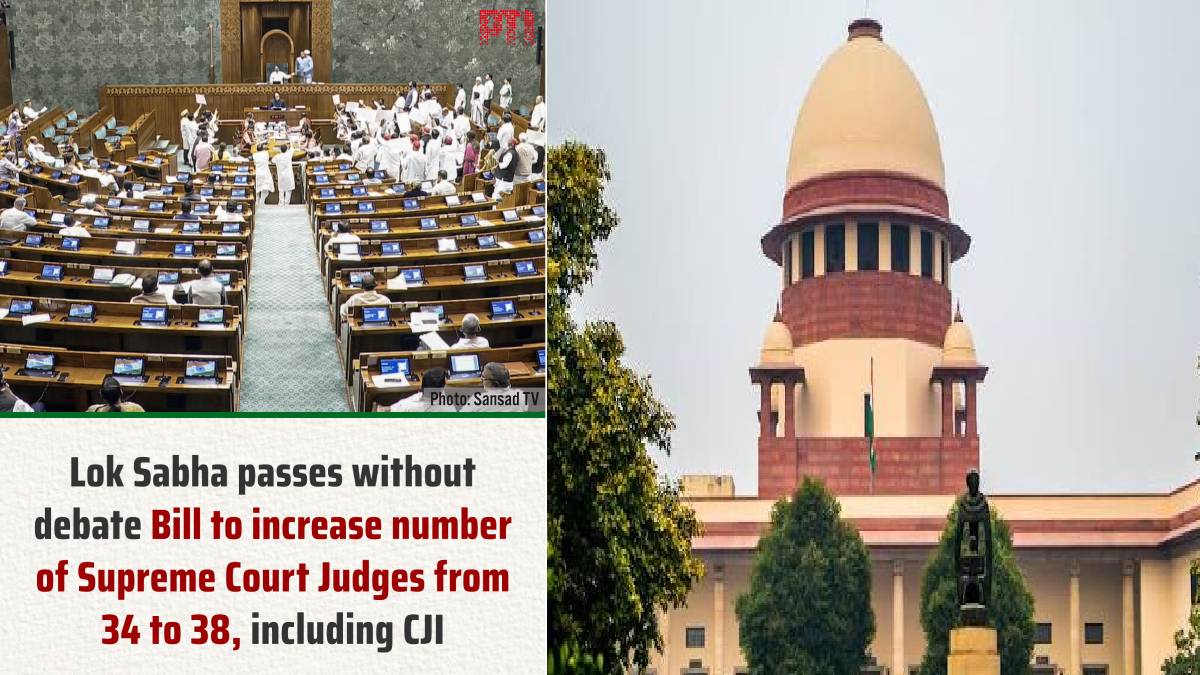
So the Bill was passed without any debate in the Lok Sabha and is the first step towards formalizing the power of the highest court in the country.
Under the proposed amendment, the number of Supreme Court judges other than the Chief Justice of India will increase from 33 to 37. With the CJI included, the total sanctioned strength of the apex court will rise to 38 judges.
The legislation is to reform the Supreme Court (Number of Judges) Act, 1956, and replace an ordinance which had already increased sanctioned judicial strength earlier in 2026.
The government has said that having four more judges will not only make the Supreme Court efficient and effective but also speed up the disposal of cases. The increase is expected to enable the court to make more benches and handle more issues at once; it’s not something that we’re ready to do.
The Supreme Court has a wide range of cases it handles– constitutional matters, appeals from High Court, public-interest litigation, commercial disputes, criminal cases, and special leave petitions. The growing number of cases reaching the apex court has put pressure on the existing judicial structure.
The sanctioned strength will increase in terms of the court being able to hear cases and the speed of the judicial process.
The Supreme Court’s sanctioned strength at the time was 34 judges, including the CJI. The new legislation adds four judicial positions to take the number of justices to 38.
The government had approved the proposal to enlarge the Supreme Court’s power and passed the Bill in the Monsoon session of Parliament. The measure was intended to replace the ordinance promulgated in May 2026.
The passage of the Bill in Lok Sabha is a key step in the legislative process. Now it needs Rajya Sabha approval before it gets to the parliamentary stage. Once passed by both Houses, the Bill will need presidential assent to become an Act.
The expansion is believed to be intended to improve the judiciary’s capacity and alleviate the mounting number of cases that remain pending.
However, the increase in sanctioned strength does not automatically mean that all the additional positions will be filled immediately. The actual working strength of the Supreme Court will depend on the appointment of judges to existing vacancies and the newly created positions.
The appointment process involves recommendations by the Supreme Court Collegium and consideration and approval through the constitutional process.
Legal experts have argued that increasing the number of judges in the court would improve the court’s capacity but would not solve the bigger issue of judicial pendency. Timely appointments, better court infrastructure, adequate staff, and efficient case management systems are also considered to accelerate the process of justice.
The expansion might allow the Supreme Court to have more benches and to better distribute its workload. It’s also the kind of thing that would allow the court to devote a lot more time to high-level constitutional and legal issues but still be able to deal with the daily stuff.
The Supreme Court forms the heart of India’s constitutional system. It is the Supreme Court that interprets the Constitution, that enforces fundamental rights, and that judges appeals from High Courts and other courts.
As a result, the increase in the number of judges will therefore have long-term implications for the functioning of the apex court.
The Bill’s passage without debate has also attracted attention because the expansion of the Supreme Court is a significant institutional development. It was passed in Lok Sabha in December, and there was no discussion of it on the floor of the House.
The government has said that new judicial positions will assist the Supreme Court in its efficiency and effectiveness and will contribute to justice being swift.
The next step is to consider the Bill in the Rajya Sabha. If the Upper House also passes the legislation, it will go forward for presidential assent.
Once the legislative process is complete, the sanctioned strength of the Supreme Court will stand at 38 judges, including the Chief Justice of India.
The development is one of the biggest recent extensions of the highest court of India and reflects the government’s effort to increase judicial capacity as it grows in the workload of India’s highest court.