A video of women travelling dangerously close to the doors of a crowded Mumbai local train has gone viral on social media, once again raising concerns over passenger safety and overcrowding in the city’s suburban railway network.
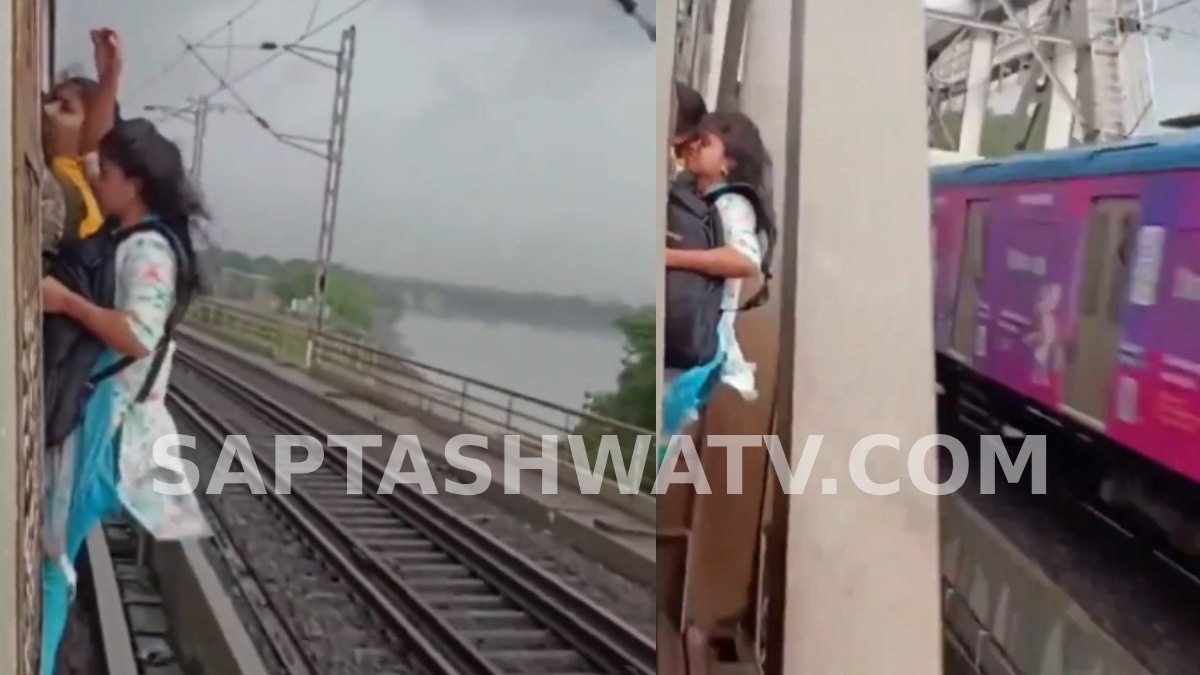
The viral video shows women standing just outside the open doors of a moving local train, leaning or hanging outside while holding onto the train. The images have generated mixed reactions online. Some praise the women for travelling in difficult situations, but others have lambasted them for an action they should have never done and called it stupid as well.
Mumbai’s local trains are one of the most important modes of public transportation in the city. Thousands of commuters depend on the suburban railway every day to reach offices, schools, colleges, markets and other destinations. During peak hours, trains can be incredibly packed, so passengers have little room in the coaches.
The video has brought greater attention to the risks of passengers who travel near the doors of moving trains. When coaches are filled to overflowing, passengers can be pushed into the doorway. But intentionally leaning out or hanging from a moving train can put commuters at risk.
A moving train is close to the railway infrastructure, platforms, poles and other objects. A small loss of balance can be deadly. It gets worse when passengers try to leave or board the train, and if they do so, they can get stuck.
The viral footage has thus brought up a strong debate: should we view such behaviour as courage, or should we view it as a safety issue?
Social media users said there is nothing adventurous about putting one's life at risk. One sentiment that resonated with people who posted on social media was: “Another train may come, but another life will not.” It tells us that personal safety is more important than a few minutes in a daily commute.
Overcrowding remains a major concern.
The incident also illustrates the greater problem of overcrowding on Mumbai's suburban railway network. Commuters from all professions and age groups travel at the same time during rush hour, adding a lot of pressure on existing services.
Simply blaming passengers might not be enough to fix the underlying problem. As the city's population and commuting needs continue to rise, authorities should focus on expanding services on the most busy routes and more efficiently handling the crowds at train stations.
Better passenger awareness is equally important. Commuters shouldn’t stand outside the train, lean out of doors or attempt to board or get down as the train is moving.
The viral video has also revived discussions about women commuters’ safety. Mumbai’s local trains have women’s compartments, but crowding and passenger movement are still vital safety issues.
Improving station management, passenger information systems, crowd control measures and awareness campaigns could reduce risky behaviour. There is also greater monitoring at places where overcrowding and dangerous boarding practices are frequently noted.
Another concern surrounding the viral video is how such visuals are presented online. Videos of risky acts can have hundreds of millions of views and can cause others, especially young commuters, to imitate the behaviour unintentionally.
Social media users and content creators need to provide context when sharing such videos. Dangerous train travel should not be portrayed as a stunt, challenge or display of bravery. Instead, such videos can be used to promote safety and encourage safer commuting.
Mumbai’s local trains remain the lifeline of the city and are vital to keep its economy going. But efficient public transport also has to be safe transportation.
Passengers should keep inside the coach as much as possible and avoid hanging from doors, leaning outside moving trains or attempting dangerous boarding and alighting. Railway authorities need to continue to work on capacity expansion, crowd management and passenger safety measures as well.
The viral video has once again brought the issue into the spotlight. The larger lesson is simple: saving a few minutes is never worth risking a life.