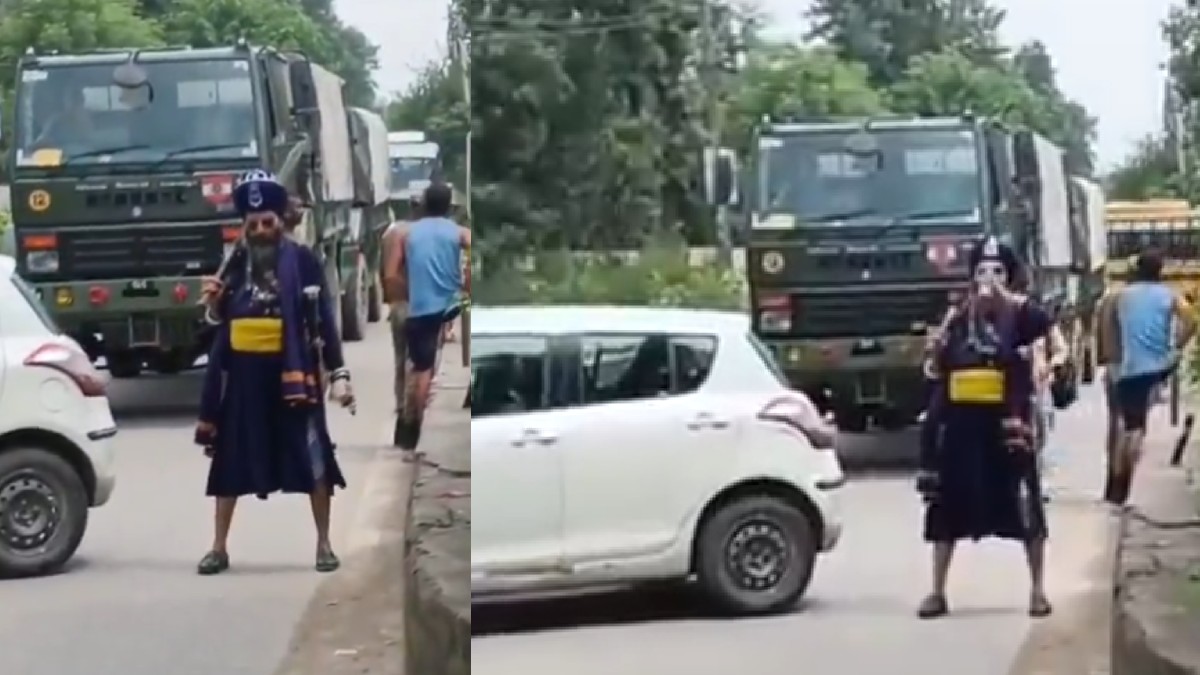
A video showing a Nihang Sikh apparently stopping Army trucks during a statewide bandh in Punjab has triggered a heated debate online on protest rights, military movement, public order and traditional Sikh martial practices in today’s demonstrations. The footage emerged in conjunction with a seven-hour statewide bandh on August 21 after a call from the Qaumi Insaaf Morcha.
The bandh was to press for the release of Sikh prisoners and to seek parole for a convict whose mother, according to reporters who were covering the protest, is in very serious health problems. The protest extended to parts of Punjab with road blockades and disruption in Patiala and Ludhiana. Markets and educational institutions were disrupted and essential services were reportedly kept outside the scope of the shutdown.
The viral video was one of the most discussed moments of the bandh. The footage shows a Nihang Sikh performing a sword display in front of Army trucks, effectively preventing the trucks from moving forward for a period. The imagery was so much more emotional because of two important elements: a public protest of Sikh religious symbolism in front of military vehicles.
Nihangs are traditionally associated with an armed warrior order of Sikhism and displays of swords and other traditional weapons have a historical and ceremonial place in the community. Such martial demonstrations are associated with Sikh traditions of self-defence and the Khalsa. But the fact that such a display was made in a roadblock of Army vehicles has raised questions about where religious tradition and protest action intersect in a modern public order scenario.
The video also divided social media reactions in a very different way. Some viewed it as a statement on Sikh identity and resistance while others argued that stopping military vehicles during a protest would create unnecessary tension. A veteran officer, according to the article, said the action would not be good for soldiers’ morale and Guru Gobind Singh’s legacy was talked about in the discussion of the episode.
The incident also has raised the difficult question of how to respond to protests involving religious symbols or traditional martial displays. A strong response could potentially escalate tensions, especially in an environment where questions about Sikh identity, political representation and treatment by authorities can quickly become contentious. On the other hand, allowing military or emergency movements to be obstructed can raise legitimate concerns about operational requirements and public safety.
The entire Punjab bandh in itself reflected anger in many sections of the Sikh community over the jailing of prisoners and the parole demand. The protesters blocked roads and highways at places, and disrupted daily life. At the same time, organisers told us that essential services would remain exempt and that it was purely political rather than an attempt to completely halt public activity.
Now if the Army was to use force to remove him and stop this stupid act, the very people praising him for his 'bravery' will be the first ones to shout discrimination against and oppression of the Sikhs. pic.twitter.com/ezGc75DLOU
— VatsRohit (@KesariDhwaj) August 22, 2026
The episode illustrates the tricky relationship between protest movements and public institutions in a democratic society. Citizens have the right to express political and social grievances but demonstrations can also affect transportation, public services and the movement of government personnel. When military vehicles are involved the sensitivity is even higher because the armed forces have responsibilities that go beyond ordinary civilian traffic.
The viral video then is more than an unusual confrontation on a Punjab road. It’s become a symbol of a larger debate about how Sikh martial heritage should be represented in public life, how peaceful protest should be conducted and how authorities should balance security concerns with the right to dissent.
The video remains online and views will remain divided. The Nihang’s actions could be viewed as in the context of Sikh tradition and protest or instead as a disruption of military movement and the potential for escalation. Ultimately the episode speaks to the delicate balance between religious expression, civil protest, public order and military operations in Punjab.