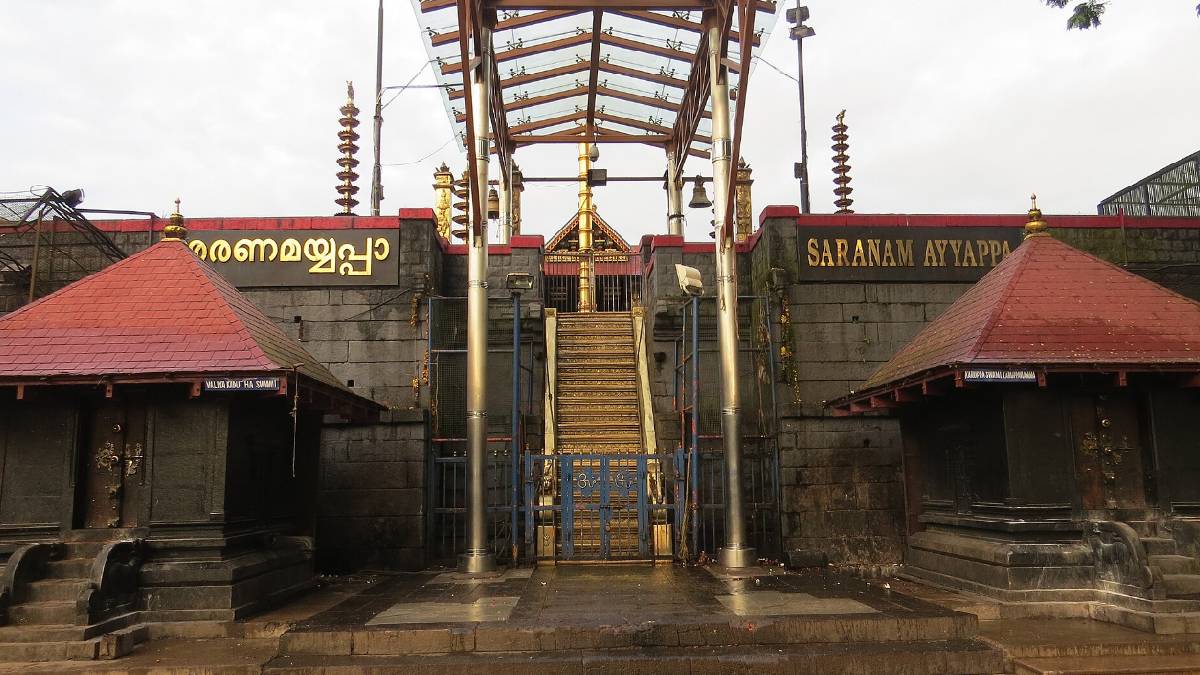
The Kerala High Court has directed the Travancore Devaswom Board (TDB) to be more watchful of the ingredients it uses to make prasadam at Sabarimala temple, and to do so in a more cautious manner. The clarification came after the court was hearing a petition to stop the use of a halal certification mark on jaggery for Aravana and Appam preparation.
The court, however, did not find any quality-related problem with the jaggery. Test reports before the bench showed that the product was satisfactory and did not contain any substance or element that would make it unsuitable for use in prasadam.
The matter was considered by a bench consisting of Justice Raja Vijayaraghavan V. and Justice K.V. Jayakumar. The petition was filed in 2021 and challenged the use of jaggery with a halal certification mark in preparation of prasadam at Sabarimala.
What is the Sabarimala Jaggery controversy?
The petition also voiced objections to the use of halal certified jaggery for making Aravana and Appam. Both are among the famous prasadam offerings given by devotees to the Sabarimala temple dedicated to Lord Ayyappa.
Aravana is a payasam-like preparation traditionally made using rice and jaggery. Appam is a sweet preparation which is also made with rice and jaggery. These are prepared and given to devotees as prasadam.
SJR Kumar argued that the halal certification on the jaggery indicated that the product had been prepared or certified in accordance with religious requirements of another community. He said that such a product should not be used for an offering at Sabarimala.
The petition asked for restrictions on the use of such jaggery in the preparations of prasadam.
Why did the jaggery carry a halal mark?
The court considered the explanation given on the certification mark on the product. The jaggery was supplied by a Maharashtra-based manufacturer that also exported its products to certain West Asian countries.
The court also said the halal certification mark was connected to the manufacturer's export business. The mark on the packaging was therefore considered in the context of the company's supply and export arrangements.
The Travancore Devaswom Board had procured the jaggery through an e-tender process. The successful bidder was required to provide approximately 19,96,034 kg of jaggery powder for the temple's requirements.
The court noted that the certification did not raise a quality concern, but the TDB could have taken more care in selecting ingredients for religious offerings.
Kerala HC says quality of jaggery was satisfactory
One of the key aspects of the court's observations was that the jaggery itself was not found to be unsafe or unsuitable for preparing prasadam.
The bench considered test reports made during the proceedings. As described in the case, the reports showed that the jaggery met the relevant quality requirements. The testing also did not find any substance or element that would make the product unsuitable for use in Aravana or Appam.
This distinction is important because the court's decision on future procurement was not based on a finding that the jaggery was contaminated, unsafe or of poor quality.
In light of this, the court said there should be a greater caution applied to what materials to give for religious offerings and that procurement should take into account the customs and practices associated with Sabarimala.
Court tells TDB to exercise greater care
The Kerala High Court said the Travancore Devaswom Board should ideally ensure that ingredients purchased for prasadam do not carry marks, symbols or declarations that could potentially conflict with the religious traditions and practices followed at the temple.
The court directed the TDB to take appropriate care in future procurement. Ingredients should meet the prescribed quality standards in addition to being compatible with the religious customs and requirements applicable to Sabarimala.
The observation puts the responsibility on the Devaswom Board to consider more than just the technical quality of ingredients when conducting future procurement exercises.
At the same time, the court's observations did not establish that the halal certification had changed the physical quality or composition of the jaggery. The test reports, as noted by the court, found the product satisfactory.
What the court's direction means?
This ruling has brought attention to the procurement processes for ingredients used in temple prasadam. For the TDB, future tenders and supply arrangements may require closer scrutiny of product labels and certifications as well as food-quality requirements.
The case also illustrates the difference between food-safety standards and religious practices. The court found no quality-related problem with the jaggery; yet the board was told to take religious customs into account while sourcing ingredients for offerings.
Sabarimala is one of Kerala's major pilgrimage centres and draws a lot of devotees during the pilgrimage season. Aravana and Appam are among the offerings associated with the temple so the supply of their ingredients is a responsibility of the Devaswom Board.
The Kerala High Court's advice is that we take greater caution in future procurement going forward.
The court did not conclude that the jaggery was of poor quality and asked the TDB to make sure that future ingredients would be of the quality it requires and abide by the legal requirement to provide both the standard of quality and the religious requirements of Sabarimala.