
Over 800 years ago the Khmer Empire built a great religious monument in the forests of present-day Cambodia. Angkor Wat is still attracting visitors from all over the world today and is the largest temple complex ever built (it’s also the largest religious structure ever built).
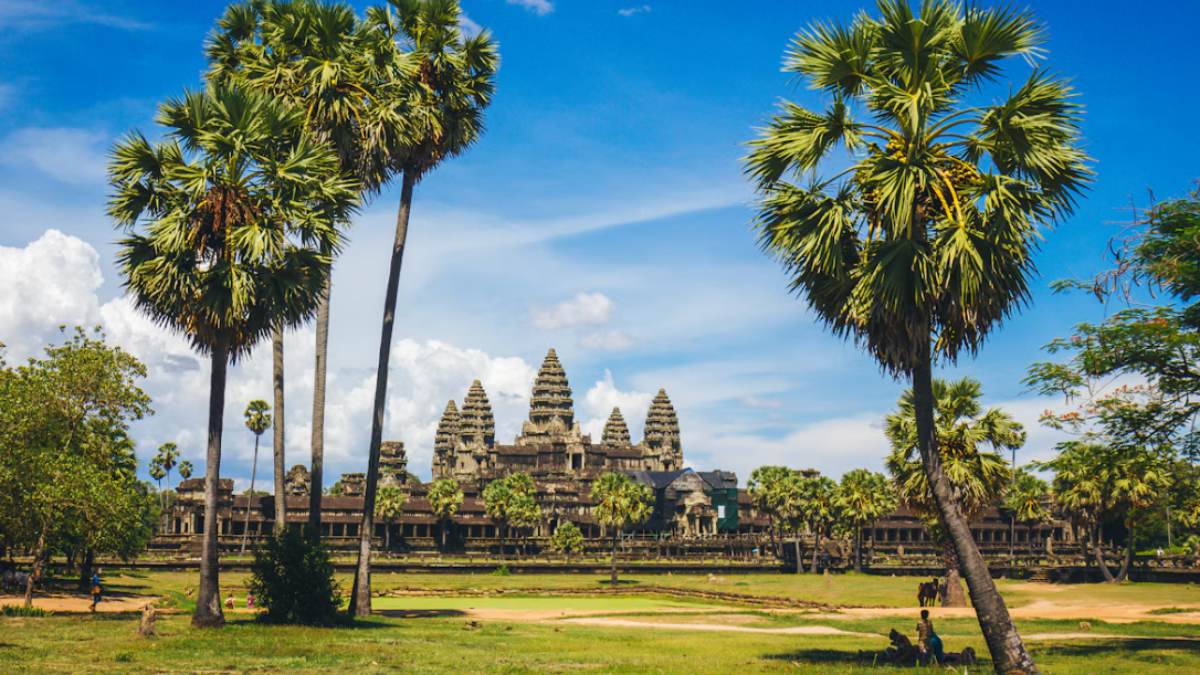
Angkor Wat is near Siem Reap in northwestern Cambodia and covers an area of about 162.6 hectares (401 acres). Its enormous scale, stone carvings and towers are some of the most extraordinary examples of ancient architecture.
Guinness World Records lists Angkor Wat as the largest religious structure in the world and it is part of UNESCO-listed Angkor archaeological site.
Who Built Angkor Wat And When?
Angkor Wat was built by Khmer King Suryavarman II (r. 1113–c. 1150).
Construction began in the first half of the 12th century. The monument was originally planned as a Hindu temple (mostly for Lord Vishnu).
The temple was also tied to power and religion of the Khmer rulers. Its huge size expressed empire wealth, engineering skills and devotion to Hindu traditions.
Construction required planning, craftmanship and a large workforce. Sandstone was used extensively so that artisans could carve intricate designs into the temple’s walls and galleries.
Why Is Angkor Wat So Architecturally Unique?
One of the most recognisable features of Angkor Wat is its five central towers arranged in a pattern. The tallest tower is at the centre surrounded by four smaller towers.
The design shows Mount Meru (which is important in Hindu and Buddhist cosmology as the sacred mountain of the gods).
The temple's layout also reflects this symbolism:
- Five towers: The five peaks of Mount Meru.
- Surrounding walls: Mountains surrounding the sacred cosmic centre.
- Large moat: Oceans believed to surround the world.
- Central sanctuary: centre of spiritual universe.
The temple facing west is another unusual architectural feature since many Hindu temples are oriented east.
How Did A Hindu Temple Become A Buddhist Religious Site?
Angkor Wat was originally dedicated to Lord Vishnu but as Buddhism became more popular in the Khmer Empire its religious identity changed over time.
By the late 12th and 13th centuries Buddhist practices had become more common at the monument. Buddhist statues were added as well as religious elements (many of the original Hindu carvings remained).
This transformation makes Angkor Wat all the more significant because it shows how the region’s religious history has changed.
Today the monument is still an important symbol of Cambodia's cultural and religious heritage (Buddhist traditions are associated with the site).
What Can Visitors See Inside Angkor Wat?
Angkor Wat is known for its bas-relief carvings, galleries, courtyards and tall stone structures.
Its walls have scenes from Hindu mythology (Ramayana and Mahabharata stories), historical scenes, battles and life during the Khmer period in artwork.
Some of the major architectural highlights include:
- Central Tower: The tallest building in the complex and its main architectural feature.
- Bas-Relief Galleries: Long corridors with mythological and historical scenes painted in detail.
- Apsara Carvings: Many representations of celestial dancers carved into the stone walls.
- Moat And Causeway: A large water filled moat and stone approach leading to the main temple.
- Outer Galleries: Grand architectural spaces that show the skills of Khmer builders.
These attributes make the monument a destination for travellers interested in history, religion, architecture and archaeology.
Angkor Wat And Its UNESCO World Heritage Status
The Angkor archaeological site was added to UNESCO World Heritage List in 1992.
The wider Angkor region covers about 400 square kilometres and contains remains of several capitals of the Khmer Empire (Angkor Wat, Bayon and Ta Prohm).
UNESCO recognises the region for its exceptional architectural, archaeological and cultural value.
International conservation programmes have also been important in protecting the temples from structural decay, environmental pressures and damage caused by human activity.
Why Angkor Wat Remains A Major Travel Destination
Angkor Wat is much more than an ancient temple. It is the engineering feats, religious traditions and artistic skills of one of Southeast Asia’s most powerful historical empires.
Its enormous scale and distinctive architecture continue to attract international travellers. The monument is also depicted on Cambodia’s national flag as an indication of its importance to the country’s identity.
Visitors to Cambodia can visit Angkor Wat and experience centuries of history in architecture, sculptures and religious heritage.
More than eight centuries after it was built, the monument is still a powerful reminder of the Khmer Empire’s extraordinary legacy.





Comments