
Cyclone Murasu formed over Bay of Bengal is intensifying and is likely to make landfall along the southern coast of Andhra Pradesh on November 3, said the India Meteorological Department (IMD). The weather department has warned that by November 2 it could become a severe cyclonic storm, and heavy rains and strong winds will lash several coastal and inland areas.
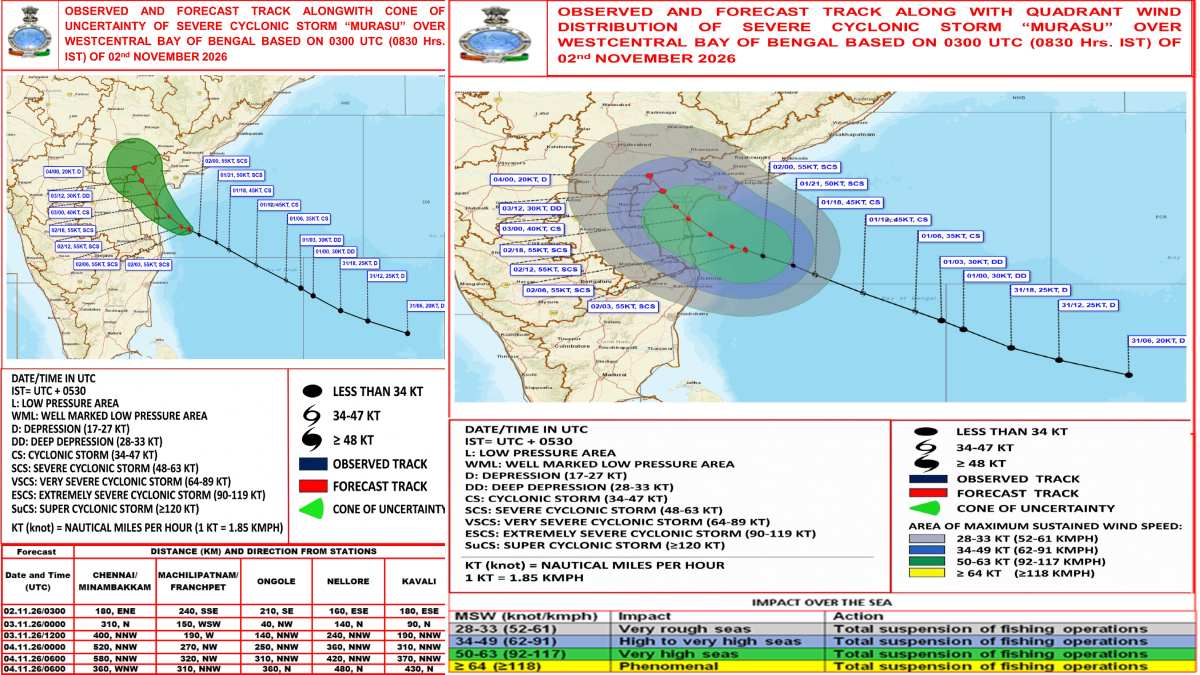
Wind speed during landfall is likely to be 100 to 110 kmph with gusts reaching 120 kmph. Authorities in Andhra Pradesh and Odisha have taken precautionary measures to minimise the impact of the approaching cyclone.
The IMD said the cyclone was moving west-northwestward at a speed of about 27 kmph during six hours ending at 2:30 pm on Sunday. As of 2:30 pm on November 1, it was centred over southwest and west-central Bay of Bengal near latitude 12.4 degrees north and longitude 84.6 degrees east. It was about 480 km from Chennai, 550 km from Nellore, 560 km from Machilipatnam, 600 km from Ongole and 610 km from Visakhapatnam. The movement and intensification of the system have forced weather authorities to closely track its movement and landfall location.
The southern parts of Odisha have also been put on high alert in view of Cyclone Murasu. The state government reportedly told officials to evacuate people living in low-lying and hilly areas to safer places. Odisha Disaster Management Minister Suresh Pujari said precautionary arrangements were being made so that vulnerable communities are protected.
Manorama Mohanty, Director of Bhubaneswar Meteorological Centre, said rainfall will start across Odisha from November 2, and intensity would increase significantly on November 3 and 4. Heavy rain may cause waterlogging, flooding in low-lying areas and disruption of transportation and essential services.
The approaching cyclone will also bring water inflows into many rivers and reservoirs. Officials say 32,500 cusecs of water would enter Budameru on November 3 due to heavy rainfall from the cyclone. Other water bodies like Errakalva, Gonelavagu, Jalleru and Pampa would also get inflow. This could add more problems for flood management authorities in areas already prone to inundation. Strong winds caused by the cyclone could damage about 15,128 electricity poles in 12 districts (estimates), which may lead to power cuts.
The #Severe_Cyclonic_Storm “#Murasu” [Pronunciation: Murasu]” over Westcentral & adjoining Southwest Bay of #Bengal moved west-northwestwards with a speed of 22 kmph during past 06 hours and lay centered at 0830 hours IST of today, the 02nd #November, 2026 over the Westcentral Bay of Bengal near Latitude 14.1°N and Longitude 81.4°E, about 160 km east-southeast of Nellore (Andhra Pradesh), 180 km northeast of Chennai (Tamil Nadu), 180 km east-southeast of Kavali (Andhra Pradesh), 210 km southeast of Ongole (Andhra Pradesh) and 240 km south of Machilipatnam (Andhra Pradesh). It is very likely to move northwestwards and cross south #Andhra #Pradesh coast as a #Severe_Cyclonic_Storm with wind speed of 100 to 110 kmph gusting to 120 kmph between #Nellore and #Narsapur, to the south of #Ongole during midnight (2330 Hrs IST) of today, the 02nd November to early hours (0400 Hrs IST) of tomorrow, the 3rd November, 2026. #CycloneMurasu
— India Meteorological Department (@Indiametdept) November 2, 2026
Meanwhile, Andhra Pradesh Chief Minister N. Chandrababu Naidu has cancelled his Delhi visit on Monday because of the cyclone warning. The Chief Minister was reviewing damage caused by Cyclone Arnab (which hit the Andhra Pradesh coast on October 28) and sought updates from officials about relief and restoration operations. He also enquired about restoration of electricity supply in affected areas. Officials reportedly told him power connections would be restored across the affected locations by Sunday night.
Naidu has asked government departments to keep personnel, machinery and relief material ready in advance so that Cyclone Murasu could be dealt with. He has asked officials to prepare a timeline for restoration of electricity if power infrastructure is damaged; tell people when the restoration schedules will be carried out so that they are aware of the progress of emergency operations.
The Chief Minister has also asked authorities to issue cyclone-related bulletins every four hours so that people get information on the movement and intensity of the storm. Telecom companies have been asked to take preventive steps to maintain mobile network connectivity in cyclone-hit areas. Naidu said network disruptions during Cyclone Arnab in October should not be repeated this time as well. Mobile connectivity is important for coordination in emergencies, rescue work and communication with people in vulnerable areas.
Cyclone Arnab (which was said to have hit Andhra Pradesh coast on Oct. 28) killed seven people and caused extensive damage to agriculture, infrastructure and electricity networks. That experience has led authorities to step up preparedness for Cyclone Murasu. Officials will work closely with disaster response teams, local administrations and utility companies to ensure emergency services are in place during the cyclone’s passage.
Murasu means “war drum” in Hindi, and India named the cyclone under its regional cyclone naming system. As the storm intensifies over the Bay of Bengal, authorities have asked people in coastal Andhra Pradesh and southern Odisha to be alert and follow official weather bulletins. Fishermen and people living in vulnerable coastal areas should follow safety instructions given by the administration, they said.
With landfall imminent, the next 48 hours will be critical for disaster management teams across the region. IMD forecasts, evacuation plans and preparedness measures will decide how Cyclone Murasu affects Andhra Pradesh and Odisha.







Comments