
India’s ambitious high-speed rail programme has achieved another milestone as its first indigenously designed bullet train B28 is undergoing structural testing at BEML’s manufacturing facility in Bengaluru. The tests being conducted are to check the strength, durability, and ability of the train to withstand the harsh conditions associated with high-speed railway operations.
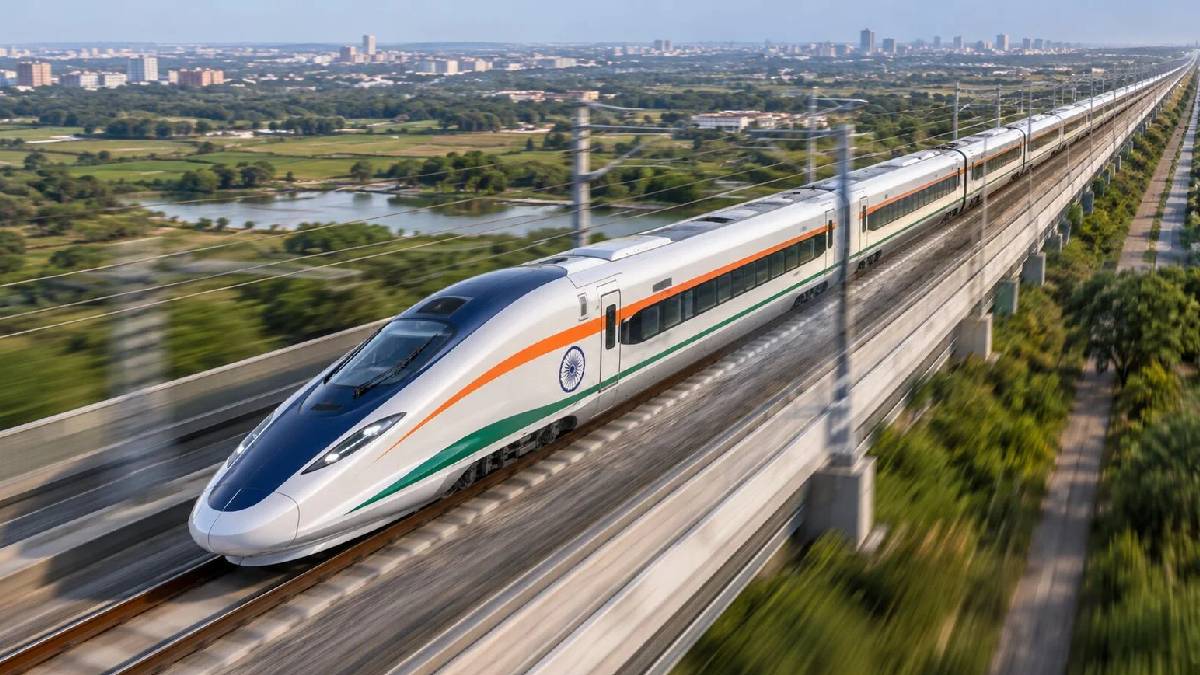
A video shared by Union Minister Piyush Goyal on social media platform X showed the manufacturing and testing activities at the Bengaluru facility. The video shows engineering work being done on the train as India moves towards developing its own high-speed rail technology.
Union Railway Minister Ashwini Vaishnaw recently visited BEML’s facility to review the manufacturing process and inspect the progress of the indigenous bullet train. He explained structural testing and showed how different sections of the train are being tested so that safety and engineering requirements are met.
The roof, side walls, end walls, and driver’s cab are tested. One of the procedures that attracts attention is the compression (squeeze) test, which tests the structural strength of body of the train.
Why Is India’s Bullet Train B28 Being Squeezed?
High-speed trains operate under very different aerodynamic conditions than passenger trains. A train traveling at extremely high speeds experiences large changes in air pressure, aerodynamic resistance, and pressure fluctuations when it moves through the air.
Vaishnaw explained how the science behind the test works: “A low-pressure region can form around a moving train which adds aerodynamic forces to its structure.”
“When the train runs at those very high speeds, then around the train a vacuum gets created,” Vaishnaw said while talking about the testing procedure.
The squeeze test is used to check whether the body of the train can take structural loads and pressure-related forces which arise from high-speed operations.
These tests are necessary because the train’s exterior structure has to be strong and stable even under tough operating conditions. Engineers have to prove that the body can take forces generated by acceleration, high-speed movement, and pressure changes without endangering passengers.
The results of these tests will feed into the wider engineering validation process before the train can be moved towards operational deployment.
BEML Bengaluru is playing a key role in India’s indigenous Bullet Train programme. BEML (Bangalore Electricity Supply Company Ltd) — a public sector manufacturing company based out of Bengaluru — is an important part of India’s drive to build domestic railway manufacturing capabilities.
The development of the B28 is part of a larger effort by the country to reduce its reliance on imported railway technologies and develop expertise in designing and manufacturing advanced high-speed trains.
The project also reflects government emphasis on domestic engineering, technology innovation and Make in India.
Building a high-speed train is much more than manufacturing its exterior body. It requires work in many engineering areas — structural integrity, aerodynamics, passenger safety, braking systems, propulsion, onboard technology and operational reliability.
BEML’s manufacturing and testing activities are therefore part of the process of developing an indigenous high-speed railway ecosystem.
What Happens Before the Indigenous Bullet Train Enters Service?
Even though the structural squeeze test is a major achievement, the train must pass several other engineering assessments and validation procedures before it can be put into commercial service.
These checks are designed to determine whether the train meets the necessary technical, operational, and safety standards.
The broader validation process for a high-speed train is usually:
-
Structural strength testing: Evaluating the train body's ability to withstand different mechanical loads and stresses.
-
Aerodynamic testing: Assessing how air pressure and resistance affect the train at high speeds.
-
Safety validation: Checking essential systems and components to ensure passenger and operational safety.
-
Performance testing: Evaluating the train's behaviour under different operating conditions.
-
Operational trials: Testing the train in realistic railway conditions before commercial deployment.
Bharat's first bullet train is BEING BUILT! 🇮🇳🚅 📍BEML facility, Bengaluru, Karnataka https://t.co/LAgeuFD9y9
— Piyush Goyal (@PiyushGoyal) November 1, 2026
A Major Step Towards Self-Reliance in High-Speed Rail Technology
India's development of indigenous bullet trains is an important step toward its ambition to become a stronger player in advanced railway manufacturing.
While the Mumbai-Ahmedabad High Speed Rail Corridor is India’s biggest ongoing bullet train infrastructure project, development of an indigenously designed high-speed train is another dimension of the country’s railway modernisation plans.
Structural testing of B28 at BEML Bengaluru shows the engineering effort needed to develop trains that can run at extremely high speeds.
For India, this is not just about faster passenger services. It is also about developing domestic expertise, strengthening manufacturing capabilities, and building technologies that could support future high-speed railway projects.
As the B28 goes through structural and engineering tests, the ongoing tests give an encouraging glimpse of India’s aspirations in high-speed rail technology.
However, the train will not be commercialised until all tests have been completed and validations and approvals obtained.






Comments