
Staying compliant with statutory requirements is important for every business to avoid penalties and operate smoothly. With the coming of April 2026, businesses are advised to identify significant GST and labour law deadlines related to the preceding month and quarter. The following is a comprehensive guide on all relevant compliance dates in April 2026, particularly for businesses in Karnataka (in particular in Bengaluru).
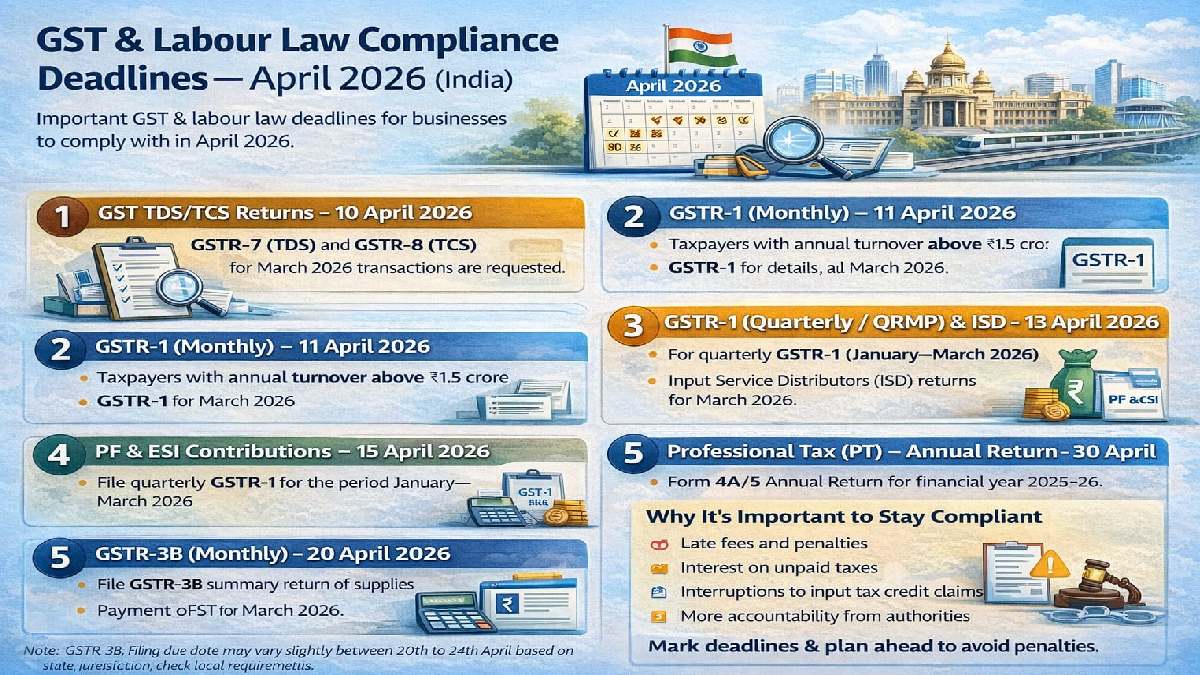
Key Compliance Calendar – April 2026
1. GST TDS/TCS Returns – 10 April 2026
The taxation liability for GST TDS/TCS returns is applicable to the business concerned whether they are concerned with collecting or deducting tax payable at source with GST and the following must be submitted by businesses:


GSTR-7 (TDS)
GSTR-8 (TCS)
For the sake of this report, these are March 2026 transactions to be submitted by monthly filers.
2. GSTR-1 (Monthly) – 11 April 2026
- Taxpayers with an annual turnover exceeding ₹1.5 crore must file:
- GSTR-1 for reporting outward supplies
- This return covers all sales made during March 2026.
3. GSTR-1 (Quarterly / QRMP) & ISD – 13 April 2026
For businesses operating under the QRMP (Quarterly Return Monthly Payment) scheme

File quarterly GSTR-1 for the period January to March 2026
Additionally:
Input Service Distributors (ISD) are required to submit returns for March 2026.
4. PF & ESI Contributions – 15 April 2026
Employers are required to provide timely delivery and filing of
Provident Fund (PF) contributions (EPF ECR filings)
Employee State Insurance (ESI) contributions
These apply to March 2026 wages and have to be in place at all ends of India.
5. GSTR-3B (Monthly) 20 April 2026
- All ordinary taxpayers will be required to file
- GSTR-3B, a summary return of outward and inward supplies
Payment of GST liability for March 2026 - Note: Due dates may vary slightly (20th to 24th April) depending on state jurisdiction.
6. Professional Tax (PT) Annual Return 30 April 2026
Employers registered under Professional Tax must file:
- Form 4A/5 Annual Return for the financial year 2025–26
- This is especially essential for PTRC registered businesses within Karnataka.
- Why It’s Important to Know Compliance is Timely
Inability to comply with statutory deadlines may attract:
- Late fees and penalties
- Interest on unpaid taxes
- Interruptions to input tax credit claims
- More accountability from the authorities
Maintaining a formal compliance calendar allows businesses to stay ahead and mitigate any risk that may be superfluous.
Conclusion
April is an important month for closing March and finalising quarterly compliance. Companies ought to plan ahead of time – with documentation or reconciliation books – and file accordingly for compliance purposes. If your GST filing needs help ensuring you’re on time, legally compliant or that you’re getting the automated reminder, then this can be simplified using assistance.










Comments