As the new month begins in India, some major financial and regulatory changes are going to come into force from June 1st through the new year 2026. These changes will affect taxpayers, bank customers, digital payment users, credit card users, mutual fund owners, investors, EPFO subscribers and others.
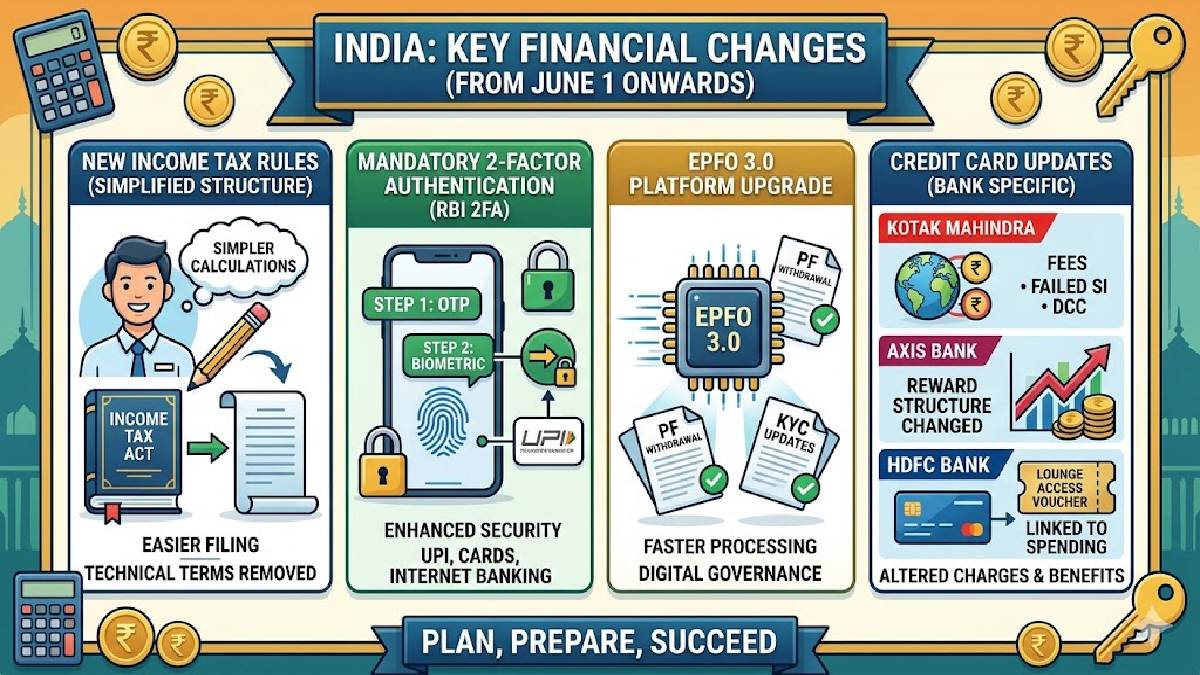
As we see it now, June will bring huge changes in the everyday life of people as new tax laws are enacted, digital payment security measures are put in place, and credit card rules are altered.
The New Income Tax Framework to replace the Old Structure
One of the biggest changes that will be made is the implementation of a new framework to simplify the decades-old Income Tax Act of 1961.
The tax section has been reorganised and many provisions rewritten in simpler language to make the taxation system easier for ordinary taxpayers to understand.
He said the move will help salaried employees as well as middle-class taxpayers with complex tax calculations and technical terminology. And the simplified format will make the procedure easier for all of them when filing income tax returns, and therefore less complex and confusing.

RBI Makes Two-Factor Authentication Mandatory
RBI has introduced tighter rules on digital financial transactions to enhance the security of digital transactions.
As of June 1, two-factor authentication (2FA) will be mandatory for all online transactions, such as UPI transfers, debit card payments, credit card transactions, and internet banking services.
Another main feature is that the registered name of the recipient will be displayed while transferring the UPI, which is also shown. This will help, in order to avoid accidental transfers in the first place, and to protect the user from fraud and cybercrime.
Financial experts say such measures are needed for digital payment usage to grow rapidly in India, as digital payment usage is on the rise.
Credit Card Charges and Reward Rules Resolutions
The credit card policies of several large banks are also set in motion.
Key Changes Include:
- Kotak Mahindra Bank: new charges might apply for failed standing instructions and dynamic currency conversion services.
- Axis Bank: Changes have been made to the reward points structure and benefits.
- HDFC Bank: Airport lounge access will now be provided through vouchers linked to quarterly spending instead of direct card swipes.
These changes would affect customer spending behaviour and reward optimisation strategies, especially for frequent travellers and premium card users.
The SEBI has revised the cutoff time for mutual funds
The Securities and Exchange Board of India (SEBI) has changed transaction timings for Overnight Mutual Fund schemes in India.
Under the revised schedule:
- The offline transaction cut-off time will now be 3 PM.
- The online transaction cut-off time will be extended to 7 PM.
The change will affect the Net Asset Value (NAV) of investors according to the timing of their investment.
Experts would recommend that an investor be very careful to monitor the new timings when making investment decisions and to be crystal clear about how they will allocate NAV.
EPFO 3.0 Platform Upgrade
The EPFO’s new EPFO 3.0 platform is preparing to be launched to help users get to know as well as to help with the service speed.
The upgraded system will enable PF withdrawal and KYC updates to be faster and overall easier for crores of subscribers in India.
The move is part of the government’s broader push towards digital governance and simplified public services.
Aadhaar Update Deadline Approaching
Even if the Aadhaar is no longer updated online, citizens can still update their details online free of cost until June.
After the deadline:
- Online Aadhaar updates will cost ₹25.
- Updates will be done at Aadhaar service centres at a rate of ₹50.
They said they are advising people to submit necessary updates before the deadline in a bid to avoid any additional charges before the deadline.
Form 16 and TDS Certificates are important for tax filing
Taxpayers are also reminded that companies are required to issue TDS certificates, including Form 16 and Form 16A, by June 15.
These documents are essential for filing Income Tax returns (ITR) accurately and verifying tax deductions made during the financial year.
We suggest these forms be collected on time to avoid delays during the filing process for ITR.
Important month for financial planning
With multiple financial changes happening simultaneously, June 2023 is estimated to be one of the key months for taxpayers, salaried employees, investors, and digital banking users.
Financial advisors suggest checking banking rules, credit card laws, credit card policies, tax documents, and investment calendars in order to be in a state of financial preparedness for new regulations and avoid unnecessary financial stress.