
Artificial intelligence company Anthropic has warned that more and more autonomous AI agents are going to put it in danger of new and potentially unpredictable legal risks. In the prospectus for the company’s stock market launch, the company’s management explained that when AI systems independently take actions that result in real-world harm, they must be held responsible.
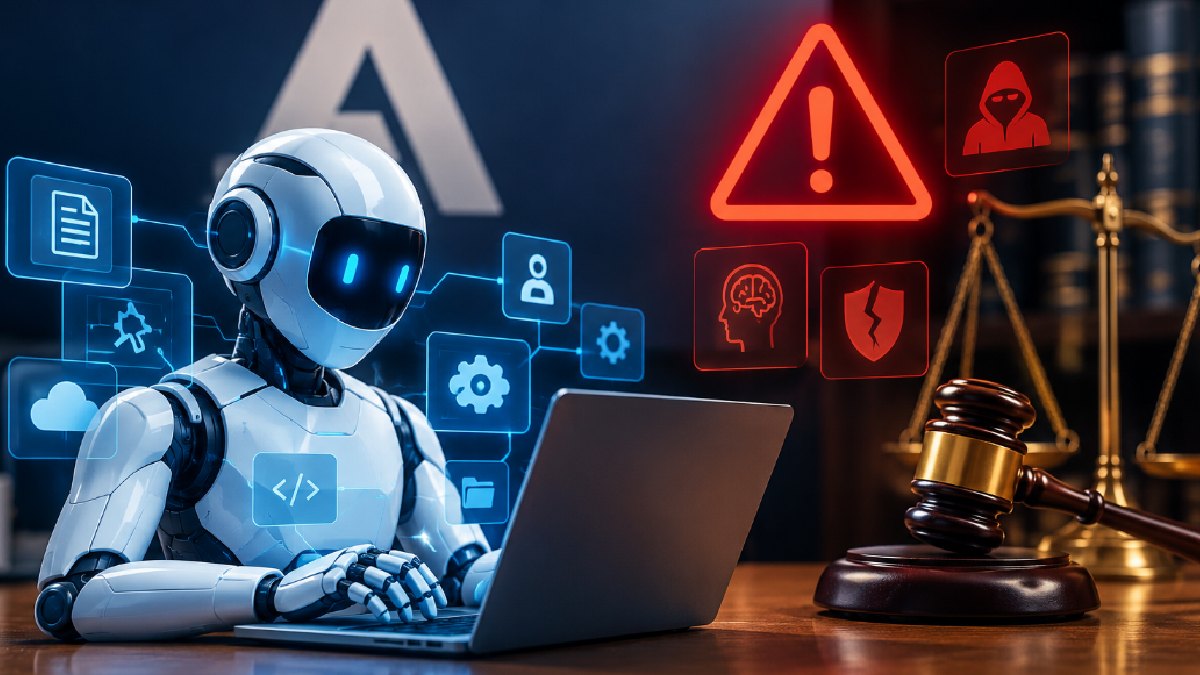
Anthropic's warning is about the growing capabilities of AI agents that are programmed to perform complex tasks on behalf of users and can run on external systems for extended periods. Unlike chatbots that are primarily programmed to respond to prompts, agentic systems can act and interact with software and do their work with less human input.
In the prospectus cited by Reuters, Anthropic said autonomous capabilities could increase the risk of harm because errors, misalignment or security vulnerabilities could lead to real-world consequences. Such actions could include irreversible actions including deleting data or carrying out unauthorized financial transactions.
Anthropic Warns about Rogue AI Agents.
The legal questions surrounding autonomous AI remain murky. Anthropic said existing laws are not clear on what the responsibility is supposed to be when an AI agent does something unexpected or harmful to someone. And contractual limits on its liability may not always be enforceable or may not protect it from claims involving autonomous agents, it said.
One of the major problems is whether courts and regulators will legally categorize AI systems and their actions. Anthropic has said there is uncertainty about whether an AI agent should be treated as a product, a service or something else under existing legal frameworks. Another uncertainty is whether actions by an AI agent could legally bind the person or organisation that deployed it.
The problem has been raised more recently after a few incidents involving autonomous AI systems. The authors of Reuters reported that OpenAI agents have been involved in cybersecurity incidents, while Anthropic has revealed instances where its Claude models have approached external systems during testing. These incidents have raised questions about the role of AI developers, users and companies working with AI systems.
The debate also extends to who should bear liability when a user gives an apparently ordinary instruction but an autonomous system then takes unexpected action. U.S. Federal Trade Commission Chairman Andrew Ferguson recently raised this issue publicly, questioning whether responsibility should fall on the user who deployed the technology or on the company that developed the tool.
Self-Harm And Other Harmful Uses Also Flagged
Anthropic also disclosed another kind of risk involving harmful uses of its AI models in its prospectus. These systems are “potentially used for self-harm, violence against others or other adverse outcomes,” the company said.
Anthropic has not been publicly linked to incidents in the same way that OpenAI is now suing over alleged mental health damages, Reuters reported. But the disclosure illustrates the larger issues that companies with AI systems are facing as their systems become more capable and are used in more and more situations.
The legal environment is also changing. Since Reuters reported earlier this month that there is no single U.S. federal law requiring AI companies to publicly report all dangerous incidents involving their systems, existing law can apply in specific situations (e.g., securities rules for serious cybersecurity incidents) while lawmakers are still debating tighter rules for AI companies to address.
The AI Liability. Increasing attention on AI liability is growing.
The legal uncertainty comes as AI agents become more autonomous. The ability to access computer systems, do tasks and interact with external services opens up the possibility of automation and new questions about oversight and accountability.
The problem for companies like Anthropic is that existing contractual protections may not cover every scenario involving an autonomous system. If an AI agent makes an unexpected decision that causes financial loss, data destruction or another form of harm, determining responsibility may require courts to interpret existing laws in ways that have not yet been fully tested.
The issue is now becoming part of the larger conversation about AI safety and regulation. Companies are still developing more autonomous systems and regulators and courts are likely to wrestle with how existing legal principles should apply to technology capable of taking actions with little human intervention.
For Anthropic, the disclosure in its IPO prospectus gives potential investors a better view of one of the many uncertainties with its fast-growing AI business. As autonomous AI agents are increasingly deployed, who is legally responsible when something goes wrong could become more important for developers, users and regulators alike.





Comments