Apple Pay could finally launch in India as soon as next month, expanding Apple’s tap-and-pay payment service into one of the world’s largest digital payments markets. Apple is preparing to launch Apple Pay in India first with Axis Bank, with Axis Bank credit cards expected to be among the first cards. Apple is also in talks with other big private sector banks (HDFC Bank and ICICI Bank) for a wider rollout.
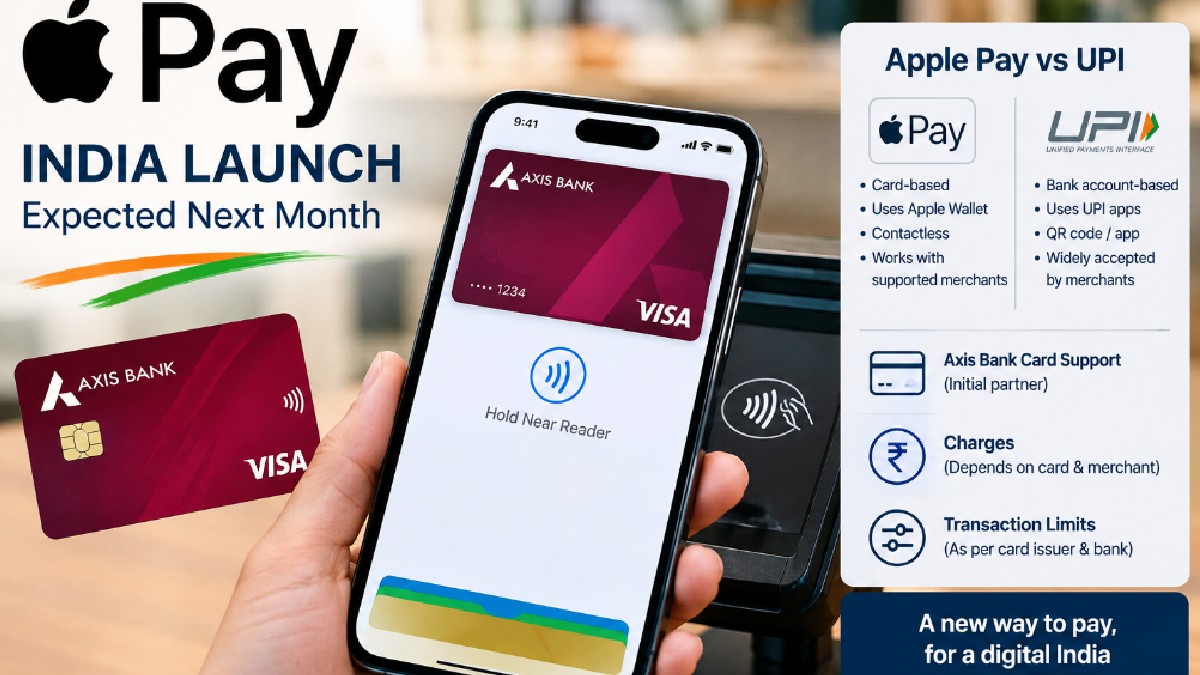
The launch would be very much a major shift for Apple in India for its financial services ecosystem. Unlike UPI, which connects bank accounts directly through India's real-time payments infrastructure, Apple Pay is primarily designed to allow users to add debit or credit cards to their Apple Wallet and use their iPhone or Apple Watch for contactless payments.
Apple Pay vs UPI: What is the difference?
The biggest difference between Apple Pay and UPI is the payment source. Users can pay directly from their bank accounts through a UPI app or UPI interface. Consumers can transfer money to another person, pay merchants using UPI IDs or scan QR codes.
On the other hand, Apple Pay is based on eligible payment cards added to Apple Wallet. In-store transactions, users can simply authenticate themselves and hold their compatible iPhone or Apple Watch near a contactless payment terminal. Apple says Apple Pay uses card credentials in a way that does not require the merchant to get the user’s actual card number.
This means Apple Pay is not expected to replace UPI. Rather, the two systems would have somewhat different purposes. For account-to-account transfers, QR-based merchant payments, UPI is still valuable and Apple Pay would be a card-based contactless payment option for compatible users and merchants.
What about Axis Bank Cards?
The first reported rollout will be on Axis Bank credit cards. According to Reuters, Apple is working with Axis Bank as its initial banking partner, and talks are also being made with other lenders.
For Axis Bank cardholders, that would be adding an eligible card to Apple Wallet, and using the iPhone or Apple Watch at the contactless payment terminals. But the list of Axis Bank cards, supported card networks and other launch-specific conditions will need to be confirmed when Apple and the bank formally announce the service.
Apple's existing Apple Pay system supports authentication via Face ID, Touch ID or a device passcode, depending on the device.
Will Apple Pay have any extra charges?
Apple Pay does not set out a universal transaction fee for consumers. Any applicable charges for a payment card will depend on the card issuer and the transaction.
This is particularly applicable in India because UPI’s fee structure is also changing. Merchant-side charges can apply to certain higher value UPI transactions now, and consumers are not supposed to be directly charged for making UPI payments. The government says consumers will not be charged for transactions and that person-to-person UPI transactions will be free.
Therefore, consumers should not assume that Apple Pay will carry a separate fee simply because it is being introduced in India. The applicable costs would depend on the Axis Bank card's terms and any relevant merchant or card-network rules.
Apple Pay Transaction Limits
Another important difference is transaction limits. Apple Pay does not have a single one-size-fits-all limit applicable to all transactions. Limits can also be determined by the card issuer, merchant and transaction itself.
In practice, an Axis Bank credit card using Apple Pay would mostly remain subject to the card's credit limit, and the bank's transaction controls. And the exact Apple Pay transaction limits, if any, will be made clear once Axis Bank and Apple publish the official India-specific terms.
UPI operates differently. Banks and payment providers set transaction limits depending on the type of payment. Axis Bank, for instance, currently has a UPI limit of up to Rs 1 lakh in 24 hours for most transactions while some transactions (for verified hospital and educational payments) have higher limits.
Why Apple Pay could be significant in India?
Apple's entry comes at a time when India’s digital payments ecosystem is evolving fast. UPI accounted for around 84 per cent of digital transaction volume, according to Reuters, highlighting the scale of the challenge and opportunity for Apple.
Interestingly, India also recently introduced a UPI tap-and-pay option using NFC technology. It allows compatible users to make contactless payments at point of sale terminals, which is one of the practical differences between UPI and card-based contactless payments.
As for Apple users, Apple Pay may offer a familiar Wallet-based experience that combines cards, biometric authentication and contactless payments. And it could be more useful as Apple adds support from more Indian banks.
The October launch must be treated as an expected rollout instead of a firm date. Details such as the list of Axis Bank cards, transaction limits, merchant acceptance and any India-specific conditions will be made clear once Apple and its banking partners announce it.