
AI is changing the way cybercriminals attack financial institutions — faster, more sophisticated attacks that are harder to detect. India’s banking sector (which has expanded rapidly in digital payment systems and online services) is already seeing cybersecurity challenges as criminals start using AI tools to identify vulnerabilities and carry out financial fraud.
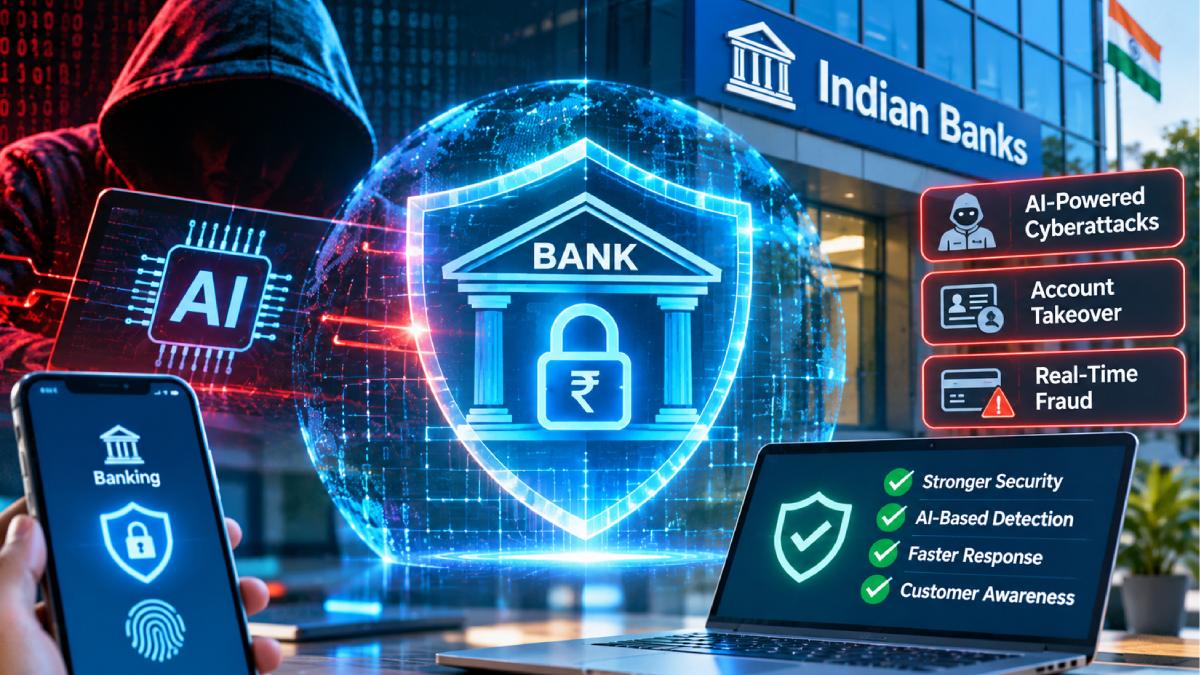
The concern has become more acute following warnings issued recently by the Indian Cyber Crime Coordination Centre (I4C) and Indian Computer Emergency Response Team (CERT-In) about AI-assisted attacks on banks, NBFCs and fintech businesses.
The Reserve Bank of India (RBI) has also identified AI-enabled cyberattacks as the biggest near-term cyber threat to India’s financial system.
Banks are investing more in cybersecurity and building up digital infrastructure but regulators say they’re not ready. It’s no longer just about stopping phishing or data breaches financial institutions also need to be prepared for automated attacks that can exploit software bugs and hit payment systems at machine speed.
Why is AI-powered cyberattacks becoming a major threat to Indian banks?
Traditional cyberattacks rely heavily on human operators finding weaknesses, preparing malicious messages and trying to gain unauthorised access to computer systems.
AI is changing this process because cybercriminals can now automate several stages of an attack.
AI tools can help find software bugs, craft convincing phishing emails, analyse compromised data and react more quickly to changes in attack strategy.
Financial institutions are prime targets because their systems process large volumes of sensitive customer information and financial transactions.
As banks rely more on mobile applications, internet banking, cloud infrastructure, payment gateways and third-party technology providers the number of potential entry points for cybercriminals has also increased.
Another issue is the increasing use of automated financial systems. If attackers gain unauthorised access to payment interfaces or fund disbursement systems they may try to execute fraudulent transactions before security teams can respond.
This means real-time monitoring, access management and incident response are more important to banks than ever.
I4C Warns Banks About AI-Driven Financial Attacks
Cybersecurity was back in the news after I4C and CERT-In issued an advisory warning financial institutions of AI-assisted cyberattacks (see below).
Cybercriminals are using AI agents to hack financial systems and carry out unauthorised transactions at machine speed (advisory 4 Nov 2026).
The agencies found cases of multi-crore fraud through automated fund disbursement systems and application programming interfaces (APIs).
The attacks are reportedly based on exploiting unpatched software, misconfigured internet facing servers and vulnerable IT infrastructure.
Once access is gained, attackers can target payment interfaces and automated fund transfer systems to move money into mule accounts.
A mule account is a bank account used to receive and transfer illegally obtained funds. Mule accounts make it harder to trace the money.
The advisory also noted that cybercriminals would try to delete records and hide their activities so investigations were difficult to follow up on.
But the agencies did not publicly name the financial institutions involved in the incidents.
RBI Identifies AI Cyberattacks as India's Biggest Near-Term Financial Risk
The RBI’s June 2026 Financial Stability Report showed that cybersecurity challenges faced by Indian banks and NBFCs were growing.
“AI-enabled cyber threats are now the biggest emerging cyber risk for financial institutions over the next 12 months,” the central bank said in its report.
The survey covered 33 scheduled commercial banks and 10 upper layer NBFCs.
Some of its key findings include:
- 95% of respondents listed AI-enabled cyber threats among their three most significant cybersecurity risks.
- 45% of institutions said their AI-threat preparedness was in the developing stage.
- 38% classified themselves as intermediate prepared.
- Only 5% believed their AI-related cybersecurity capabilities were mature.
- None of the respondents considered their preparedness to be advanced.
The findings show a gap between the increasing sophistication of AI-powered attacks and the ability of financial institutions to defend against them.
The RBI also found that nearly one in three respondents said cyber risks increased moderately or significantly over last year.
Most institutions rated their existing cyber risk exposure as low to moderate but the nature of threats has changed so much that this is still a major concern.
Are Indian banks investing enough in cybersecurity?
Indian banks have responded to the growing digital threats by increasing technology and cybersecurity investments but data available shows that more needs to be done.
According to the RBI survey:
- 67% of institutions increased IT and cybersecurity workforce between March 2025 and March 2026.
- 71% said cybersecurity spending as a percentage of overall IT budget had increased in the past three years.
- 81% reported spending less than 5% of revenue on IT in FY26.
These figures show that financial institutions are improving their security capabilities but investment levels and preparedness differ across organisations.
The problem is acute for institutions with older banking infrastructure alongside newer digital platforms.
Legacy systems, old applications and weak access controls can all create vulnerabilities that attackers could exploit.
Cybersecurity spending is therefore not enough to tell whether a bank is protected adequately. Its ability to detect suspicious activity, contain attacks and restore critical services must also be strong.
Four Major Cybersecurity Measures Indian Banks Are Adopting
Indian banks are looking at advanced security frameworks to tackle emerging AI-related threats.
Industry reports state that lenders have put forward several measures in their cybersecurity action plans submitted to RBI.
1. Stronger Software and Identity Protection
Banks are looking to gain more control over critical software systems and protect encryption keys, digital identities and sensitive credentials.
Restricting unauthorised access to these components can reduce the likelihood that attackers enter critical banking infrastructure.
2. AI-Based Threat Detection
Banks are looking at AI-powered cybersecurity systems that can spot unusual network activity, flag vulnerabilities and flag suspicious transactions.
These tools can help security teams find threats faster than conventional monitoring systems.
3. Network Micro-Segmentation
Micro-segmentation means dividing a network into smaller, separately protected sections.
This approach prevents attackers who get into one part of a banking network from moving freely into other critical systems.
4. Zero-Trust Security Architecture
Zero-trust security assumes that no user, device or application should be automatically trusted.
Every access request must be verified according to identity, permissions and security policies.
This is becoming more important as banks work with vendors outside the bank, cloud platforms and automated applications.
Third-Party Technology Providers Create Another Security Risk
Another major cybersecurity concern that RBI mentioned was the banking sector’s growing dependence on external technology providers.
Banks increasingly rely on third parties for cloud infrastructure, security monitoring, payment processing, software development and other critical services.
These partnerships increase operational efficiency but also introduce additional security vulnerabilities.
The RBI survey showed that 93% of respondents were partially or substantially dependent on vendors for cybersecurity functions.
About three-fourths also said they had moderate to very high operational dependence on third party technology providers for critical applications.
This is what makes interconnected risks possible.
For example, if a security breach occurs at one major technology service provider then multiple financial institutions that rely on the same infrastructure could be affected.
Banks therefore need stronger vendor assessments, access controls, continuous monitoring and contingency arrangements.
Why Employee Awareness Remains Important
Even though banking technology has improved, human error is still an important cybersecurity challenge.
Employees may inadvertently expose sensitive information through links that are suspicious, credentials that have been compromised, unsafe downloads or unauthorised applications.
AI phishing attacks can make these risks harder to spot because fraudulent messages may seem more convincing and personalised.
RBI has called for employee awareness and cybersecurity training across financial institutions.
Banks also need stronger forensic capabilities to investigate security incidents, trace the source of attacks and preserve evidence for regulatory and law enforcement investigations.
Cybersecurity preparedness therefore has to go beyond IT departments and become part of an institution’s overall operational risk management framework.
What Measures Have I4C and CERT-In Recommended?
The latest advisory from I4C and CERT-In has called for stronger protection of payment infrastructure and faster reporting of cybersecurity incidents.
Some of the recommended measures include:
- Keeping track of all payment-related APIs.
- Disabling obsolete unused and testing interfaces that could expose systems to attack.
- Increase monitoring of automated fund disbursement systems.
- Coordination between cybersecurity, transaction monitoring and IT teams.
- Finding and fixing vulnerabilities in internet facing infrastructure.
Following RBI cybersecurity requirements and CERT-In advisories.
The advisory also stressed incident reporting requirements. Financial institutions have been asked to report cybersecurity incidents to CERT-In and RBI through DAKSH portal within six hours of detection.
These requirements are meant to increase coordination and faster response when financial infrastructure is compromised.
What Does Growing AI Cyber Risk Mean for Banking Customers?
The increasing use of AI in cybercrime has consequences beyond banks and financial institutions. Customers too may be at greater risk of digital financial fraud.
Cybercriminals can use AI to write convincing impersonation messages, fake customer support calls and sophisticated social engineering attempts.
Customers should therefore follow basic digital banking security practices:
- Never share OTPs, PINs, passwords or banking credentials.
- Don’t click on suspicious links received through messages or emails.
- Check payment requests before transferring money.
- Use official banking applications and websites.
- Enable transaction alerts and monitor account activity.
- Alerts will be triggered on transactions and account activity will be monitored.
If an unauthorised transaction is detected contact the bank immediately.
Customers should also report suspected financial cyber fraud to the national cybercrime helpline 1930 or official National Cyber Crime Reporting Portal.
Are Indian Banks Ready for the Next Generation of Cyberattacks?
India’s banking sector has been strengthening cybersecurity through higher investments, monitoring systems and regulatory oversight (e.g., PSD2).
However, the RBI’s findings show that preparedness is not yet at a level where we can confidently deal with increasingly sophisticated AI-enabled threats.
The fact that only 5% of institutions surveyed considered their AI-threat readiness mature shows how big the challenge is.
Going forward banks will need to build stronger software infrastructure, better identity protection, reduce third party vulnerabilities and deploy more sophisticated threat detection systems.
The increasing use of AI in banking also means cybersecurity strategies need to change with technology adoption.
But protecting India’s financial system will not happen simply by increasing IT budgets. Banks need to show that they can spot threats quickly, prevent unauthorised transactions, contain security breaches and get operations back up and running without too much disruption.
As AI makes cyberattacks faster and easier to launch, India’s ability to respond will become an increasingly important indicator of financial stability and customer trust.





Comments