
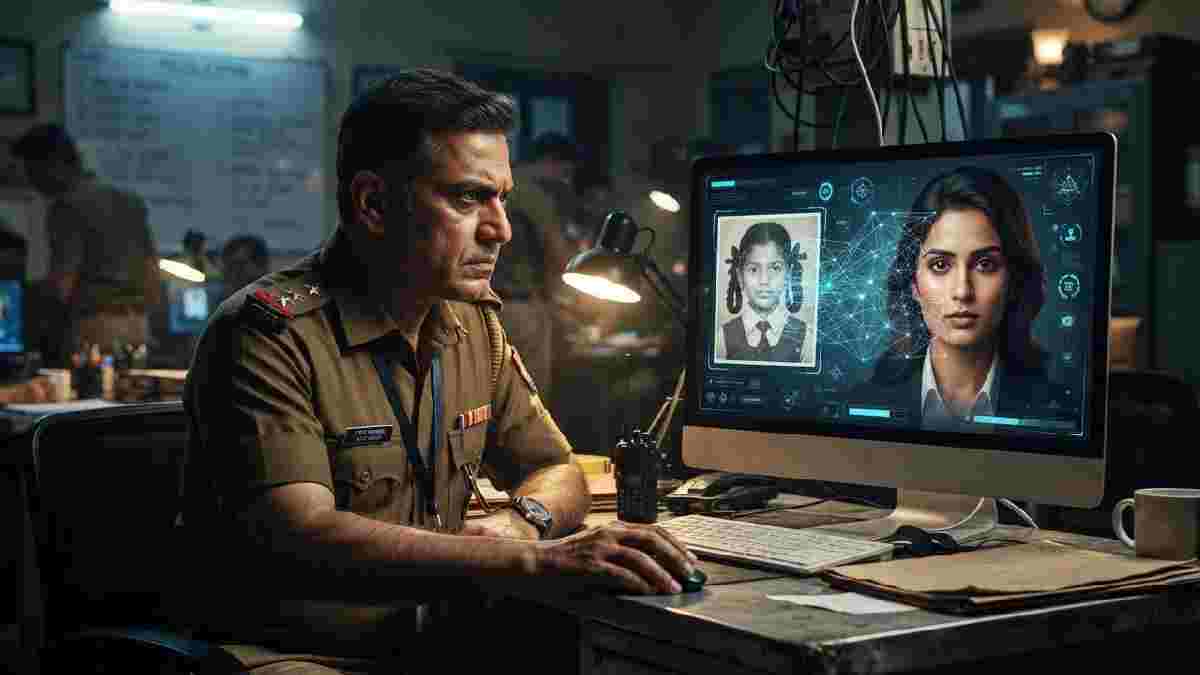
AI is not just for chatbots, content creation, and business automation anymore. In an unusual case from Uttar Pradesh, ChatGPT and Google Gemini helped police find a woman who had been missing for nearly five years. A constable used AI tools to recreate an approximate picture of the woman’s present-day appearance from an old childhood photograph.
The case shows how emerging technology can support traditional police investigations (when investigators don’t have recent photographs or other identification details).
The woman (Manju Devi Kharwar) was traced to Rajasthan’s Churu district. She reportedly went missing in 2021 from the Babhani area of Sonbhadra district in Uttar Pradesh. The AI image helped her family recognise her and gave investigators an important lead.
How ChatGPT and Gemini Helped UP Police
The breakthrough was made by Constable Vijay Pandey, who is posted at Babhani police station in Sonbhadra.
During the investigation, police had a major problem because Manju’s family did not have any recent photos of her. The only one they had was almost two decades old (taken in 2007 when she was studying in Class IV).
Since her appearance would have changed considerably over the years, identifying her using the childhood photograph alone was not easy.
Pandey addressed this problem with ChatGPT and Google’s Gemini AI. He used the childhood photo as well as recent photos of Manju’s parents and sister to create an approximation of how she might look as an adult.
The AI-generated photo was then shown to family members. They recognised the image as Manju and so gave the police team a visual cue to continue with their investigation.
How Police Found the Missing Woman in Rajasthan
The investigation began after Manju's mother, Kimat Devi Kharwar, went to Babhani police station on July 14, 2026, and lodged a missing-person complaint.
Manju had disappeared five years ago, the complaint said. Another woman from their village took her to Varanasi on the pretext of arranging her marriage, and then she lost touch with them.
The police registered a case under Sections 87 and 137(2) of the BNS respectively.
Having produced the age-progressed photo, investigators linked this new visual reference with local intelligence and conventional police enquiries.
On 16 October 2026, police were informed that Manju could be in Rajasthan. Police traced her to Govind Singh Ka Bas village under Hamirwas police station limits in Churu district.
Police officials said Manju lived there with her husband Umesh and their two children.
The recovery ended a search that had gone on for nearly five years.
Constable Vijay Pandey Receives Cash Reward
The Uttar Pradesh Police honoured Constable Vijay Pandey for his innovative use of artificial intelligence during the investigation.
Uttar Pradesh DGP Rajeev Krishna announced a cash reward of ₹5,000 for his contribution in tracing the missing woman.
Sonbhadra SP Abhishek Verma also presented Pandey with a commendation certificate and an additional cash reward of Rs 2,100.
Senior police officials were pleased he had used readily available AI platforms to tackle an important investigative problem.
The case has also made the Sonbhadra police department think about using technology in other investigations too.
UP Police Conducts AI Training for Personnel
Soon after this development, Sonbhadra Police organised a workshop to familiarise police personnel with artificial intelligence tools like ChatGPT and Google Gemini.
Officers learned how AI platforms could be used for different investigative activities (e.g., analysing information, helping with identification efforts, and working with available digital material).
However, police officials also emphasized that information generated by AI should be independently verified.
AI photos are only estimates of what someone could look like. They cannot prove someone’s identity independently or provide conclusive evidence. Family identification, field investigation, and other reliable information still need to be used.
In Manju’s case, the technology was an important lead, but conventional police work helped police find her.
How AI Is Changing Police Investigations in India
The Sonbhadra case shows how generative AI can be used to tackle real-world problems faced by law enforcement agencies.
Missing-person investigations get difficult when several years have passed, and families don’t have up-to-date photographs. Traditional methods can involve extensive field inquiries, intelligence gathering, and coordination between police departments.
AI-assisted age progression can give investigators another visual reference when only childhood photographs are available.
However, there are also limits to such technology. AI-generated faces may not show how someone looks today — facial structure changes with age and lifestyle, etc.; AI can only generate a result based on what it knows at the time of generation.
Therefore, AI should be considered an investigative support tool rather than a replacement for professional identification methods.
Manju Kharwar’s recovery shows how ChatGPT, Google Gemini, and police work can come together to make something useful; how accessible technology can support public services if used carefully and responsibly alongside traditional investigation methods; how technology can help us all.



Comments