
The BRO is under fire after a video of heavy construction machinery being used near the famous Sheshnag Lake in Jammu and Kashmir went viral on social media. Environmental activists, political leaders and religious figures have expressed concern over the roadwork destroying the fragile Himalayan ecosystem.
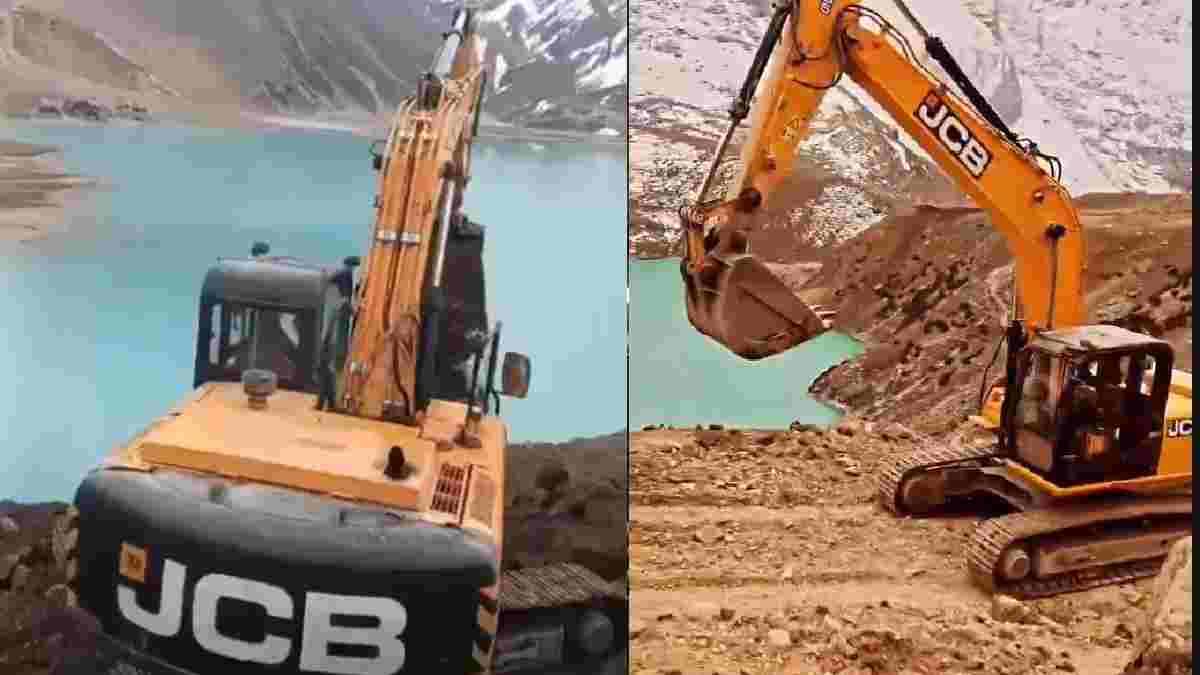
Sheshnag Lake is in Anantnag district of south Kashmir and it is an important landmark on the traditional Amarnath Yatra route. The controversy broke out after a video was released showing crawler excavator doing earthwork near the lake levelling parts of shoreline and moving soil.
Critics have called for an immediate halt to the work and independent environmental assessment but BRO has defended it saying it is part of post Amarnath Yatra track-widening and stabilisation operations.
Here is why the Sheshnag Lake controversy became a major issue.
What Happened Near Sheshnag Lake?
The controversy started when a video uploaded by a construction machinery operator was widely shared on social media. In the video, a heavy excavator was seen operating close to Sheshnag Lake and people asked why such large machinery was being used at such an environmentally sensitive place.
Reports said the activity was part of a BRO project along the existing Amarnath Yatra track. “The work is widening and stabilising vulnerable stretches of the existing route to improve access and reduce congestion during annual pilgrimage,” the organisation said.
However, environmental activists and residents questioned whether the construction activity could disturb the natural surroundings of the lake.
Heavy equipment used near the shoreline has been particularly controversial because of soil disturbance, waste disposal, natural drainage and damage to the glacial landscape.
Why Is Sheshnag Lake Environmentally Sensitive?
Sheshnag Lake is located at an altitude of about 3,590 metres in the Himalayas. It is a high-altitude glacial lake surrounded by mountain slopes, rocky terrain, and fragile natural ecosystems.
The lake is one of the 14 high-risk glacial lakes in Jammu and Kashmir. That classification has raised concerns about construction in its vicinity.
Glacial lakes are very sensitive to environmental disturbances. Slopes surrounding the lake change (slope stability), drainage channels change (drainage stability), and loose deposits may change (stability of the ground).
One of the major concerns is a Glacial Lake Outburst Flood (GLOF). This occurs when water stored in a glacial lake suddenly releases itself, sending large volumes downstream and destroying settlements, roads, and infrastructure.
Environmentalists have therefore asked whether heavy machinery should be used near Sheshnag without transparent scientific assessments and safeguards.
Sheshnag is also part of the wider water system of the region – drainage from it feeds streams into the Lidder River, so protection of the surrounding landscape is important for downstream communities too.
Why Is the Lake Religiously Important?
Apart from its environmental significance, Sheshnag Lake has religious importance in Hindu tradition as well.
It is on the traditional pilgrimage route to the Amarnath cave shrine (one of the most important Hindu pilgrim centres in the country).
In Hindu mythology, Lord Shiva left the serpents behind at Sheshnag before proceeding towards the Amarnath cave to narrate Amar Katha to Goddess Parvati.
The lake and surrounding mountains have been linked for generations to the spiritual journey to the Amarnath shrine.
PDP leader and spokesperson Mohit Bhan strongly criticised the construction work, saying that disturbing the sacred landscape was against everything attached to protecting religious heritage and nature.
The controversy has therefore turned into an environmental and religious debate.
What Has BRO Said About the Construction Work?
In response to the criticism, BRO issued a clarification on November 23, 2026.
The organisation said it was carrying out post-Amarnath Yatra work in accordance with applicable safety requirements and environmental safeguards.
The BRO says the project will widen existing tracks and stabilise vulnerable stretches based on requirements identified during previous pilgrimages.
The organisation said wider tracks were needed to relieve congestion and ensure safer movement for pilgrims, Yatra personnel and others on the route.
BRO also said the work was to existing tracks and that measures were being taken to ensure excavated material was safely disposed of, natural drainage protected and disturbance to surrounding terrain minimised.
It dismissed claims on social media that entirely new construction was taking place.
But the clarification hasn’t answered critics’ questions about what exactly was happening near the lake, how environmental assessment was done, and how permissions were obtained for the work.
🚨 EXCAVATORS NEAR KASHMIR’S PRISTINE SHEESHNAG LAKE! Visuals show heavy machinery operating near fragile #Himalayan Lake. Activists warn that unchecked construction could threaten the alpine ecosystem. Is this the price #Kashmir must pay for development? #Environment #BREAKING https://t.co/Vop0scr0Hp
— Subhankar Bera (@subhankar_org) November 24, 2026
Political Leaders Demand Environmental Investigation
Political leaders and environmentalists have questioned the use of heavy machinery in the region.
CPI(M) leader and MLA M.Y. Tarigami said ecological risks were there, as Sheshnag is one of Jammu and Kashmir’s high-risk glacial lakes.
He demanded that details of the project be made public and permissions for it be made available; he asked glaciologists and environmental experts to inspect it.
Climate activist Raja Muzaffar Bhat also asked how heavy construction machinery could have reached the glacier area.
PDP leaders were concerned about the environmental damage as well as the religious significance of the place. Mirwaiz Umar Farooq was also worried about it.
Congress leaders have criticized the decision to build near such a sensitive natural and religious site.
The central demand from critics is that development activities in the high Himalayas should be based on scientific studies, environmental impact assessments and consultations with experts.
Mehbooba Mufti Stopped From Visiting Sheshnag Lake
The controversy further intensified on November 24 when former Jammu and Kashmir Chief Minister and PDP president Mehbooba Mufti tried to visit Sheshnag Lake.
However, police stopped her at Chandanwari citing security reasons. She was accompanied by PDP MLA Waheed Para and other party leaders.
The incident provided another dimension to the debate; political attention was increasingly on the construction activity and authorities’ response.
Development Versus Environmental Protection
The Sheshnag Lake controversy illustrates a difficult question for infrastructure development in the Himalaya: how can authorities improve connectivity and pilgrim safety without damaging fragile mountain ecosystems?
BRO says its work is to make the existing Amarnath Yatra route safer and more accessible. Critics want more transparency about what’s being done as well as an independent scientific assessment of its environmental impact.
It’s important because damage to high-altitude ecosystems has consequences beyond the immediate construction site.
For now the debate is about how to strike a balance between infrastructure needs and religious heritage and environmental protection. Whether the work near Sheshnag Lake meets ecological safeguards is likely to remain a key question as authorities face more demands for clarification.




Comments