
The Supreme Court of India has said that access to and use of the internet is a fundamental right of every individual, including children, under Articles 21 and 19(1)(a) of the Constitution. The comments were made by the Bench that included Justice J.B. Pardiwala and Justice K. Vinod Chandran who were looking into kids’ safety and harmful content on the internet.
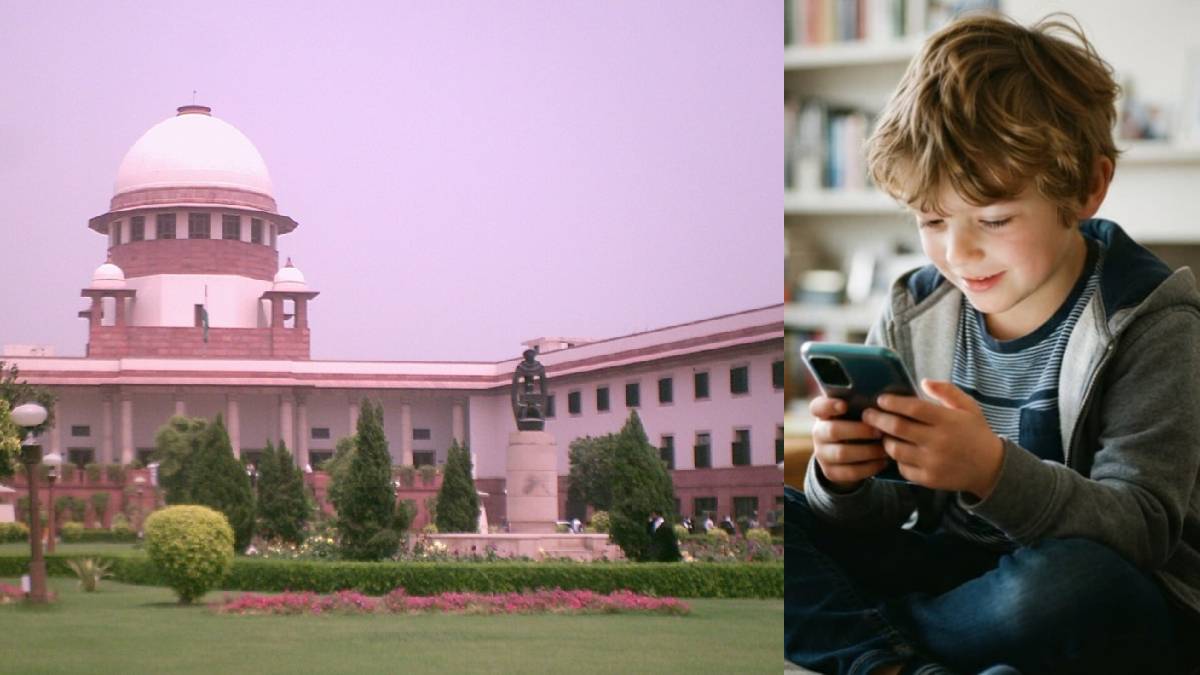
Children cannot be denied access to the internet on the grounds of protecting them from online harm, the Court said. Such a blanket ban would raise questions about their freedom of expression and other fundamental rights.
The Court’s observations are in line with mounting calls for restrictions on children’s access to social media, and worrying about online exploitation, cyberbullying, harmful material and the impact of digital platforms on young minds.
What is the balance between children’s online safety and their constitutional freedoms and the situation in the world is becoming more and more critical.
What is the Supreme Court saying?
The Bench noted that the right to access and use the internet is a fundamental right under Article 21, which protects life and personal liberty, read with Article 19(1)(a), which guarantees freedom of speech and expression.
The Court questioned the notion of denying internet access to children simply because of their age, saying such an approach would be comparable to saying that children below a certain age do not have a conscience worth protecting or freedom of speech worth expressing.
The Court also said children’s safety and freedom should not be considered as competing objectives.
But rather than banning social media or internet access, it should be a more comprehensive approach with kids’ rights safeguarded; in other words, that you protect kids’ rights to use the internet and not give up on them.
The observations were made in the context of measures to detect and remove child sexual exploitation and abuse material from online platforms.
What about parental controls and harmful content?
The Court called for stronger safeguards to protect children from harmful online material. Child-specific modes on social media platforms and removal of sexual exploitation and child abuse content are some measures which are in place, such as parental controls, child-specific modes, and so on.
The concern is that banning kids from social media in and of themselves might not eliminate them from those platforms.
Instead, children could continue accessing them without openly seeking help or reporting abuse because they might fear getting into trouble themselves.
Children may already be worried about reporting abuse, the Court noted. A blanket ban would further discourage them from coming forward, potentially undermining the objectives of the Protection of Children from Sexual Offences (POCSO) Act.
The objective, therefore, is in creating safer online environments where children can report abuse without fear and where harmful content can be identified and removed.
What about the earlier Supreme Court ruling?
The observations also follow the Supreme Court's earlier decision in Pragya Prasun and Others v. Union of India, heard along with Amar Jain v. Union of India on April 30, 2025.
A Bench comprised of Justice J.B. Pardiwala and Justice R. Mahadevan addressed barriers to digital access, particularly for persons with disabilities who faced difficulties using digital know-your-customer (KYC) systems.
In this increasingly technology-based society, digital access to services is necessary to achieve dignity, inclusion and access to services, the Court concluded.
In this case, the earlier judgment was about making digital systems accessible while the above observations concern children's access to the internet and the need to protect them from online harm without denying their freedoms.
The Internet reacts: Three perspectives.
The Supreme Court’s observations have brought in different perspectives on children’s internet access and social media restrictions into focus. Online discussions are all about child safety, parental responsibilities and the government’s own stance on digital freedom.
1. Child safety concerns.
One side of the debate is concerned that unfettered internet access could expose children to harmful content, manipulation and online exploitation.
Social media sites are increasingly crowded for attention with engagement-based features that can encourage prolonged usage. Some suggest children are especially susceptible to such systems as they are still learning to recognize manipulation and assess online risks.
Some also point to the dangers of online echo chambers, where children can be exposed to polarising content that influences their views and behaviour.
Previous online safety controversies, such as the Blue Whale challenge, are mentioned in discussions of the dangers that arise when young people encounter dangerous online material.
And those worried about the ruling say legal protection and regulation may come too late. They say stronger rules and protections are required before children are exposed to potentially dangerous online environments.
2. Support for the Court’s observations.
Another part of the debate is consistent with the Court’s focus on what is best for basic rights and online safety.
A blanket ban would not necessarily stop children from being exposed to social media. But it can drive them into smaller spaces, they say, the less visible spaces that the children are doing so, and it’s harder for parents and authorities to know if there is harm from which to identify harmful interactions.
They believe parental controls, age-appropriate settings, stronger platform accountability and awareness by parents can make more practical safeguards.
This view places enormous responsibility on parents and guardians to see what children are consuming online and guide their digital habits.
And also supporters of this argument say children should be taught how to use the internet safely, not to be cut off from it.
3. Questions on government restrictions on internet access.
A third point of view raises the question of the implications of the Court’s observations on the government’s internet restrictions.
Some users have questioned why internet access and freedom of expression are being discussed as fundamental rights for children while internet shutdowns and content restrictions have also been imposed in various parts of the country.
They have referred to restrictions in Jammu and Kashmir and Manipur, and restrictions on protests at Jantar Mantar, to question the consistency with which digital and civil liberties are protected.
The broader argument is that fundamental rights must be protected not only when discussing children’s access to social media but also when governments impose restrictions on internet connectivity or online expression.
But the legal questions around internet shutdowns and content restrictions are different from children’s social media access. Government restrictions need to be evaluated under the constitutional and legal standards, including reasonable restrictions and proportionality.
Balancing freedom and safety in the digital age
The Supreme Court’s findings exemplify the difficult issue facing parents, technology companies and policymakers: how do we protect children from online harm but allow them to be educated and express themselves?
The internet has become an integral part of learning, communication and everyday life. At the same time, harmful content, online exploitation, cyberbullying and manipulative platform features present real concerns. A blanket ban might seem simple, but does not really solve the root cause of online harm. To make online places safer and secure, greater protection must be in place from the start to the end, and there must be responsible parental supervision, reporting mechanisms and greater accountability of digital platforms.
The wider debate also raises questions about how constitutional freedoms should be protected when restrictions are imposed in the name of safety or public order.
Ultimately, the challenge is to keep children safe from the hazards of the internet. Safety and freedom are not mutually exclusive, the Supreme Court makes it clear.


Comments
Leave a Comment