
China has achieved a milestone in electric aviation after its independently developed 19-seat commercial aircraft CE-25A completed its first crewed flight. The CE-25A was developed by the Commercial Aircraft Corporation of China (COMAC) with several research and industry partners and took to the skies for the first time on 14 November 2026 in Binzhou, Shandong Province.
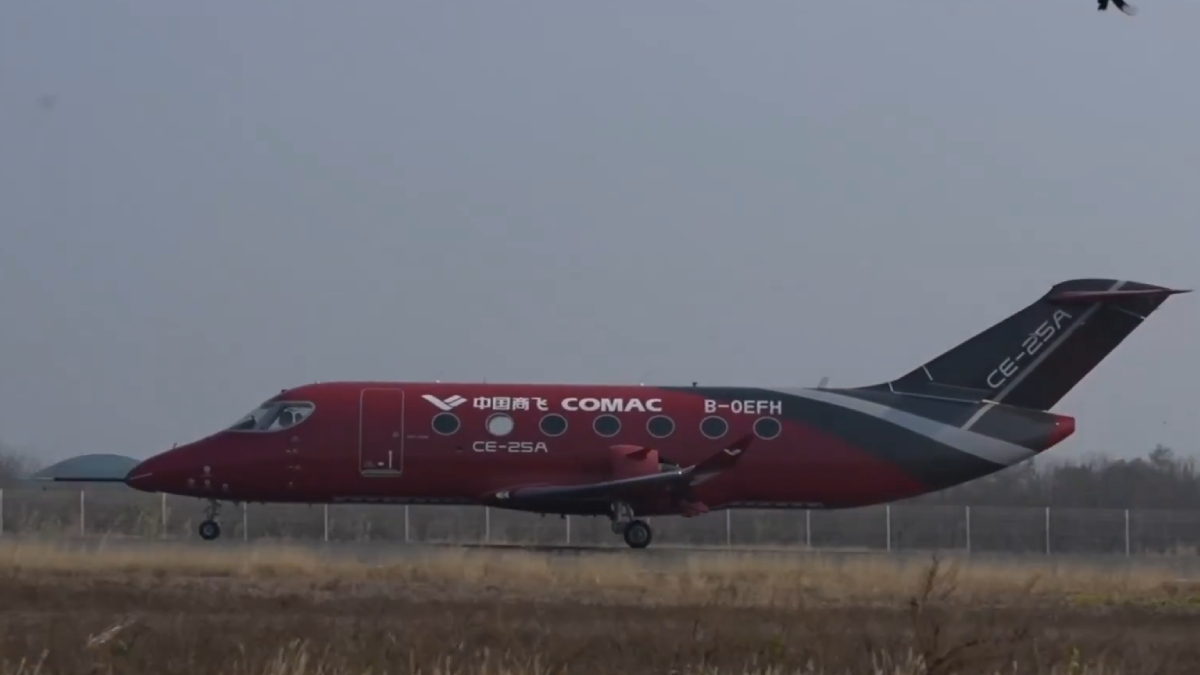
The flight is an important step in China’s push to develop battery-powered passenger aircraft for short haul commercial travel. Two pilots and one flight test engineer were aboard the plane during the test progress beyond earlier autonomous flight trials.
COMAC said the aircraft operated normally and all indicators were within expectations.
China's CE-25A Completes Its First Crewed Flight
The CE-25A made its maiden piloted flight on 14 November in eastern China’s Shandong Province.
The aircraft was airborne for about 16 minutes and 38 seconds (60.4 km). Two pilots and a flight-test engineer were on board.
This test followed several autonomous flight validations earlier in the year. The aircraft had already flown its first unmanned autonomous flight on 2 February 2026.
This is blowing my mind 🤯 China has developed a 10-ton-class electric passenger jet that can fly either with a pilot or fully autonomously. It can carry 19 passengers, cruise at 300 km/h, and fly up to 400 km. The plane completed its first piloted flight today in China. Its first autonomous flight was back in February, and it has completed 19 unmanned verification flights.
— Li Zexin 李泽欣 (@XH_Lee23) November 14, 2026
COMAC said the CE-25A had flown 19 unmanned autonomous flight validations before entering the crewed testing stage.
The successful flight is an important step in testing the aircraft with a human crew on board but more testing and regulatory approval will be needed before it can carry paying passengers.
What Is China's CE-25A Electric Aircraft?
The CE-25A is a 10-tonne class electric commercial aircraft designed primarily for short-haul passenger travel between cities.
Unlike conventional aircraft (jet engines or turboprop engines powered by aviation fuel) the CE-25A uses an electric propulsion system.
It has multiple electric ducted fans along the wings. Electric motors drive the fans which produce thrust to move the aircraft (it is the thrust that moves the plane).
It can carry up to 19 passengers so it could be used on regional aviation routes where smaller passenger aircraft are used.
Its development also reflects the growing interest in electric propulsion as aviation industry looks for alternatives to conventional fuel-powered aircraft.
CE-25A Electric Aircraft: Key Specifications
The aircraft's reported design specifications are:
- Aircraft model: CE-25A
- Manufacturer: Commercial Aircraft Corporation of China (COMAC)
- Maximum takeoff weight: 10 tonnes
- Passenger capacity: Up to 19 passengers
- Cruising speed: 300 kilometres per hour
- Cruising altitude: 2,400 metres
- Designed range: 400 kilometres
- Propulsion: Battery-electric system
- First crewed flight: November 14, 2026
- Flight location: Binzhou, Shandong Province, China
These specifications make the CE-25A a short range aircraft and not replacement for long distance passenger planes.
Which companies and institutions developed the aircraft?
The CE-25A is the result of collaboration between several Chinese organisations.
COMAC (the country’s state-owned commercial aircraft manufacturer) is spearheading the aircraft development programme.
Other partners include:
- Contemporary Amperex Technology Co. Limited (CATL): China’s largest battery manufacturer with expertise in battery technology.
- Shanghai Jiao Tong University: An academic institution for research and technical development.
- Other research and industry partners: Supporting the aircraft’s engineering and development work.
The collaboration shows how battery technology, electric propulsion and aerospace engineering are all needed to develop next generation aircraft.
However the battery configuration and technical information of CE-25A energy storage system have not been disclosed publicly.
China Moves Towards Electric Regional Aviation
The CE-25A’s first crewed flight is part of a larger effort to explore electric powered aviation for shorter routes.
Electric aircraft are being developed so dependence on conventional aviation fuels can be reduced and operating emissions may be lower.
Regional aviation is seen as more practical starting point for battery-powered passenger aircraft since shorter routes generally use less energy than long distance flights.
The CE-25A’s 400 kilometres range could mean it would be suitable for some intercity routes depending on final certified performance, operating conditions and regulatory requirements.
However the actual commercial range of the aircraft may be less than design if passenger load, weather, battery reserves and operational safety requirements are taken into account (e.g.).
What Is the Current Certification Status?
Flying crewed doesn’t guarantee that an aircraft is ready for commercial operation.
The Civil Aviation Administration of China (CAAC) has accepted COMAC’s application for a type certificate for CE-25A.
This is a regulatory step as the aircraft needs to be certified in order to show that it meets airworthiness and safety standards (applicable).
Acceptance of the application does not imply that aircraft has already been certified for final use.
Testing, technical evaluations and regulatory approvals will still be required before commercial passenger operations can begin.
COMAC has not announced a date for the aircraft entering commercial service.
How Might Electric Aircraft Change Regional Travel?
Battery powered aircraft may open up new possibilities for short distance air travel in the future.
If electric aircraft become commercially viable they might have some advantages:
Electric aircraft could provide some benefits if they become commercially available.
1. Reduced dependence on aviation fuel
Electric propulsion could reduce or eliminate the need for conventional aviation fuel on suitable routes.
2. Lower direct operational emissions
Battery-electric aircraft do not produce CO2 from fuel combustion during flight. But how environmentally friendly they are overall also depends on how electricity is generated and batteries made.
3. Potentially quieter operations
Electric motors might produce less noise than conventional aircraft engines but the overall noise profile also depends on aircraft design and propulsion systems.
4. Improved regional connectivity
Smaller electric aircraft could support short-haul routes between cities and regional locations where there may not be demand for larger passenger aircraft.
These benefits will depend on the aircraft’s final performance, operating costs, charging infrastructure and regulatory approval.
Electric Aviation Still Faces Major Challenges
While the CE-25A shows progress, electric passenger aviation has several technical and commercial challenges.
Battery energy density is still one of the biggest limitations. Aircraft need a lot of energy to generate lift and keep flying, batteries add weight that can reduce the amount of energy available for passengers and cargo.
Other challenges include:
- Developing lightweight and high capacity aviation batteries.
- Battery safety under demanding flight conditions.
- Building suitable charging infrastructure at airports.
- Meeting strict aviation certification requirements.
- Complying with strict aviation certification requirements.
- Making electric aircraft commercially competitive.
- Keeping enough range when carrying passengers and luggage.
These factors mean battery-powered aircraft are not well suited to long distance international travel yet.
What Happens Next for the CE-25A?
The successful crewed flight is an important milestone as COMAC continues to develop China’s first electric commercial aircraft.
The next steps will be flight testing, technical validation and regulatory certification.
Its 400km range and capacity for 19 passengers could make it a candidate for regional air travel if the required evaluations are successful.
Currently, the CE-25A is under development and has not been approved for commercial passenger operations.
Its first crewed flight nevertheless signals progress in China’s electric aviation programme and adds another chapter to the global effort to explore cleaner propulsion technologies for air travel.





Comments