
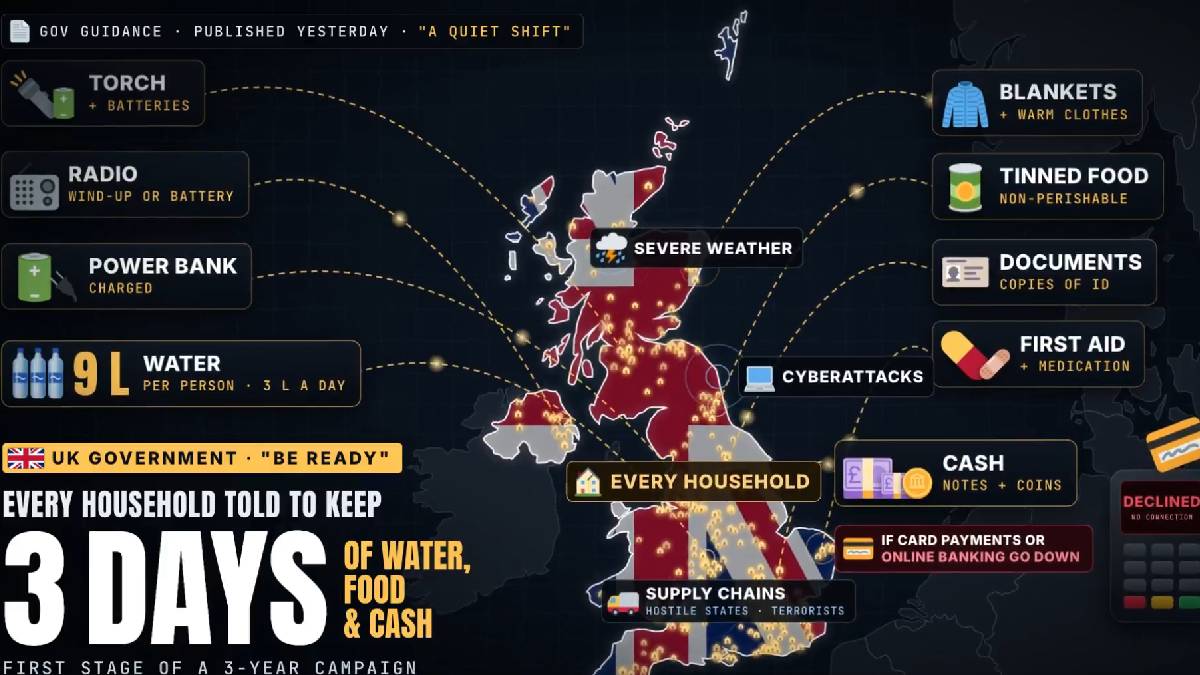
Britain has launched its “Be Ready” campaign, urging households to keep at least three days’ worth of essential supplies in preparation for emergencies that could disrupt everyday services. While the advice is not a warning that nuclear war is imminent, its timing has drawn attention amid rising tensions between Russia and Europe, growing cyber threats and concerns over the security of critical infrastructure.
The campaign follows a recent security warning involving PHP, a widely used programming language. British cybersecurity authorities warned that critical vulnerabilities could allow attackers to execute commands on affected web servers, urging organisations to update their systems and take protective measures.
The government’s “Be Ready” initiative encourages citizens to prepare for situations in which services they normally depend on become temporarily unavailable. The checklist includes bottled water, non-perishable food, a torch, spare batteries, a radio, a power bank and essential medical supplies. These are supposed to be the first step to a three year long initiative??
The aim is for households to remain self-sufficient for 72 hours during an emergency, allowing emergency services to prioritise those who need immediate assistance. Security Minister Dan Jarvis has described the initiative as a way to improve national resilience, while Defence Secretary Wes Streeting has stressed the importance of being prepared without causing unnecessary alarm. The campaign also brings Britain closer to the approach followed by European countries such as France, Ireland and the Netherlands.
However, it is difficult to ignore the wider security climate surrounding the announcement. On October 23, Britain and France confirmed that British RAF Typhoon fighters had participated in a French nuclear exercise for the first time. During Exercise Rummy, British aircraft escorted French Rafale jets on a simulated nuclear-strike mission. The exercise did not involve nuclear weapons, but it marked a significant step in military cooperation between the two countries as European nations reassess their defence preparedness amid Russian aggression and uncertainty over future American security commitments.
The developments come as Russia’s war against Ukraine continues and European governments face questions about how to maintain support for Kyiv. Concerns have also grown over the future level of American involvement in European security, increasing pressure on European allies to strengthen their own defence capabilities.
At the same time, diplomatic efforts have not disappeared. Russia has agreed in principle to resume trilateral discussions with Ukraine and the United States after November 10, according to the Kremlin, although the proposed talks should not be mistaken for an ongoing peace negotiation or a guarantee of progress.
Taken together, these developments highlight the difficult balance between preparing for potential crises and avoiding unnecessary public fear. Britain’s emergency advice covers several possible disruptions, from severe weather to cyberattacks, rather than pointing to a specific military threat. Still, as Europe strengthens its defences while pursuing diplomatic options, the campaign reflects a broader recognition that governments and ordinary citizens alike need to be better prepared for uncertainty.






Comments