
A major rocket failure has dealt a huge blow to Amazon’s satellite internet ambitions as the United Launch Alliance (ULA) Vulcan rocket failed to put 40 Amazon Leo satellites into orbit. The incident happened on November 15, 2026 shortly after the rocket took off from Cape Canaveral Space Force Station in Florida.
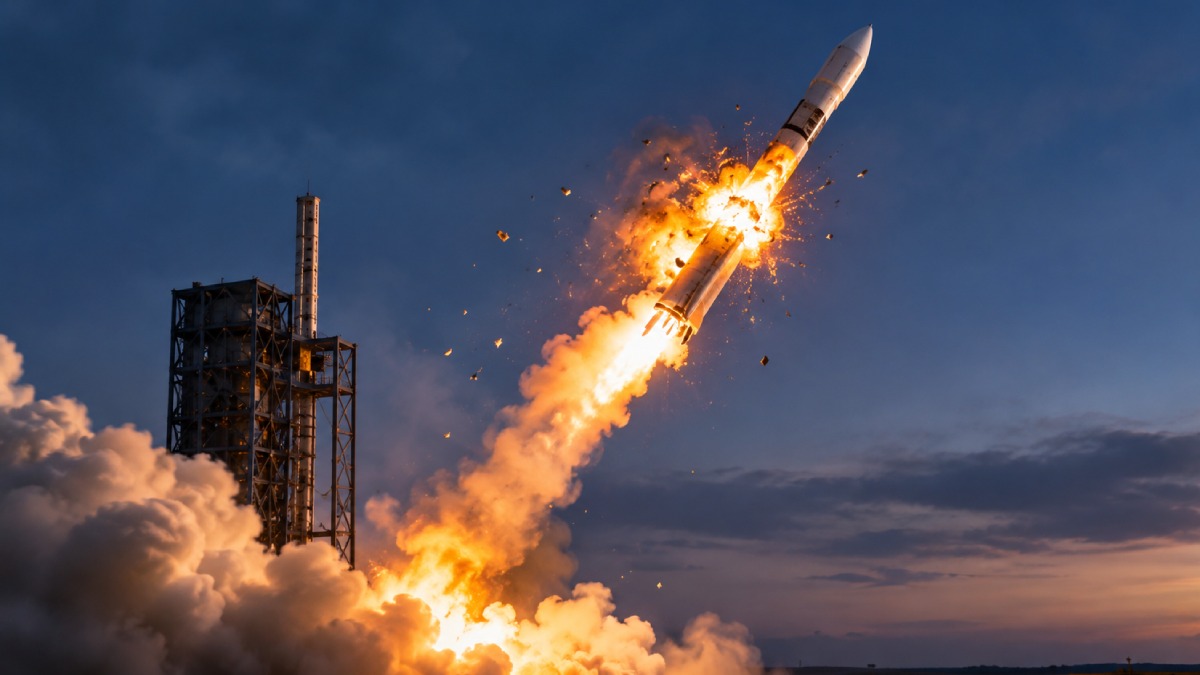
The failure is the first complete mission loss in ULA’s history (Boeing owns a stake of Lockheed Martin). It also raises questions about when Amazon will deploy satellites to expand its broadband internet network and compete with SpaceX’s Starlink.
What Happened During the Vulcan Rocket Launch?
The Vulcan rocket lifted off from Space Launch Complex 41 at Cape Canaveral around 12:40 p.m. local time on November 15. It was carrying 40 Amazon Leo broadband satellites the largest ever deployed for the program in one launch.
The first few minutes of the flight went fine. Then 10 minutes after liftoff, something happened and the rocket couldn’t complete its mission.
ULA later said the vehicle had failed to put its payload into orbit. All 40 Amazon satellites on the rocket were lost as a result.
ULA said in its statement that it would work with Amazon and other organisations to “determine the cause of failure, necessary corrective actions and prepare the rocket for flight.”
Why Did the ULA Vulcan Rocket Fail?
The exact cause of the incident is not known. ULA has not released any details on the technical problem and said it needed to analyse the flight data available before it could work out what had gone wrong.
Early flight information has questioned how the rocket performed while in its first stage and after separation but they do not establish the cause of failure.
The Vulcan has two BE-4 engines (made by Blue Origin) on its first stage; the upper stage is powered by RL10 engines. Blue Origin will assist in the investigation but there’s no confirmation that the BE-4 engines caused it yet.
The investigation will be useful in figuring out whether the failure was an engine, the rocket’s propulsion systems, flight control or some other technical component.
A Major Setback for Amazon Leo's Satellite Internet Plans
Amazon Leo (previously Project Kuiper) is the company’s satellite broadband initiative. It will provide high-speed internet connectivity through a large constellation of satellites in low Earth orbit.
The programme is meant to compete with existing and new satellite internet providers (SpaceX’s Starlink network in particular).
The 40 satellites lost in the latest incident were part of Amazon’s deployment plans. The launch was also the first of 38 Vulcan missions contracted by Amazon to put its satellites into orbit.
The loss presents two major challenges for the company:
- Satellite replacement: Amazon will need to account for the loss of 40 spacecraft and figure out how to change its deployment schedule.
- Launch delays: Any investigation-related grounding of Vulcan would slow future missions and complicate the company’s plans to expand its satellite network.
Amazon also contracted other launch providers (Blue Origin, Arianespace and SpaceX) giving it options for deploying its satellite constellation.
ULA Faces Its First Major Mission Failure
United Launch Alliance was formed in 2006 as a partnership between Boeing and Lockheed Martin. It has been the major provider of launch services for commercial, government and national security missions.
The November 15 incident was its first complete mission failure since it was formed.
It was also only the fifth flight of Vulcan, which was developed to replace ULA's older Atlas V launch vehicle. Vulcan had been back in flight after about nine months (since its previous flight) following technical reviews of solid rocket boosters earlier this year.
The earlier missions had problems with the boosters but still got their payloads into orbit. This time it’s worse because the entire Amazon mission was lost.
What Happens Next?
ULA will have to conduct an investigation before Vulcan can return to service. Investigations typically involve looking at flight telemetry, checking recovered hardware where possible and identifying corrective actions taken.
We don’t yet know how long the investigation will last or whether any launch restrictions would result.
The outcome will go beyond Amazon’s commercial satellite programme. Vulcan is also a launch vehicle for US government and national security missions so reliability is a big issue for the wider space industry as well.
For Amazon the first thing to do will be to assess how that will impact its satellite deployment schedule and coordinate with launch partners.
The incident exposes the technical and operational risks of building large satellite internet networks — Amazon is still on track to expand global broadband access but losing 40 satellites and not knowing what happens with Vulcan launches next are a big blow.





Comments