
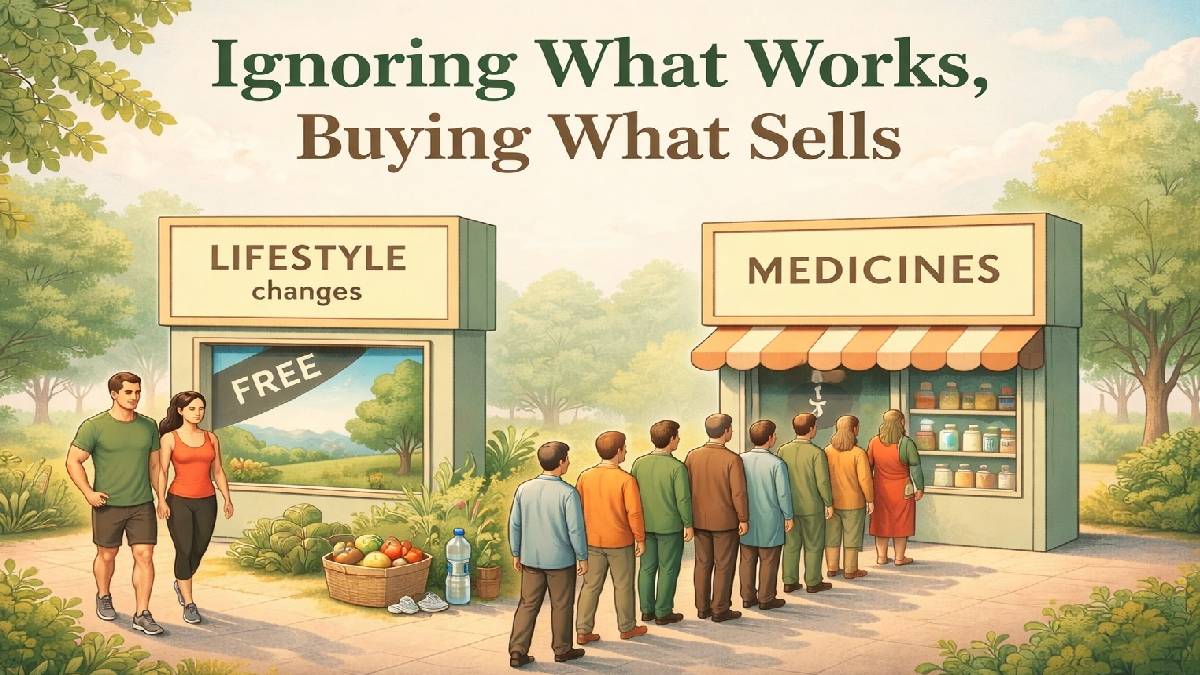
In our fast‑moving world, convenience frequently wins out over loyalty. An illustration of this fact running through its web page captures it perfectly. On one side is a shop called “Lifestyle Changes,” with a giant “Free” sign emblazoned on the sidewalk. On the opposite wall is a store labeled “Medicines,” stocked with merchandise and marked by a dollar sign. Outside the medicine store, a long line waits – an empty lifestyle shop. The message is simple yet profound: we mostly ignore what really works and spend money instead on what's sold and marketed to us.
Prevention vs. Cure
Modern health challenges like diabetes, hypertension, obesity and heart disease are very much influenced by lifestyle patterns. International organizations like the World Health Organization always stress preventive care: right nutrition, exercise, sufficient sleep and stress management. Preventing things, however, is discipline at its best. The practice requires daily effort and long‑term commitment.
Medicines, by contrast, usually offer faster and more convenient results. They are available, packaged, marketed, and purchasable. Medicines are essential and life‑saving approaches to many, but can also be substitutes for behaviors that could have prevented them in the first place.
The Business of Health
Healthcare is one of the world’s largest industries. Pharmaceutical companies spend significant resources on research, branding, and distribution. Their products are ubiquitous and well visible. No marketing campaigns exist for lifestyle changes. No one profits directly from your morning walk, home‑cooked meals, or mindful breathing practice.
This creates a psychological shift: we often confuse value with what costs money. If something is free, we may suppose it has less impact. Ironically, the most impactful health interventions — walking every day, eating whole foods, decreasing processed sugar, staying active — don’t cost nearly as much, if anything.
Personal Responsibility Has Power
Making lifestyle changes isn’t always easy. It takes repetition, patience, and self‑monitoring. But these gains stretch well beyond just physical well‑being: greater mental clarity, emotional balance, financial savings and longer‑term resilience.


Medicines do have their place of course. They save lives and treat serious conditions. It’s the issue when we approach them as the primary remedy rather than reinforcing the basis of prevention.
A Shift in Perspective
But the illustration forces us to reconsider what matters. Are we waiting in the wrong queue? Are we ignoring what works precisely because it isn’t in a bottle? You cannot buy health. It develops on a daily basis with small choices. Perhaps the strongest prescription isn’t on a pharmacy shelf — but in our daily routines.
Disclaimer
This article is for informational purposes only and does not constitute medical advice. Always consult a qualified healthcare professional before making any changes to your diet, lifestyle, or medical treatment.







Comments
Leave a Comment