
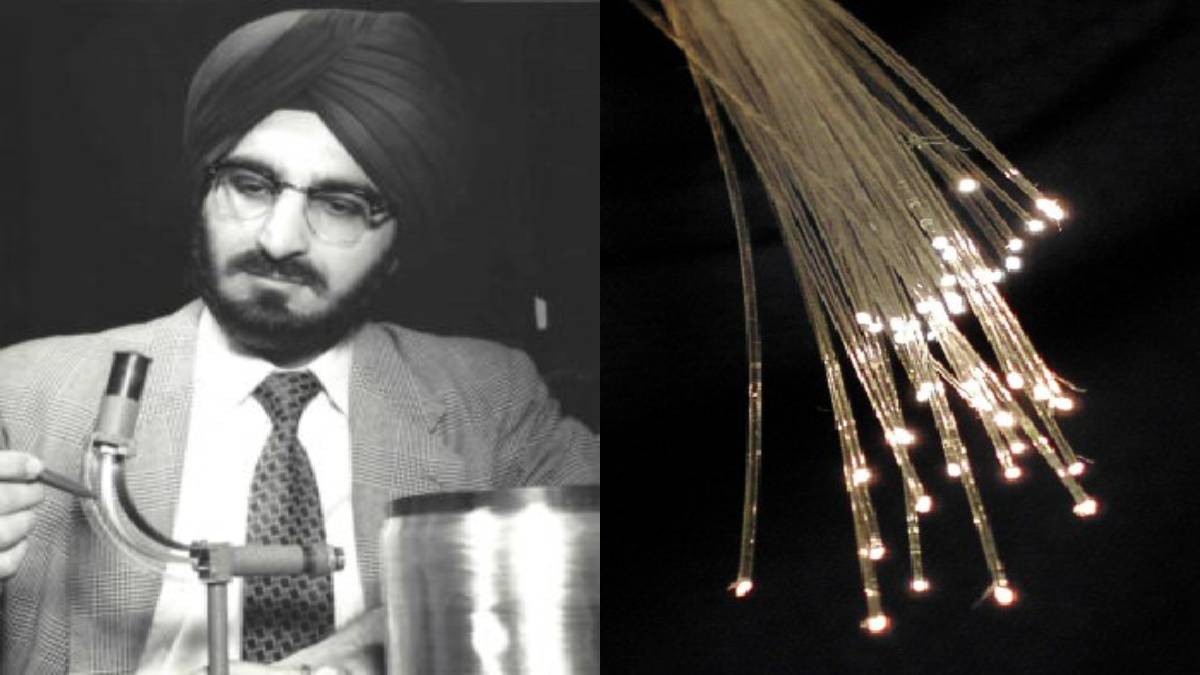
Fibre optics cannot be untold the story of modern communication, internet and global connectivity in its entirety. But the name of the man behind this revolutionary technology often gets lost in the dominant narratives. Narinder Singh Kapany, born in Punjab in 1926, was the scientist who figured out how to direct light through thin glass fibres originally in the 1950s. His work established the basis of the digital revolution, allowing us to enjoy, access and consume the internet, medical imaging technology, and countless other technologies that we rely on today. But much of the recognition & patents went to others, leaving Kapany’s contributions behind as a footnote instead. It is time for him to be regarded as a fully-fledged “Father of Fibre Optics.”.
The Invention that Changed the World:
Kapany was conducting experiments in the 1950s to facilitate light transmittance. He found light to be bent and directed through thin strands of glass fibres without losing its strength. This leap was an amazing achievement. Until then, communication was based on copper wires and radio signals, which couldn’t get speed and capacity to work. Fibre optics allowed massive datasets to be sent at lightning speed. Fibre optics has all the electricity today. Every email, video call, or online search moves through fibre optic cables. Without Kapany’s creation, the internet would not be as it is now. His work changed communication, but also medicine, defense and entertainment. Fibre optics are applied in endoscopes for medical diagnosis, in lasers for surgery, and also in numerous businesses around the globe.
Narinder Singh Kapany (1926–2020): The Inventor of Fibre Optics.
Born in Punjab, Kapany fundamentally transformed communications in the 1950s by inventing the technology that guides light through glass fibres. This invention laid the foundation for the modern internet and the… pic.twitter.com/0xHf6djYvK— JIX5A (@JIX5A) January 21, 2026ALSO READ


Recognition Denied:
Kapany was not acknowledged as a worthy figure despite the fact that he had discovered something of great significance. Many of the patents and formal credits were awarded to scientists and companies in the United States. Biases of history and politics of the scientific community conspired to obscure Kapany’s name in textbooks and mainstream accounts. That omission exposes a larger problem: how the contributions of scientists beyond the Western world frequently went unheard or were dismissed. Kapany’s invention was hailed, but his name was not. Others built off of his work, commercialized it and rose to fame, while Kapany lingered in the shadows.
Beyond Fibre Optics:
Legacy Kapany was a pioneering scientist and visionary. He moved to the United States, where he did more research then taught at university. Over 100 scientific papers published by him and in excess of 50 patents he held made him one of most recognised experts in the field. His book Fibre Optics: Principles and Applications became a standard reference source in the field. He also became deeply entrenched in his cultural roots beyond science, Kapany felt deeply connected to his cultural heritage beyond science. He used to represent the promotion of Sikh education and culture, and donated his life story for museums and universities; He also encouraged Sikh art and heritage, giving large amounts of money to museums, libraries and Indian museums and universities. It was on his moral mission to give back to the public good, to make sure that all knowledge and cultural heritage, culture is conserved and preserved.


Why Does His Story Matters Today?
Fibre optics are everywhere in today's time of digital communication. From undersea cables linking continents to tiny fibres within hospitals, Kapany's invention reaches billions of lives in daily use. But his name is seldom mentioned. But recognizing him isn’t just about granting credit– it is about righting historical wrongs and forging new inspiration in the future. Kapany suggests to us that innovation can come from anywhere. We can all appreciate that he is a major figure in science. It should be remembered that he was not confined to any given region, state, or nation. And in acknowledging him young scientists from all walks of life will feel assured that their efforts make a difference.
Narinder Singh Kapany really was the person that shone the torch on the Internet. Fibre optics was his invention and enabled communication, medicine, and technology – creating an effective modern digital world. His name, however, was often erased in history, a reflection of others. It is our duty to ensure his memory remains, to rejoice in his successes and to remind him of the blessings he has earned. Kapany’s life was a tale of brilliance, perseverance and humility. He added a gift that, by this time, lives on in our lives almost every single day. While we send out messages to around the world in seconds, at least, let us stop and admire the man who made it possible: the forgotten pioneer who broke ground when fibre optics lit the world.











Comments
Leave a Comment