India, with a vengeance (even if only for a moment): India every 28 February is the celebration of both curiosity and logic. National Science Day is not a date you can simply look up for on a calendar, but the year to celebrate one of the most innovative scientific innovations and to note India's growing importance to the global scientific community. The theme for National Science Day 2026 is "Women in Science: Catalysing Viksit Bharat."
Why February 28? The Legacy of C.V. Raman
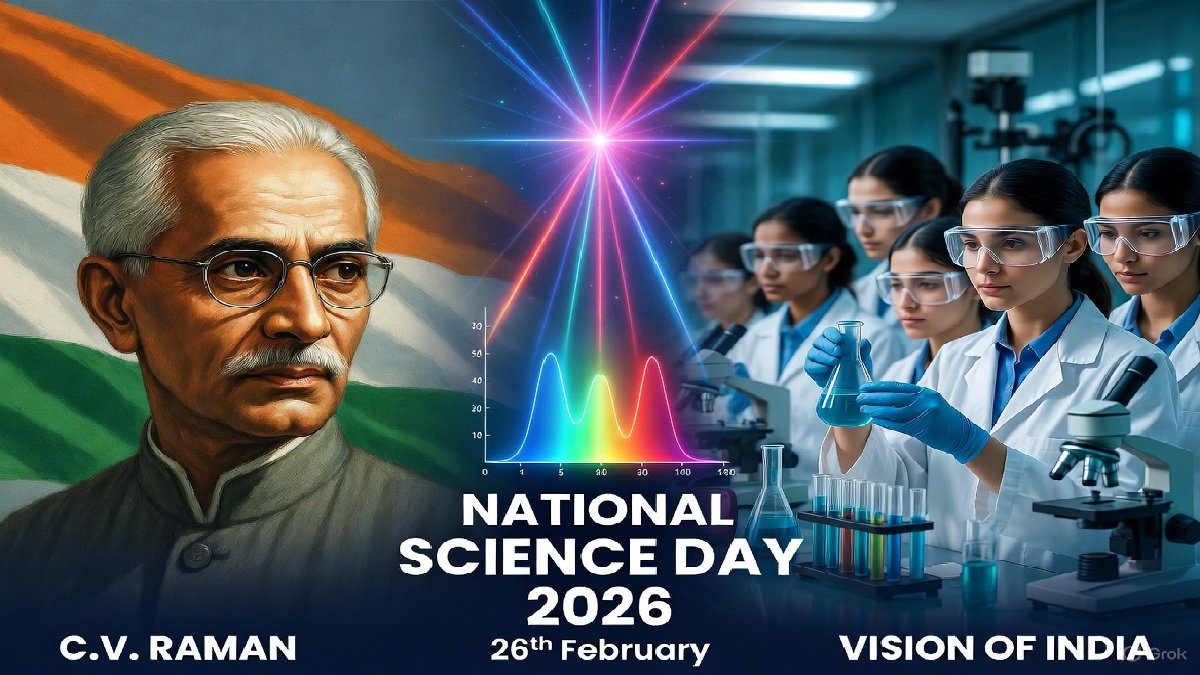
Contrary to popular belief, February 28 is not the birthday of Sir Chandrasekhara Venkata Raman. Instead, it is the day he actually discovered the Raman Effect in 1928.
While on his way through the Mediterranean Sea in 1921, Raman was enchanted by its deep blue color of water. This curiosity encouraged him to challenge the widely held theory that the ocean simply reflected back from the sky. After years of stringent experimentation on rudimentary apparatus, he showed that when light passes in a transparent material, a tiny fraction of that light comes out at a different wavelength after passing through it.
His use, referred to as the Raman Effect, helped earn him the Nobel Prize in Physics in 1930, becoming the first Indian and Asian individual to be awarded the Nobel Prize in any science field of study.
2026 Theme: "Women in Science: Catalysing Viksit Bharat."
For the year 2026, the Department of Science and Technology (DST) has made efforts to bring gender parity in its field of scientific, technological engineering and mathematics (STEM) (such as that found in India). It points out that India’s journey to becoming a developed nation (Viksit Bharat) is deeply connected with the efforts of female scientists who innovate and lead it. From such space missions as Gaganyaan an early uncrewed flight in early 2026 for mankind's humanoid robot Vyommitra to the development of deep tech and sustainable energy, women are driving India’s future technology path.
A Special Day
Today's National Science Day does many urgent things for India:
- Promoting Scientific Temper: It encourages, especially students, the students to change old ideas into evidence-based.
- Sharing Informatics: Schools such as IISER, NITK Surathkal and IIT Gandhinagar have a stage through which innovative technology can be shown to the public.
- Ensuring Inclusivity: Initiatives introduced this year, like Braille science periodicals geared towards the handicapped using Braille language to enhance science at home and beyond, help make science available to all.
A Celestial Treat in 2026
To top it all up this year, National Science Day 2026 celebrates an unusual planetary alignment. Mercury, Venus, and Saturn appear grouped near the western horizon at the close of evening hours, observing stars all over India, while Jupiter and the Moon shine brightly in the east a suitable cosmic homage to a day devoted to the marvels of the universe. And as we celebrate today, we are not simply reminiscing about Raman’s lab in Kolkata, though; we are anticipating the laboratories of tomorrow, that the next generation of Indian innovators is currently building and working in.