In these remote, lofty meadows along the Indian Himalayas, a distinct organism drives local economies and attracts global notice. The Yartsa Gunbu, or Ophiocordyceps sinensis, is a parasitic fungus that trades for prices equivalent to gold and is also one of the most precious biological commodities worldwide.
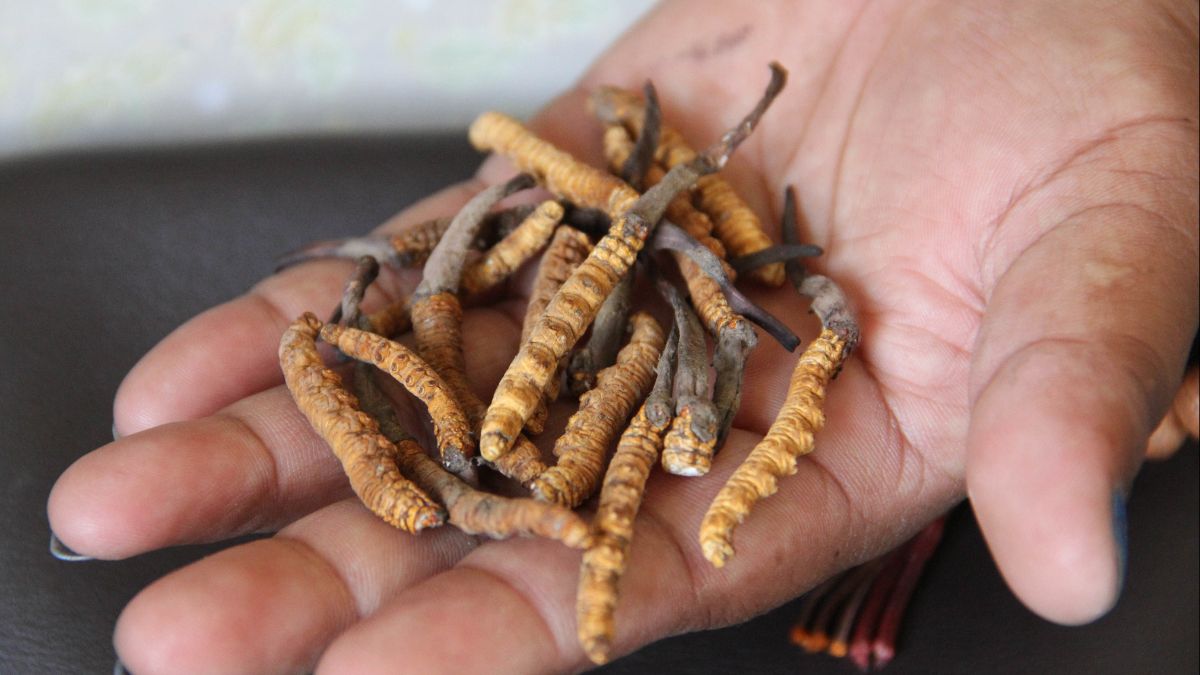
What is Yartsa Gunbu? The “Winter Worm, Summer Grass.”
Its name Yartsa Gunbu means winter worm, summer grass from Tibetan and gives a poetic description of its amazing life cycle:
- The Host: Ophiocordyceps fungus in late autumn infects the larvae of the ghost moth, which then burrow underground.
- The Parasite: The fungus slowly consumes the larva from within, mummifying it.
- The Fruiting Body: By the spring, a slender dark-brown fungal stalk grows out of the mummified caterpillar’s head and burrows through the soil to the surface. This whole affair the mummified larva and the stalk is the prized Yartsa Gunbu.
Why is it So Expensive? The ₹15 Lakh Price Tag
Yartsa Gunbu is a quintessential Indian produce, costing ₹10 lakh to ₹15 lakh a kg, depending on quality, due to many circumstances:
- Extreme Rarity: Only grows at altitude above 3,500m in the Himalayas, mainly in Bhutan, Nepal, Tibet and parts of India (Uttarakhand and Sikkim).
- Harsh Harvest: Yartsa Gunbu is expensive to collect, and can take hours of painstaking searching on a small scale by hands and knees on steep, high-altitude terrains. It is a short season, lasting just a few weeks--from May to June most of all.
- Heavy Demand from Traditional Medicine: It is essential to traditional Chinese and Tibetan medicine, where it is recognized by people for its supposed aphrodisiac properties and applied as a general tonic.
- Supply shortages & regulation: Over-harvesting in some areas has led to ever lower crop sizes. There are now tougher collection regulations from the governments to minimize damage to the ecology.
Himalayan Viagra And Its Traditional Uses
Yartsa Gunbu has been used in various forms for centuries:
- Aphrodisiac: Its most well-known usage is as a natural aphrodisiac, why the name Himalayan Viagra.
- Immune boost: Thought to boost endurance, lower fatigue levels & boost immune function.
- Respiratory & Renal: Used for respiratory illness and kidney disease.
- Anti aging: Other traditional practitioners believe it is anti-aging.
Economic Impact & Controversy
Yartsa Gunbu collection is often the sole source of livelihood for the impoverished communities in the high Himalayas. Each year, the harvest can bring in millions of rupees, changing local economies. But that wealth comes with challenges.
- Inter-village Clashes: Sometimes disagreements over sites to harvest from have been accompanied by brutal episodes.
- Environmental Risks: Scarcity of alpine ecologies is a danger to fragile systems.
- Sustainable practice: Researchers are still going to find green collection methodologies and growing fungus but so far even this has been very much out of reach.
Yartsa Gunbu continues to be an iconic image of the Himalayan biodiversity and interdependence between nature, culture, as well as global marketing even as the demand for natural remedies increases.