The discovery could change Mars and the scientific study of Mars so much more than anything else in the billions of years since its formation. For the first time, garnet, a mineral never found in a Mars sample, has been discovered in a meteorite from the Red Planet. With this new kind of Martian rock that could help scientists to discover that Mars is in the process of a different type of rock and is giving scientists a sense of heat, pressure, and geological processes in the very origins of Mars in its earliest days, and for the first time they have found the first such geological processes.
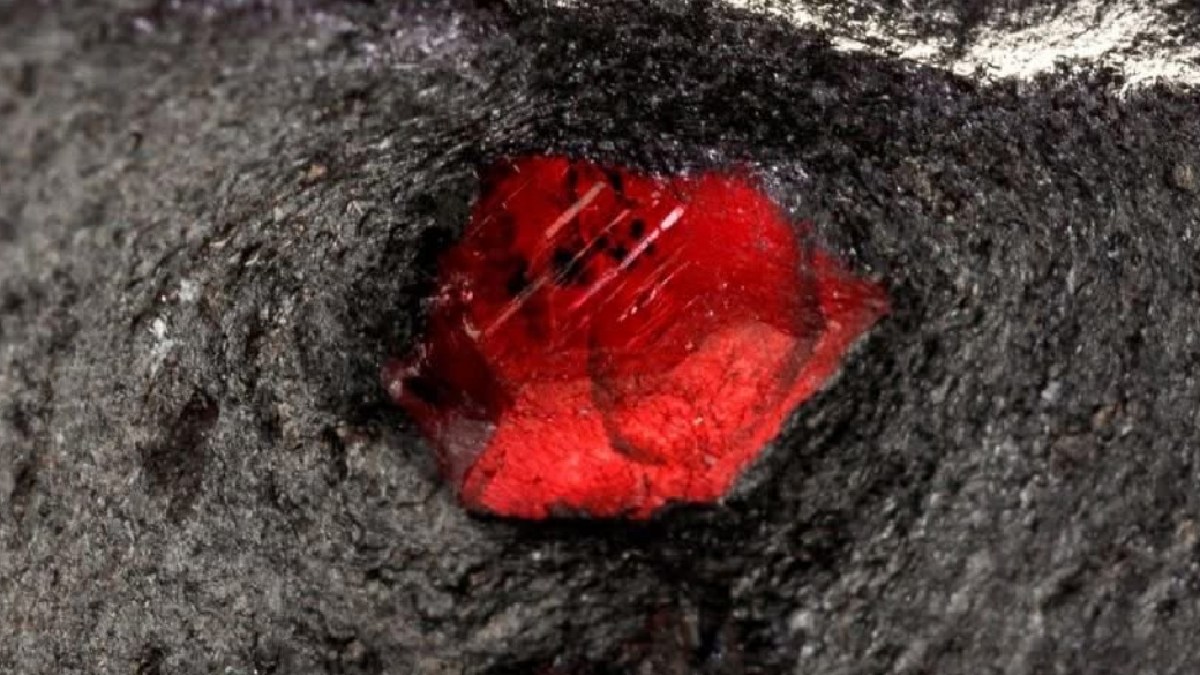
Researchers say the newly discovered garnet-bearing rock is a geological “time capsule” because it preserves evidence of conditions on Mars nearly 4.5 billion years ago. Scientists hope to reconstruct some of the planet’s ancient history and better understand how Mars evolved from a potentially habitable world to the cold, dry planet we know today.
This was discovered by an international team of scientists working on a Martian meteorite called NWA 8171 which is housed in the Royal Ontario Museum in Toronto, Canada. Scientists initially thought the meteorite contained pyroxene, a common mineral in most planetary rocks. But closer inspection showed something else.
With state-of-the-art electron microscopy and laser analysis equipment, we found out that the strange mineral was garnet. On Earth, garnet is known to geologists as it forms in the hottest and most stressful situations, and it can also be used to identify what is there in a rock and how it formed.
The discovery was made by Tanya Kizovski, Assistant Professor of Earth Sciences at Brock University in Canada. The presence of garnet on Mars indicates geological processes were more complex than previously understood, said the research team.
Garnet is usually associated with metamorphic rocks, which occur when old rocks are transformed by high temperatures and high pressures or chemically active fluids. Scientists think such a scenario might have existed on ancient Mars. The heat and pressure needed to produce garnet could have been generated by huge asteroid impacts, volcanic activity, or magma that was produced via the Martian crust.
The discovery is particularly fascinating because Mars had a very different climate once. Rovers and orbiters have found rivers, lakes, and even oceans on Mars billions of years ago. That suggests Mars may have even been home to microbial life.
So it is important to know the planet’s geological history to assess whether life could have existed on it. The garnet-covered rock revealed in the past is already very intriguing but provides at least a glimmer of that far past and may also open up a better understanding of what was there on Mars when it was warm and wetter.
One big question remains unanswered: Was the garnet-bearing rock formed on Mars or did it originate from elsewhere in the solar system through an ancient meteorite impact? Scientists are hoping to understand this by studying the oxygen isotopes of the rock that can tell us about its origin. But such tests would destroy a large fraction of the extremely rare sample, and scientists are cautious about that.
Experts say the discovery opens an exciting new window into Mars’ geological evolution. And with future missions going to and from Mars and collecting samples, this first garnet discovery could be the missing piece in the puzzle of how Mars evolved and if life existed in the Mars past.