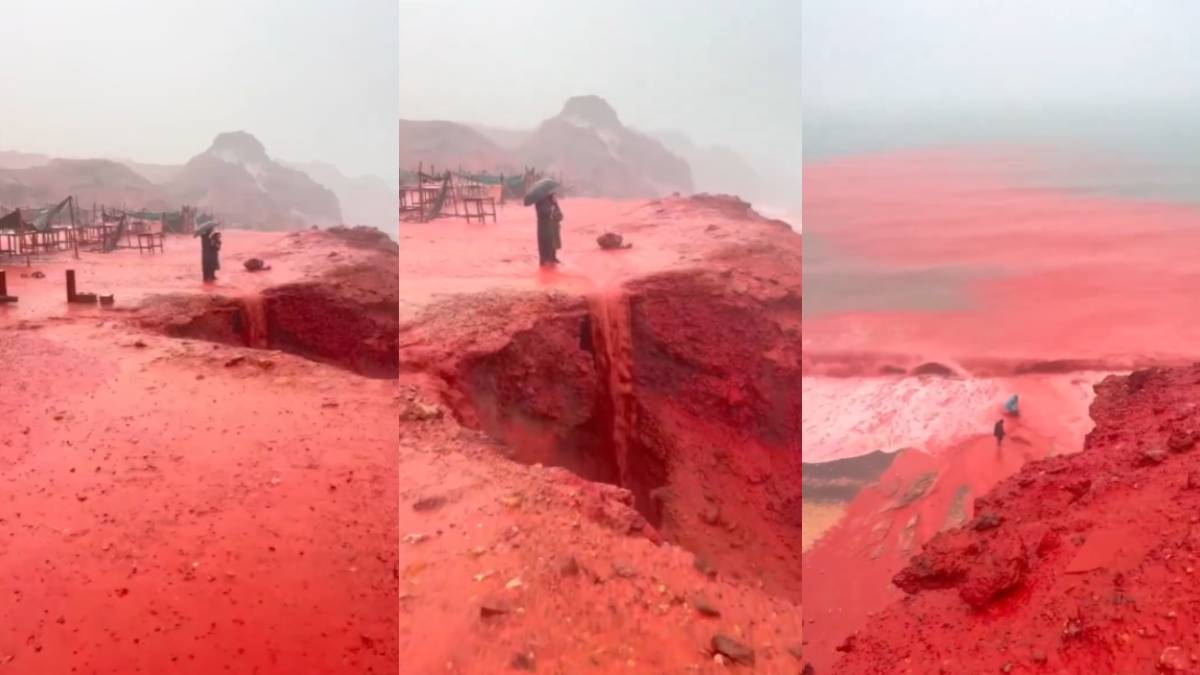
Hormuz Island, located in the Persian Gulf near the Strait of Hormuz, is already famous for its colourful landscapes and mineral‑rich soil. It is often called the “Rainbow Island” because of its red, yellow, and orange hills. After the recent heavy rains, the island once again displayed one of its most striking natural wonders the red sea effect, where rainwater mixes with iron rich soil and flows into the ocean, turning the water bright red.
Why the Sea Turned Red
The soil of Hormuz Island contains a very high amount of iron oxide, especially a mineral called hematite, which gives the soil its natural red colour. When heavy rain falls:
- Rainwater flows through the iron rich hills.
- The water picks up red soil and minerals.
- This mixture flows into the sea.
- The sea water turns rust red or deep crimson.
Scientists confirm that this is the same process that gives the island its famous red beaches and colourful cliffs.
This red colour may look scary or dangerous, but experts say it is completely safe. The iron‑rich soil does not harm humans or marine life, and the colour fades naturally as the water settles.
A Natural Wonder, Not a Warning
Many people online compared the scene to “blood rain” or a disaster, but researchers quickly clarified that this is a normal geological event. Hormuz Island experiences this phenomenon often after heavy rainfall, and it has been studied for years by geologists and environmental scientists.
The island’s red soil is even used traditionally as a natural pigment in local art and food, showing how deeply it is connected to the region’s culture.
A Reminder of Nature’s Beauty
The red‑coloured coastline has once again drawn global attention to Hormuz Island’s unique natural beauty. Tourists, photographers, and nature lovers see it as a reminder of how extraordinary Earth’s landscapes can be. While the visuals may appear dramatic, the science behind them is simple and completely harmless.