The decision of India’s representative to remain in the United Nations General Assembly hall during Israeli Prime Minister Benjamin Netanyahu’s speech on September 24, 2026, has created a heated debate on social media in India.
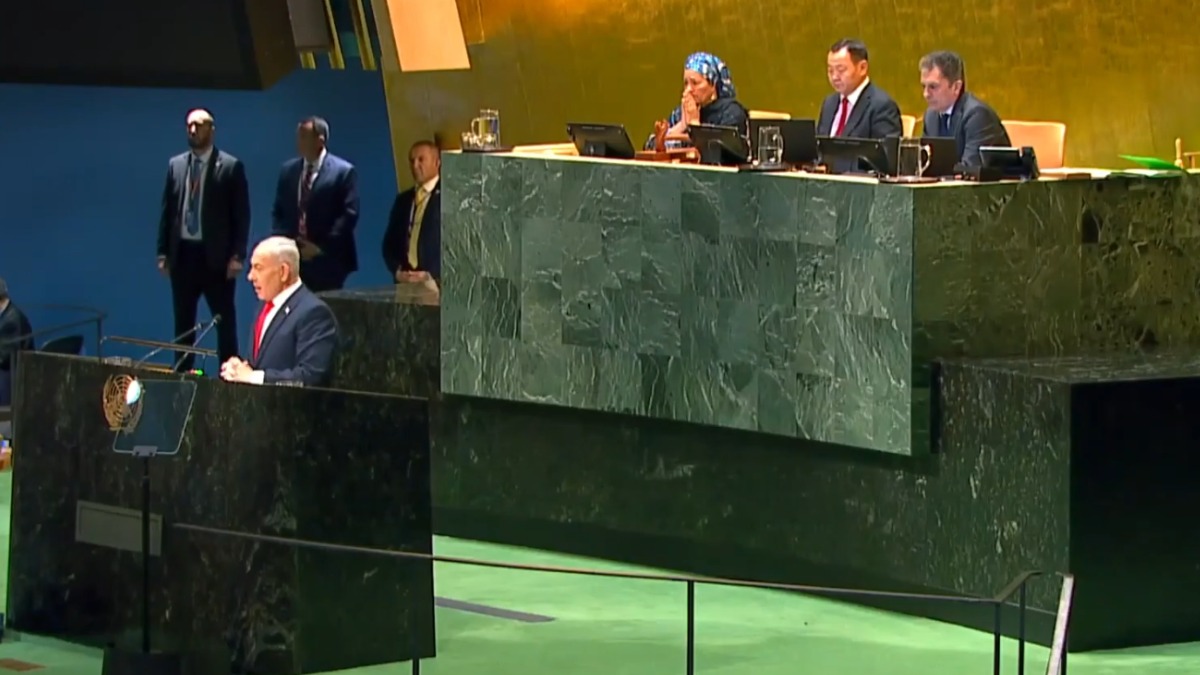
As Netanyahu began his speech at the 81st UN General Assembly in New York, dozens of diplomatic delegations walked out of the chamber. The walkout was widely interpreted as a protest against Israel’s policies and military actions. Almost all delegates walked out of the room as Netanyahu began speaking, Reuters reported.
India’s reported decision to remain in the hall has since drawn criticism and appreciation from Indian social-media users.
Why Some Indians Criticised India
One section of online users criticised India for staying during Netanyahu’s address.
Their argument was that the walkout was a symbolic statement of opposition to Israel’s actions and that India should have joined other countries in leaving the chamber.
Some social media users said India’s decision was disappointing and asked why the Indian representative remained while many of the other delegations walked out of the meeting.
For these critics, staying in the hall could be interpreted as sending a different diplomatic signal at a time when Israel’s actions in Gaza and the wider region remain highly controversial.
However, these are not official opinions but online opinions about India’s foreign policy.
Others Applaud India’s Decision
Another section of Indian social-media users defended the decision to stay.
They argued that “remaining in the hall does not automatically mean supporting everything Netanyahu said.” From this perspective, listening to another country’s leader and maintaining diplomatic engagement can be different from endorsing that leader’s policies.
Supporters also noted that India has been in diplomatic relationships with countries on opposite sides of major international disputes before.
For these users, the decision represented an approach based on maintaining diplomatic space rather than participating in a symbolic walkout.
The Debate Is About Diplomacy
The contrasting responses also highlight a more general question of how countries should respond in highly polarised international events.
A walkout is a diplomatic signal. The Indian Express states that walkouts at the UN are generally symbolic acts of protest rather than formal UN procedures.
At the same time, staying inside the chamber can also allow a delegation to hear another country's position directly.
Thus, India's presence should not be taken as an endorsement of Netanyahu's entire speech.
#WATCH | New York | Israeli Prime Minister Benjamin Netanyahu says, "...Devastating Iran's nuclear facilities was hard. It was very hard to do. But for me, it was one of the easiest decisions I've ever had to make as prime minister. Because if we hadn't done it, we'd all be dead.… pic.twitter.com/Es8hk1nQZd
— ANI (@ANI) September 24, 2026
No Official List of Who Stayed
There is also an important verification point.
Although photographs and video footage can show which seats were occupied or empty, **there was no official UN country-by-country list confirming every delegation that walked out or remained**.
LiveMint reported that no official list of countries that walked out was available.
Therefore, claims about India's presence should be framed carefully as being based on available footage and reports rather than an official UN attendance record.
Two Strong Reactions From Indian Social Media
The episode has effectively produced two competing interpretations.
Critics see India’s decision to stay as a missed opportunity to make a stronger symbolic statement.
Supporters see it as a sign of diplomatic independence, that India can listen to all sides without automatically endorsing them.
Neither social-media reaction should be framed as representing Indians as a whole. The discussion instead shows how one diplomatic decision can produce very different interpretations among Indian users.
The incident finally puts India’s diplomacy under the spotlight, and the debate extends beyond Netanyahu's speech to a larger question: Should diplomacy focus on symbolic protest, continued engagement, or a combination of both?