NASA's James Webb Space Telescope (JWST) has provided a new view of the FS Tau star system that has revealed baby stars, glowing streams of gas and many distant galaxies that had been shrouded in deep clouds of cosmic dust.
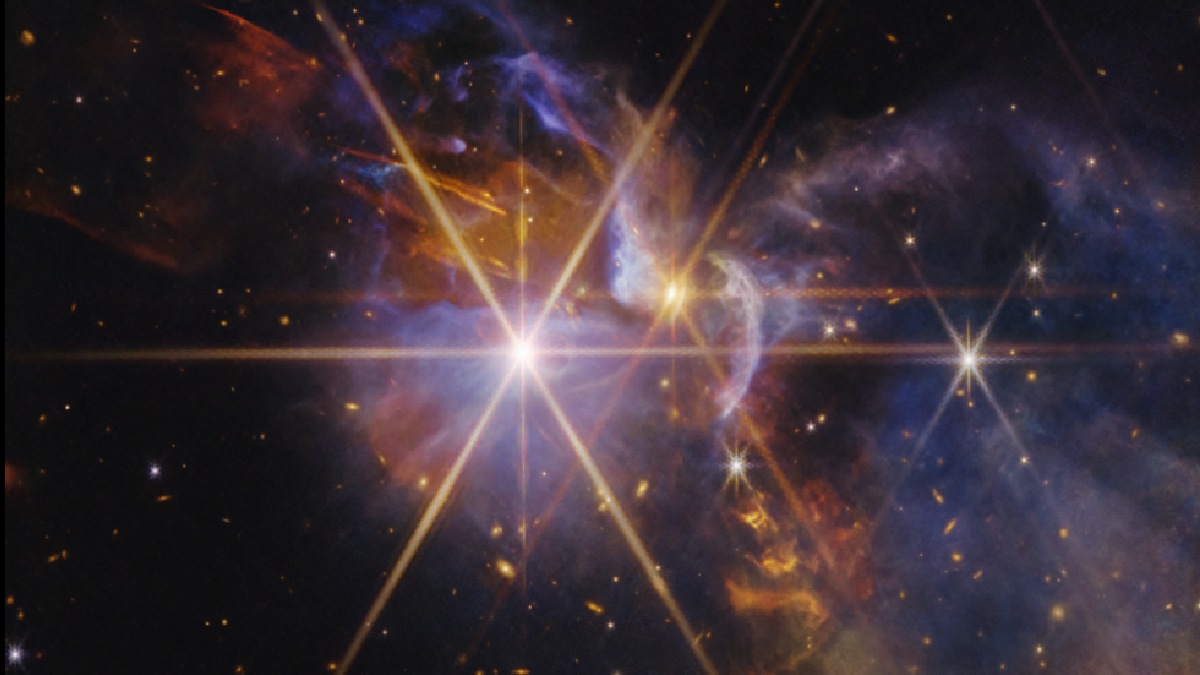
Webb was able to peer through the dense dust around the star forming region and detect details not seen with the earlier telescopes. The new image from the young FS Tau system not only shows the young FS Tau system visible, but also a large number of background galaxies and several protostars (newly formed stars which are still in their infancy).
The protostars in the FS Tau region are estimated to be between 1 million and 3 million years old, making them extremely young by cosmic standards. By comparison, our Sun is about 4.6 billion years old.
Because we know low-mass stars are less energetic than massive stars in contrast, they produce less powerful stellar wind and thus much less damage to the background environment. We can observe the formation process in more detail.
One of the most striking objects in the image is FS Tau A, a pair of protostars that are slightly left of the centre. Together, they have about half the mass of the Sun and produce the largest diffraction pattern of the image. Nearby we see FS Tau B, another young protostar that appears with an orange diffraction pattern and might be responsible for spectacular outflows of gas visible throughout the image.
As FS Tau B continues to gather surrounding dust and gas in its accretion disk, it simultaneously ejects some of it back into space. These energetic outflows are clearly visible as vivid orange and red wisps and larger streams may arise from interactions between the protostar's magnetic field and superheated material that is orbiting close by.
One of Webb’s most crucial discoveries was to see big gaps between these outflows. Scientists believe these gaps provide strong evidence that protostars don’t grow continuously but accumulate material in bursts or episodes. During these active growth phases, the young stars expel jets of hot gas before settling into relatively quiet periods.
The telescope also captured spectacular light-blue ridges of dust and gas surrounding FS Tau B. Scientists believe that these structures were formed when powerful outflows from the protostar compressed nearby material and that the bright image is the result of reflected light from the young star itself.
Apart from the protostars, Webb's extraordinary sensitivity has revealed a rich network of dust clouds, gas structures and distant galaxies. The different colours of the image help astronomers to map the distribution of cosmic dust.
Redder galaxies are visible behind thicker dust because shorter blue wavelengths are scattered and absorbed, while longer red wavelengths penetrate more easily. Yellow galaxies appear through less dust, and the few bright white stars visible are most likely much closer foreground stars in our own galaxy.
The latest findings are also a further demonstration of the capabilities of the James Webb Space Telescope, the most advanced space telescope in the world. NASA, ESA, and CSA jointly run Webb, which will be used to make new discoveries in science and will help us study astrophysics in the next few decades; we are looking for evidence of distant galaxies, exoplanets, star formation, and the origins of cosmic structures.
The new FS Tau image is one of the most accurate images of how stars such as our own Sun begin their journey and it really gives astronomers a window into the earliest stages of stellar evolution and how it is going to shape our universe.