NASA's new James Webb Space Telescope has also taken the first look at the lion's eye view of the Lion Nebula, allowing astronomers to get closer to the star's final phase when a star is dying. At over 6,000 light-years from Earth, the lion-like cloud of gas and dust is quite a picture of the face of a lion and has fascinated astronomers for years.
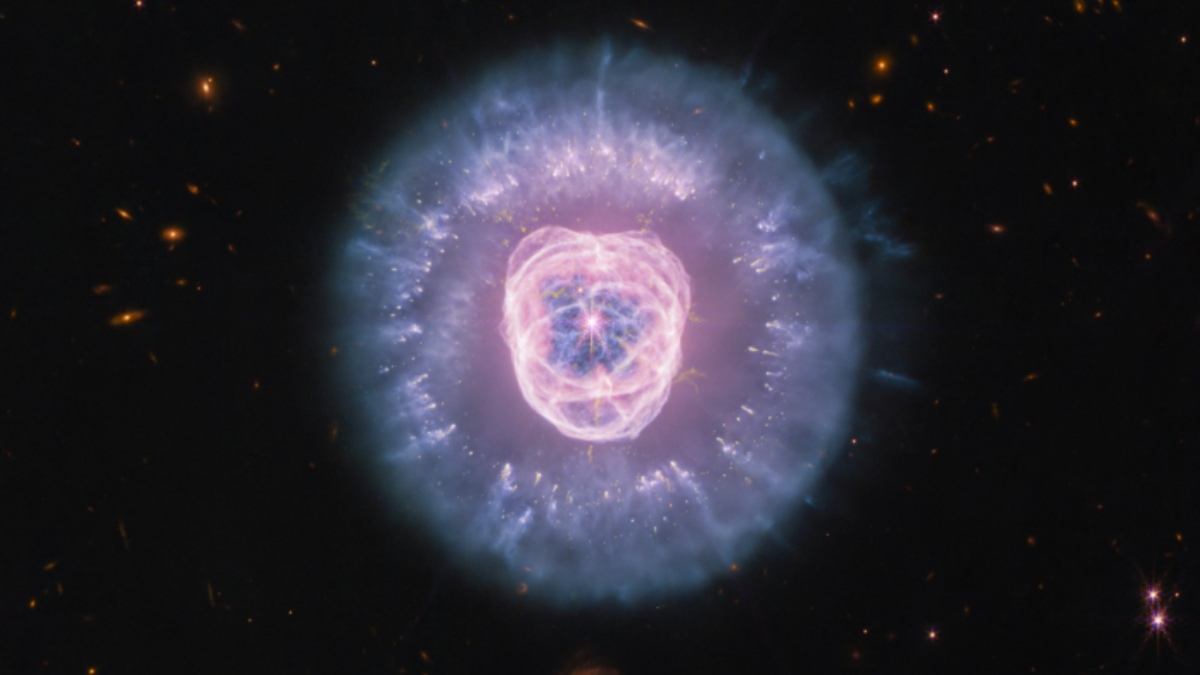
NGC 2392 is the nebula officially. It is a planetary nebula, and that is confusing because it has nothing to do with planets. The name was coined by early astronomers who thought these objects looked like planets when viewed through older telescopes.
At the center of the Lion Nebula are the remains of the star that created it. The star has already pushed away its outer layers, leaving behind a very hot and dense core called a white dwarf. Webb's new observations reveal the material around this dying star in much greater detail.
The image is not just a beautiful picture of space. Scientists also now have an opportunity to see how stars like our Sun undergo change as they die.
A Star's Final Chapter
Stars don’t live forever. A star like our Sun will produce billions of years of energy, but eventually run out of the fuel required for it to live in its normal life. As it gets older, it changes and becomes much larger. In the last stages, it begins to lose its outer layers.
That is what happened to the star at the center of NGC 2392.
The material thrown out by the star does not disappear. It spreads out into space and forms the glowing cloud which we now see as the Lion Nebula. The hot core left behind continues to send out energy, lighting up the surrounding gas.
In infrared light, the James Webb Space Telescope was able to study the nebula. This is important because infrared observations can disclose details that may be difficult to see in visible light. Webb used two of its powerful instruments, NIRCam and MIRI, to observe the nebula.
The new observations reveal that the cloud around the star is much more complicated than one would see from the surface. There are layers, clumps, and patterns of gas and dust flying around the central star.
The Lion Nebula had been previously photographed by NASA’s Hubble Space Telescope. The images of it previously showed the object as a lion-like shape. Webb's data provide new insight, and the material around the star is more detailed.
The central white dwarf is an important part of the structure. The original star is at the end of its life, but its story is still being told. The material it releases is still moving out widely in space.
The Cosmic Lion Will Not Last Forever
The Lion Nebula is such a beautiful place that its beauty is temporary. The gas and dust surrounding the star will continue to be distributed into space. The nebula will thin out and eventually disappear over thousands of years.
We estimate that a planetary nebula like NGC 2392 can be visible for only a relatively short time compared with the life of its parent star. This star could have been visible for billions of years while the visible nebula is just a small part of its final journey.
This makes the James Webb image so valuable. It captures a brief period of a star’s life, and scientists get to study a process that will eventually happen to many stars throughout the universe.
The Lion Nebula also tells scientists what could happen to stars similar to our Sun in the distant future. Our Sun isn’t expected to reach this stage for billions of years, but studying stars that are already going through the process helps scientists understand what the future may look like.
There is something more happening besides the death of the star. The gas and other material released into space can eventually become part of future cosmic systems. The material from older stars contributes to the wider supply of elements from which new stars, planets, and other objects can form.
So death is not just an ending for a star. It is also a piece of the universe’s cycle.
The Lion Nebula looks like a gigantic lion floating peacefully in space, but it is actually a cloud that transforms and changes as a dying star dies. Webb’s powerful instruments have allowed astronomers to see this process in such a way that it’s very different from the ones we have ever seen.
For human beings on Earth, the picture offers a very beautiful glimpse of a universe that is thousands of light-years away. For scientists, it is far more than a beautiful space picture. It’s a great opportunity to see how stars change, how they lose their outer layers, and leave behind a white dwarf.
The cosmic lion will eventually disappear as its gas and dust spread into space. But for now, the James Webb Space Telescope has taken a picture of this amazing part of a star’s last journey, and we’re in a beautiful and rare window into a stellar farewell.