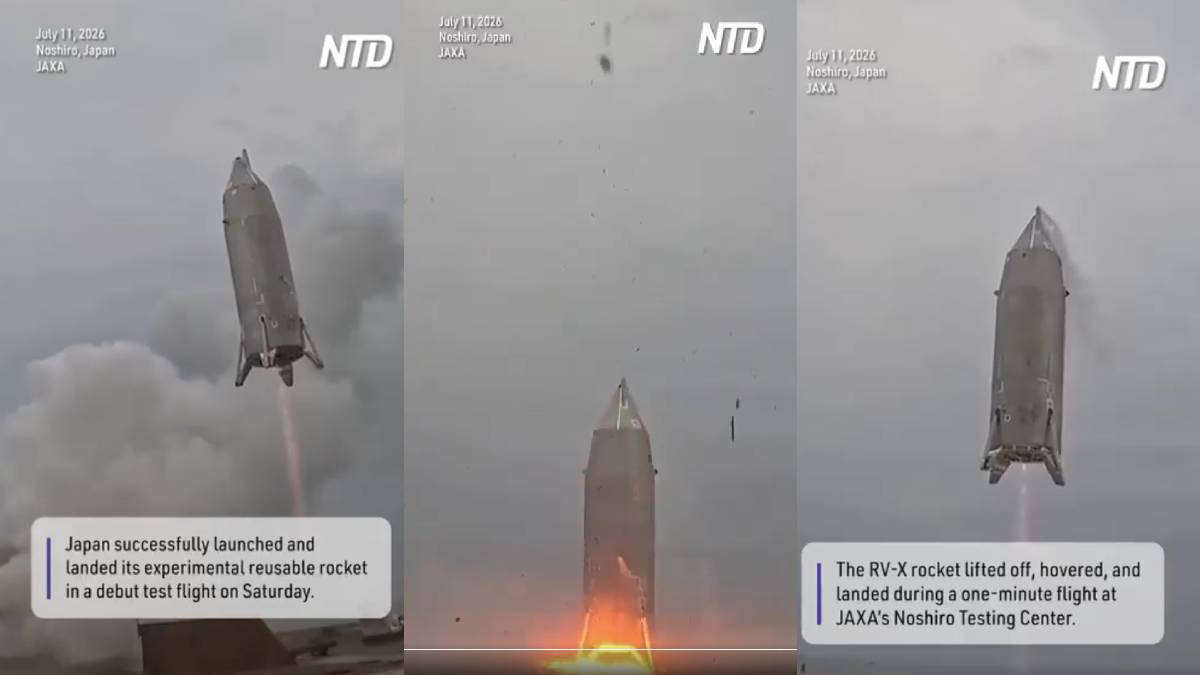
Japan has made a huge leap in space technology as one of the countries developing reusable rockets. The successful vertical landing of a new space rocket prototype is a huge step for the country’s commercial aerospace industry, and it is in line with competing in an age of space-based innovation.
Reusable rockets are one of the most important developments of modern spaceflight. Unlike traditional launch vehicles that can be discarded after a single mission, reusable rockets can return to Earth, undergo refurbishment, and be launched again, which would result in a much lower launch cost and therefore more frequent and sustainable missions.
Japan Joins the Reusable Rocket Club! 🚀
— Black Hole (@konstructivizm) July 15, 2026
In a milestone that could reshape Asia’s space ambitions, Japan’s experimental RV-X reusable rocket successfully blasted off, hovered, maneuvered horizontally, and landed safely during its very first test flight on Saturday.
The short… pic.twitter.com/1aP3NjbPRj
Japan’s success as an aerospace engineering player will show that Japan can lead and will contribute to the commercial space economy. With a practice of reusable launch technology in the future, Japan will have more access to space for satellite deployment, scientific research, and other exploratory research.
The successful test involved the rocket ascending vertically in a controlled manner before landing on the ground with precision navigation and propulsion systems. In landings such as this one, computers need to be ready to rapidly adjust in the descent to assure stability and accuracy.
Until now, only a handful of companies and countries have pioneered reusable rocket technology, and many of them have been pioneers in reusable rocket technology. Successful recoveries have brought down the cost of launching payloads into space. Japan’s achievement shows that it is determined to become an important player in a very competitive sector.
The global demand for satellite launches is increasing as governments and private firms are developing constellations for communications, navigation, Earth observation, climate monitoring, and defense. The lower launch costs of reusable rockets made possible by reusable rockets will help to accelerate this industry and make space more accessible to potential commercial operators.
Japan has a reputation for science, robotics, precision manufacturing, and aerospace engineering. The country’s space program has been behind many scientific missions, asteroid sample return efforts and satellite technology. Reusable launch vehicles are the next step in developing this field.
Reusable rockets not only have commercial opportunities, but they also provide environmental and operational benefits. Rather than building a new launch vehicle for each mission, instead of building new rockets, reusing the components of rockets would save on the production costs and save time to prepare them, save resources, and reduce the launch time.
The achievement might also spur Japan's space startup ecosystem. Investor interest in private aerospace ventures is leading to new launch systems, satellites, and space services. Successful reusable rocket demonstrations will therefore attract more investment and international partnerships.
With the increasing competition in the global space economy, countries are more reliant on reusable launch technologies for strategic independence and to support the development of satellites. Japan’s progress puts it alongside other leading spacefaring nations that have access to space at a low cost and in a sustainable way.
Reusable rockets will play an important role in future lunar missions, deep space exploration, space tourism, and launching new satellite networks, industry experts believe. Testing and development of the technology will take time for commercial orbital rockets to be ready for commercial launch, and more refinement will be necessary, but Japan's successful launch shows that Japan is well on the way to that goal.
With that successful landing, Japan has entered the reusable rocket era and is now a world leader in aerospace technology. Development of advanced launch systems for commercial space and the growing global space economy is going to be even more important for Japan as it goes to develop its advanced technology.