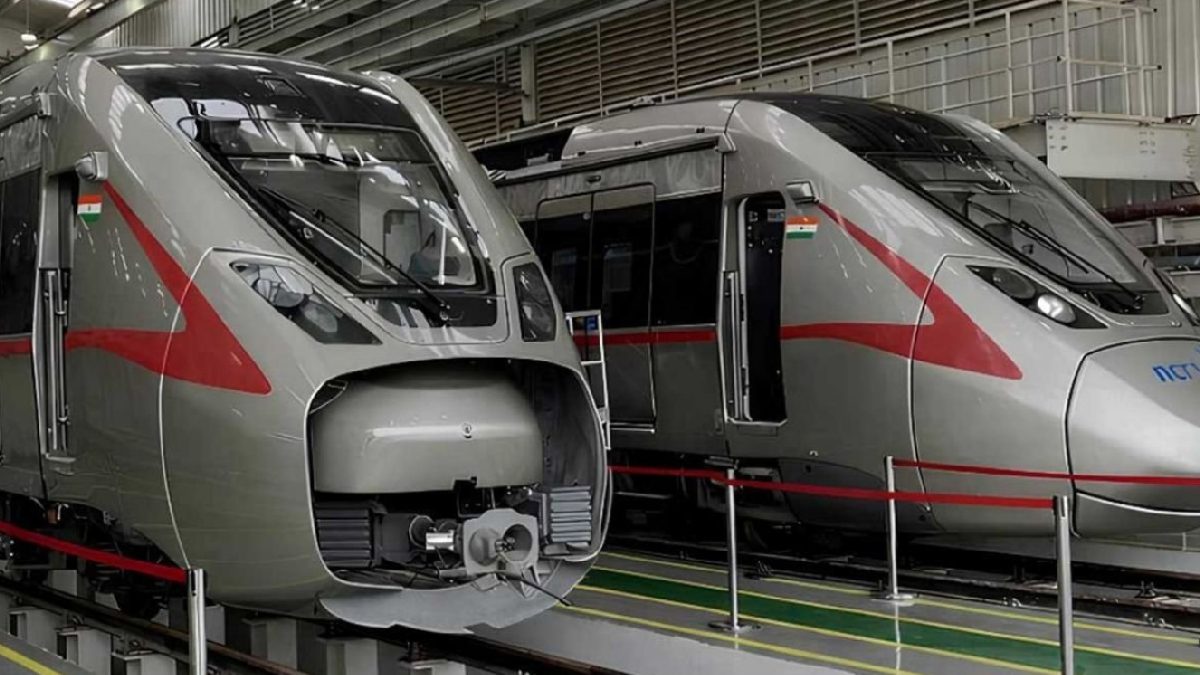
Namo Bharat train has already revolutionized regional travel by reducing journey times between Delhi, Ghaziabad and Meerut. Now the high-speed regional rail network is set for a major expansion which, at this stage, could take it all the way to the foothills of the Himalayas.
The Centre has in principle approved to extend the Delhi-Meerut Regional Rapid Transit System (RRTS) from Modipuram in Meerut to Haridwar and Rishikesh. The proposed 150-kilometre corridor will connect two of India’s major pilgrimage centers with India’s fast-paced regional railway network and promises greater speed of travel, better connectivity and new economic opportunities.
Although the project is still in the planning stage, officials have already started work on a Detailed Project Report (DPR), which will determine the final route, station locations, engineering design and project cost.
A minor step towards Greater Regional Connectivity
The proposal gained momentum after Uttarakhand Chief Minister Pushkar Singh Dhami repeatedly raised the issue with Prime Minister Narendra Modi and Union Housing and Urban Affairs Minister Manohar Lal Khattar.
After these discussions, the Centre agreed in principle to move the project forward.
The governments of Uttar Pradesh and Uttarakhand along with the National Capital Region Transport Corporation (NCRTC) have also agreed to jointly develop the project. Uttarakhand has appointed Additional Secretary Reena Joshi as the nodal officer for coordination, while the NCRTC and Uttar Pradesh are also involved in the planning process.
The DPR survey is currently underway and only after it has been completed will the final cost estimates and construction timeline be announced.
Proposed Route
The proposed extension will start from Modipuram, which is the northern terminal of the implemented Delhi-Meerut Namo Bharat corridor.
From there, the line is expected to pass through:
Daurala, Khatauli, Muzaffarnagar, Purkazi.
After crossing into Uttarakhand, the corridor is proposed to continue through:
Roorkee, Haridwar, Rishikesh (near Laxman Jhula).
According to the government, about 72 km of the corridor will lie in Uttar Pradesh and the remaining 78 km will be through Uttarakhand.
When integrated with the existing Delhi-Meerut corridor, passengers from Haridwar and Rishikesh will be able to travel directly to Ghaziabad, Anand Vihar and Sarai Kale Khan without changing trains.
Future interchange stations could also connect the corridor to the proposed Delhi-Panipat and Ghaziabad-Noida International Airport RRTS routes.
Travel Time Could be almost halved
We expect travel time to be significantly reduced as a result of the extension.
Currently, travelling from Delhi to Rishikesh by road usually takes five to six hours, depending on the traffic condition along National Highway 58.
Namo Bharat trains can run at speeds of up to 160 kmph and reduce the journey time to 2.5 to 3 hours.
The faster connection would benefit passengers in large parts of the world including:
Pilgrims visiting Haridwar and Rishikesh, business travellers making same-day trips, weekend tourists from Delhi-NCR, daily commuters travelling between western Uttar Pradesh and the National Capital Region. Investment Worth Thousands of Crores
The final cost of the extension has not yet been announced because it will depend on the DPR findings.
For comparison, the existing 82.15-km Delhi-Ghaziabad-Meerut RRTS corridor was constructed at an estimated cost of around ₹30,274 crore, funded jointly by the Centre, state governments and multilateral financial institutions such as the Asian Development Bank (ADB), Asian Infrastructure Investment Bank (AIIB) and New Development Bank (NDB).
As the proposed Haridwar-Rishikesh extension is nearly twice as long, experts expect the project cost to run into tens of thousands of crores.
More than a Rail Project
And there are experts who say the corridor could be more than passenger travel.
Improved connectivity is expected to drive industrial growth, logistics, tourism and real estate development in western Uttar Pradesh and Uttarakhand.
Modipuram can become a major transport hub, Muzaffarnagar might see new warehousing and logistics investments. Roorkee, home of IIT Roorkee, should see increased student housing and rental properties.
Haridwar and Rishikesh will also see growing interest from investors who are looking to build hotels, serviced apartments, holiday homes and rental villas for tourists and pilgrims.
Lohia WorldSpace’s Managing Director Pyush Lohia believes that the biggest impact might actually be on industry rather than tourism.
He thinks that faster connectivity would reduce travel time for exporters, traders and logistics operators, making movement between industrial centres, warehouses and markets much more efficient. Boost for Tourism and Pilgrimage.
Haridwar and Rishikesh attract millions of visitors every year, including pilgrims, yoga lovers, adventure tourists and Char Dham travellers.
During the Kumbh Mela and the Char Dham pilgrimage season, roads leading to these cities are frequently crowded. The high-speed rail link might provide a reliable solution: less traffic on highways and quicker, safer and more predictable transportation.
The project will also be crucial for the so-called “Ganga Growth Corridor” as it will help improve regional mobility and economic ties between Delhi-NCR, western Uttar Pradesh and Uttarakhand.
If the DPR is finally approved it will be one of the most important transport infrastructure projects in North India and change the way people travel but also the economic landscape of the region for decades to come.