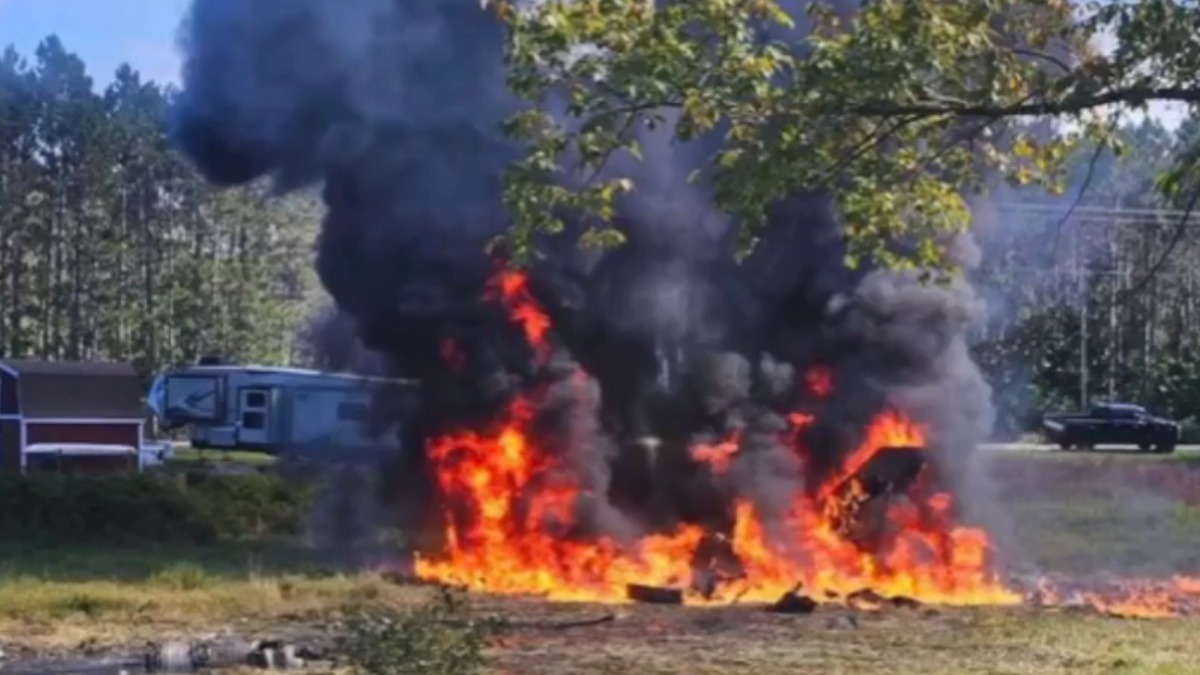
A U.S. military F-16 Fighting Falcon crashed in Michigan during a routine training mission and led to an emergency response and evacuation order in the surrounding area. The pilot ejected from the aircraft before it crashed and was transported to a local hospital for treatment; the fighter jet was on the 149th Fighter Wing of the Texas Air National Guard, said the unit.
The incident occurred near Traverse City, just outside Traverse City, where the aircraft was in a scheduled training exercise at a National Guard base in Alpena, located 305 kilometres north of Detroit. Law enforcement and emergency officials quickly rushed to secure the area after the plane fell, and emergency officials warned residents about the ongoing response, authorities said.
The Texas Air National Guard confirmed that an F-16 Fighting Falcon assigned to the 149th Fighter Wing had crashed during a routine training mission. Military officials did not give any details about what happened. They also declined to identify the pilot or give any information about the pilot’s medical condition, which was governed by military policy.
The aircraft was able to eject the pilot before the aircraft crashed to earth; the pilot was able to escape from the cockpit and was taken to the hospital for evaluation and treatment.
Following the crash, Grand Traverse County Emergency Management announced that an evacuation order was in effect because of the aircraft accident. Emergency officials appealed for residents to heed the warning order as officials studied the crash site and decided whether additional safety measures were required.
Michigan Senator Gary Peters also confirmed it, saying he was aware of the plane crash near Traverse City and was in the process of monitoring the situation while officials were looking into the situation further. The crash attracted much attention from the people in the area because there was a strong noise heard around the time the fighter jet crashed, people said.
Local resident Wendy Sobeck described hearing what she thought was a major accident near her rural home. She and her husband also saw a massive dark smoke column, and she drove her husband over the area and saw aircraft debris in a field. After the first crash, she also heard more explosions, Sobeck said. Emergency workers and officials then took care of the situation and kept the area secure.
The F-16 Fighting Falcon is one of the most widely operated fighter aircraft in the US military and has been used for decades in air-combat, training, and other missions. The US military began operating F-16 fighter jets in 1979. The aircraft is a single-engine, multirole fighter designed for a wide range of missions and has also been widely adopted by allies.
Aircraft accidents involving military fighters are investigated to determine what happened and whether mechanical, operational, environmental, or other factors contributed to an incident. The aircraft, flight data, maintenance records, pilot information, and other evidence are generally examined as part of the process.
Data from the US Air Force Safety Center has previously indicated several serious F-16 incidents. A Class A mishap is generally used by the US military for the most serious types of accidents, including the destruction of an aircraft, a fatality, or damage of a high magnitude. It is reported that at least 14 Class A mishaps involving F-16 aircraft have taken place since 2000.
The Michigan crash is still being investigated by military officials and could have been caused by the training flight. Authorities will also investigate the crash site where they plan to visit and work with local emergency agencies, the military said.
The incident has once again highlighted the risks associated with military flight training, where pilots regularly fly high-performance aircraft in difficult conditions. For the people living in military training areas, the crash also underscored the need for emergency preparedness and coordination between military installations and local authorities.
✈️ F-16 fighter jet crashes during training exercise in northern Michigan, pilot in stable condition
— Steve Gruber (@stevegrubershow) September 17, 2026
The plane was participating in training exercises at a National Guard Base in Alpena, Michigan.
The crash was in Blair Township, which is southwest of Traverse City in Grand… pic.twitter.com/hofaE3qXqE
As investigators continue to investigate, any additional details about the aircraft, training mission, the pilot’s condition, and the circumstances surrounding the crash may be released by military or local officials. As of now, authorities have confirmed that the pilot ejected safely and that emergency teams responded to the F-16 crash in Michigan.