If an earthquake strikes anywhere in the world, Japan gets the attention of the world. Japan is known for having the strongest and most frequent earthquakes. It is less than 0.25 percent of the landmass of the planet but it experiences almost 20% of the world’s earthquakes of magnitude 6.0 or more. The mass of earthquakes is not a coincidence but an order from the natural world.
Unlike most earthquake-prone countries where the boundary between two tectonic plates is located, Japan is situated at the intersection of four major tectonic plates, Pacific Plate, Philippine Sea Plate, Eurasian Plate and North American Plate. These huge stretches of Earth's crust move in both directions and become one of the most complex and active seismic zones on the planet.
The Pacific Plate, one of the fastest-moving oceanic plates, pushes westward and is forced under Japan in a process called subduction while the Philippine Sea Plate moves from south under part of the Japanese archipelago. Eurasian and North American plates are being driven from all directions. This constant collision, grinding and locking of plates creates stress that grows deep beneath the Earth’s surface.
The Pacific Plate moves at an estimated 8 to 10 centimetres per year, which is extremely fast in geological terms. But the movement is not smooth. The plates are locked because of friction and huge amounts of energy accumulate over decades or even centuries.
The pressure is too high at a point. When the rocks are not able to withstand the stress any more and suddenly slip, they release massive amounts of energy in the form of an earthquake. This creates megathrust earthquakes, among the most powerful natural events on Earth.
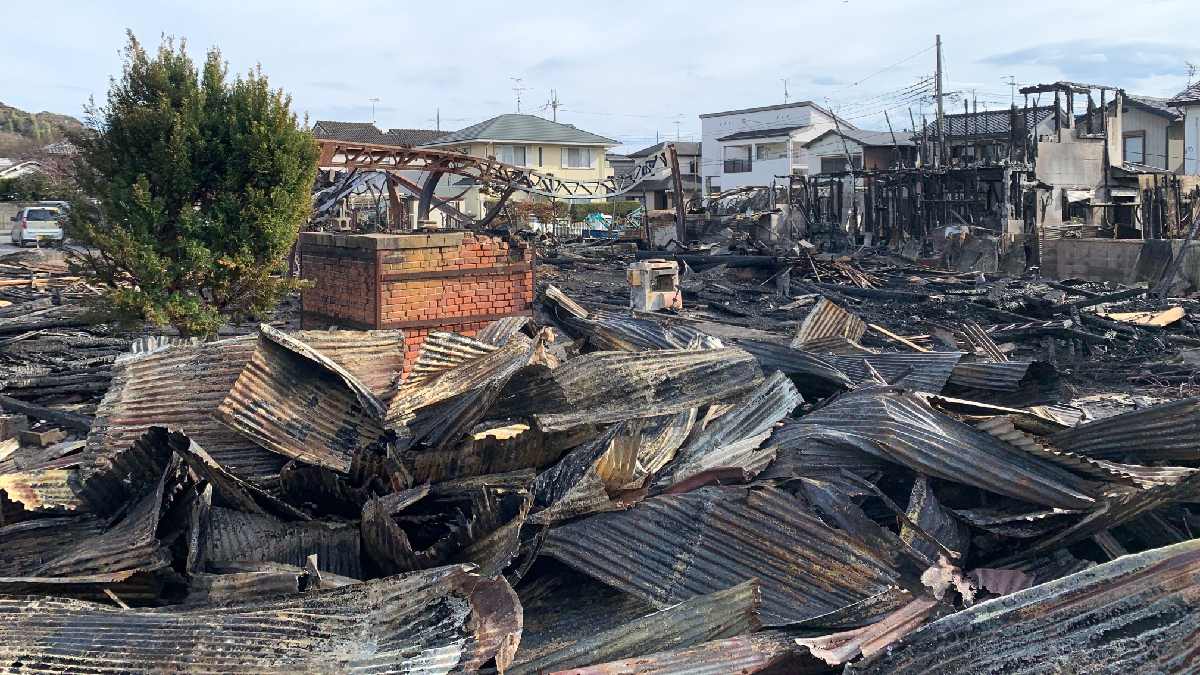
The most devastating example was the 2011 Tohoku earthquake, a magnitude 9.0 earthquake that struck on the northeast coast of Japan. It created a tsunami, killed nearly 20,000 people and caused the Fukushima Daiichi nuclear disaster. Scientists discovered parts of Japan’s main island Honshu had moved nearly four metres eastward from the earthquake because of the huge force that had been released.
Researchers drilled deep under the seafloor at the rupture zone after and found an unusual factor that may explain why earthquakes like these can be so powerful in Japan. They found layers of very weak, clay-rich sediments around parts of the fault. That so-called “slippery clay” can enable faults to move much further once they break apart, which in turn increases both the magnitude of the earthquake and the size of the resulting tsunami.
Japan is also situated in the 'Pacific Ring of Fire', a horseshoe-shaped belt around the Pacific Ocean, where nearly 90% of the world’s earthquakes and about 75% of active volcanoes are located. It is also one of the most vulnerable countries due to its strong tectonic activity.
Even under constant earthquake threat, Japan is one of the world leaders in earthquake preparedness. The earthquake threat has been reduced by strict building regulations, earthquake-resistant building design, advanced early warning systems and national disaster drills in every state of Japan every single year. High-speed trains stop when seismic waves are detected and smartphone and television networks send alerts seconds before strong shaking starts.
While earthquakes can’t be avoided, Japan has shown that science, engineering and preparedness can dramatically reduce their impact on disasters. And in so many places in the geological history of this country, earthquakes are always present, but decades of innovation have made Japan one of the world’s most resilient countries in the face of nature’s strength.