A seventh-grade student from California has won national recognition for a research project that explores whether sound may help extract more water from humid air. Ankith Burki, a student at BASIS Independent Silicon Valley in San Jose, is one of 30 finalists for the 2026 Thermo Fisher Scientific Junior Innovators Challenge.
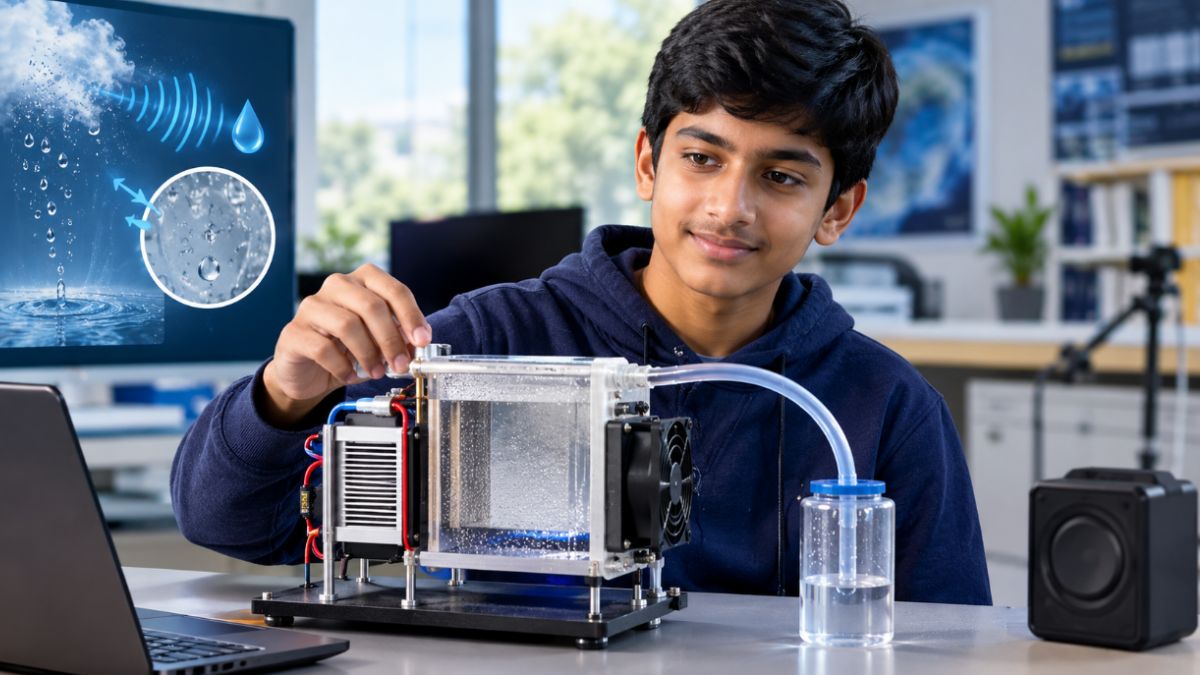
Ankith’s work is based on an atmospheric water generator that takes moisture from the air and transforms it into water. Although the idea is already being explored as a possibility to generate water in regions with few sources of water, the young researcher wanted to know if low-frequency sound would help the process work better.
His work Investigating the Effect of Low-Frequency Sound in Enhancing the Efficiency of Water Generation in Thermoelectric Atmospheric Water Generators combines atmospheric water production and an unusual approach involving sound waves.
Ankith Burki's Water-From-Air Experiment
Ankith’s work started with a simple question: If air contains water vapour, does that moisture need to be collected efficiently enough to produce useful quantities of water?
To explore the idea, he built an atmospheric water generator based on the Peltier effect. A thermoelectric device based on this principle can transfer heat from one side to another when electricity is applied, so one surface gets cold.
The cooling process is important because atmospheric water generators are based on condensation. When humid air is cooled below its dew point, water vapour starts to form liquid droplets. The droplets can be collected as water.
During his experiments, Ankith's prototype was able to reduce the surrounding temperature by about 7.5 degrees Celsius. This allowed the air to reach conditions in which condensation could occur and was a way to measure the amount of water produced by the machine.
But Ankith didn’t stop after successfully generating water; instead, after generating water, Ankith looked for something that could improve the collection process.
How Sound Became Part Of The Experiment
The next stage of the project was a speaker placed near the atmospheric water generator. Ankith wanted to know whether low-frequency sound waves might affect the behaviour of tiny water droplets produced during condensation.
His hypothesis was that sound-induced vibrations could potentially stimulate smaller droplets to merge into larger ones. If droplets merged into larger ones, they might be easier to collect, so that the system could collect more water.
To test the idea, Ankith conducted a series of four-hour experiments under controlled conditions. Five trials were carried out without sound, providing a baseline against which the sound-assisted experiments could be compared.
He then conducted 10 more trials using low-frequency sound. He did sine waves and triangle waves in the experiments to compare different types of sound.
Sine Waves Produced The Strongest Result
The results of Ankith's experiment showed the clearest increase when low-frequency sine waves were used. According to his project results, the atmospheric water generator collected 117 per cent more water under the low-frequency sine-wave condition than it did during the silent trials.
The result is significant in his experiment because sound may affect the behaviour of condensed water droplets and potentially improve collection efficiency.
But that doesn't mean that atmospheric water generators can produce twice as much water in every environment. The experiment was done using Ankith's prototype and conditions, and more work would be needed to see whether the result can be reproduced in a different machine, humidity level, and operating environment.
This distinction is important in thinking about whether this technology, for example, would eventually be used at a larger scale.
From School Project To National STEM Competition
Ankith’s research has now taken him well beyond the classroom. His project has earned him a place among the 30 finalists of the 2026 Thermo Fisher Scientific Junior Innovators Challenge.
The finalists will meet up and attend from October 23 to 28 in Washington, DC. They will present their research and participate in team competitions.
All finalists are to receive $500 each, and the competition will award more than $100,000 in prizes. Ankith is among a group of young students whose research projects are being recognised at a national level.
As for a seventh-grade student, reaching the final stage also highlights the role that curiosity and experimentation can play in introducing younger students to scientific research.
Ankith's Interest Goes Beyond Science
Ankith doesn't only have engineering and environmental studies interests. He is also a singer trained in Indian Carnatic classical music.
The connection between his musical background and his science project is so interesting as sound is key to the experiment. Music and atmospheric water generation are very different fields, but Ankith has investigated sound in two ways: as a form of musical performance and as a physical phenomenon that could potentially influence a scientific process.
He also aims to become an environmental engineer in his profile with the Society for Science. He also wants to create scientific solutions that can be available to the least privileged people.
That goal gives his atmospheric water research a wider context. The project does not seek to win a competition just so it focuses on a technology that could be used in areas where access to reliable water is difficult.
Can Atmospheric Water Generation Help Address Water Scarcity?
Atmospheric water generators are not a substitute for water infrastructure, but an alternative way of accessing moisture that is already present in the atmosphere. Their effectiveness depends greatly on humidity, temperature, energy consumption, and the efficiency of the condensation system.
The way to improve the amount of water collected without exponentially increasing energy use is therefore a major challenge. If Ankith's findings can be replicated and further developed via further work, the use of low-frequency sound could be an area worth investigating in atmospheric water-generation technologies.
For now, his research is still an experimental early-stage work and not a solution to the global water crisis. But it is an opportunity to see how a simple question can turn into a scientific idea that can be tested.
Ankith Burki's journey from a school experiment to a national STEM competition shows how young researchers can tackle major environmental challenges from unexpected angles. His water-from-air project might need far more testing before its wider potential becomes apparent, but getting a seventh grader to the national final is already a major achievement.