Karnataka Minister B. Nagendra has resigned once again from the state cabinet in connection with the Karnataka Maharshi Valmiki Scheduled Tribes Development Corporation scam, bringing renewed political attention to one of the major financial irregularity cases that has shaken the state government. Nagendra said he resigned after returning to Bengaluru following a meeting with the Congress high command.
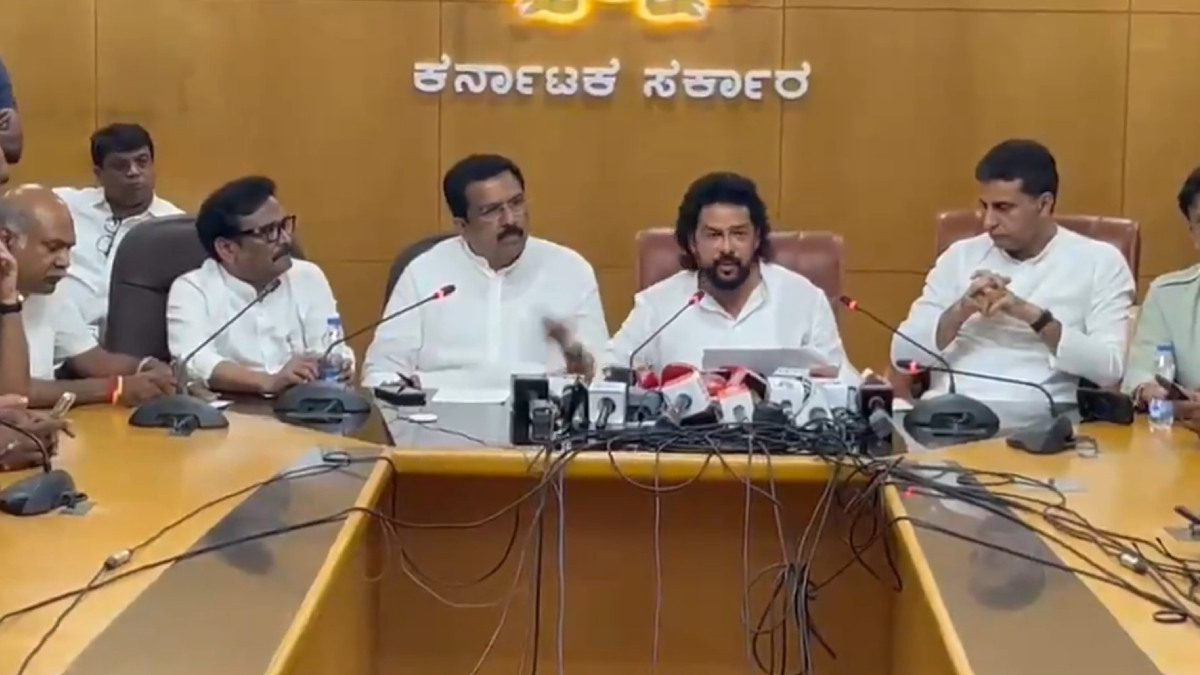
The Valmiki Corporation issue had already become a major political issue in Karnataka, with BJP and JD(S) constantly attacking the government over the alleged financial irregularities. During the monsoon session of the Karnataka Legislative Assembly, Opposition parties had launched a campaign to remove Nagendra and hold him accountable as the government. The Opposition also launched a padayatra on the issue to put pressure on the ruling Congress government.
Nagendra's resignation is the second time he lost a ministerial position in connection with the same issue. Nagendra resigned from the Cabinet on June 6, 2024, when Siddaramaiah was the Chief Minister, and after a change of political situation, came back to the Cabinet under Chief Minister D.K. Shivakumar and took the oath as a minister on August 3, 2026. Opposition parties had been critical of his appointment as a minister and questioned why a leader associated with the corporation case was brought back into the Cabinet.
The political pressure ratcheted up again, and Nagendra has finally decided to step down again. His resignation will further deepen the debate in Karnataka around ministerial accountability, financial oversight, and the protection of welfare schemes for the poorest and needy communities.
What is the Valmiki Corporation scam?
The Karnataka Maharshi Valmiki Scheduled Tribes Development Corporation scam is about large-scale financial irregularities of funds for the welfare and development of Scheduled Tribe communities in the state. In May 2024, the controversy started to emerge when P. Chandrashekharan, who was serving as an accounts superintendent at the corporation, died by suicide at his home in Shivamogga.
According to the report, investigations of the corporation’s financial transactions revealed serious irregularities. The corporation received funds amounting to ₹187 crore, out of which ₹88 crore to ₹89.6 crore was illegally transferred from the M.G. Road branch of Union Bank of India to unauthorised accounts.
The investigation unearthed evidence of forged documents and signatures to make such transfers. The alleged diversion of money raised serious questions about internal financial controls within the corporation and monitoring mechanisms for public money earmarked for Scheduled Tribe welfare.
The case subsequently became a major political issue, with opposition parties claiming the government had failed to prevent the misuse of public funds. The issue also put considerable pressure on ministers and officials in the department and corporation.
Political Fallout in Karnataka
The issue is still very sensitive for the Congress government. BJP and JD(S) leaders repeatedly used the case to question the government’s handling of financial irregularities and demand that it take stronger action against those responsible.
Nagendra’s second resignation shows the continued political significance of the case, even though it’s been over two years since the controversy first emerged. His return to the Cabinet had already been criticised, and the renewed Opposition campaign only increased pressure on the government.
So the latest development is no longer just a ministerial decision but another major political impact of the Valmiki Corporation dispute. The focus is likely to shift back to the ongoing investigation, recovery of the diverted funds, identifying all those responsible, and actions that will be taken to prevent a repeat in government-funded welfare corporations.
For the Karnataka government, transparency in welfare funds will be a major issue. The Valmiki Corporation case has demonstrated the need for stronger financial protection, auditing, and supervision of public money. As Karnataka's politics continues to rage, accountability and the protection of funds for Scheduled Tribe communities will be central issues.