The government’s ambitious Integrated Township Project at Bidadi, located in Bengaluru South district (formerly Ramanagara), is drawing increasingly strong opposition from the local farmers. The government sees the township as a big step towards reducing Bengaluru’s urban congestion and helping to develop the city’s economy, but many farmers are vehemently against it and want a piece of their fertile agricultural land.

But despite numerous talks and a series of government representatives’ efforts to convince landowners, the resistance has not abated despite these talks and government representatives’ attempts to get landowners to give in. Farmers from the affected villages have reiterated their refusal to give up their land under any circumstances and the state government now finds itself in a bind as it goes forward with one of its biggest urban development projects.
Government Talks with Farmers
Following the advice of the state leadership, Magadi MLA H.C. Balakrishna has recently held a meeting with farmers at the Revenue Bhavan in Ramanagara to reduce the tension over the project.
The meeting was attended by hundreds of farmers from Bhairamangala and Kanchugaranahalli, two of the villages most affected by the proposed land acquisition.
The MLA explained the benefits of the township in terms of infrastructure development, employment opportunities, and compensation packages in the discussions. But the farmers were not convinced, and they were still vehemently opposed to the project.
Instead of accepting the government’s assurance, farmers asked for a meeting with Deputy Chief Minister D.K. Shivakumar to discuss their concerns directly in person, they said.
H.C. Balakrishna said the government would organise a meeting between the farmers and the Deputy Chief Minister in the coming days.
The Government Says the Project Cannot Be Withdrawn
Protesters are still protesting, but the Karnataka government has made it clear that the project is unlikely to be cancelled.
As H.C. Balakrishna said, the final notification for the township project has already been issued, so it remains very difficult to withdraw the proposal.
He also stated that:
- As part of the project, we are going to carry out joint measurement certificates (JMC) surveys on the land for the landholders who have agreed to sell their land.
- Compensation amounting to ₹110 crore has already been disbursed to the eligible landowners in villages covered by the area.
- The process of land acquisition is well underway as per the laws.
This has further fueled the opposition from protesting farmers.
Farmers are afraid of losing fertile agricultural land for farming
Farmers' primary concern is the loss of highly productive farmland that has sustained their families for generations. The land that is being acquired for the acquisition is said by residents to produce up to three crops annually and is one of the most fertile agricultural belts near Bengaluru.
Farmers say that replacing productive agricultural land with urban infrastructure would permanently affect their livelihoods and reduce agricultural output in the region.
Many have said they will continue to protest to protect their land, saying development should not come at the expense of farming communities.
Political Debate Intensifies
The controversy has also evolved into a very important political issue.
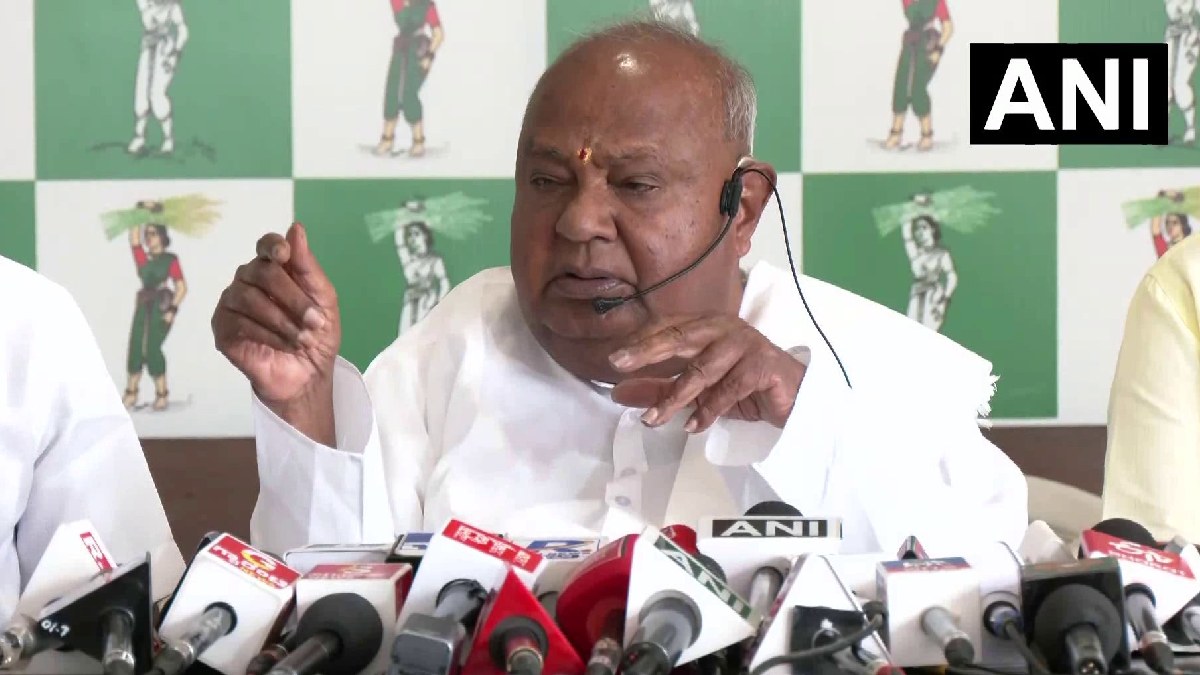
The Union Minister and former Karnataka Chief Minister H.D. Kumaraswamy has openly supported the protesting farmers. He recently joined demonstrations in Bidadi and criticized the government's approach to land acquisition.
Kumaraswamy urged the state government to avoid any forced acquisition of farmland and called on Deputy Chief Minister D.K. Shivakumar to visit the protest site and hold direct discussions with the affected families.
The government’s decision not to hold an on-site meeting has been criticized by opposition parties, who say more dialogue would be needed before it could work on such a large-scale project.
Balancing Development and Livelihoods
The proposed Bidadi Township will play an important role in Bengaluru’s long-term urban planning strategy by providing a well-developed suburban city with residential, commercial, industrial, and public infrastructure.
Urban planners argue that Bengaluru requires additional satellite townships to cater to the rapidly growing population, reduce the pressure on its core, and enhance regional connectivity.
But the project also illustrates the larger issue of infrastructure development in relation to the rights and livelihoods of farming communities.
The government is currently struggling to balance economic development and legitimate issues of land acquisition, compensation, rehabilitation, and environmental sustainability.
What lies ahead?
With farmers refusing to withdraw their protest and the government still not backing down, the Bidadi Township proposal remains at a critical juncture.
Much now depends on the proposed meeting between the farmers and Deputy Chief Minister D.K. Shivakumar. Can both sides come up with an acceptable solution, or will this dispute escalate into a long-term legal and political fight?
The Bidadi Township project could set the stage for all future infrastructure and urban expansion projects in Karnataka.