A biology teacher in Purnia, Bihar, has caught a lot of attention online after a classroom video showed him using a cucumber and a condom as teaching aids while explaining reproductive health and safe-sex concepts to students.
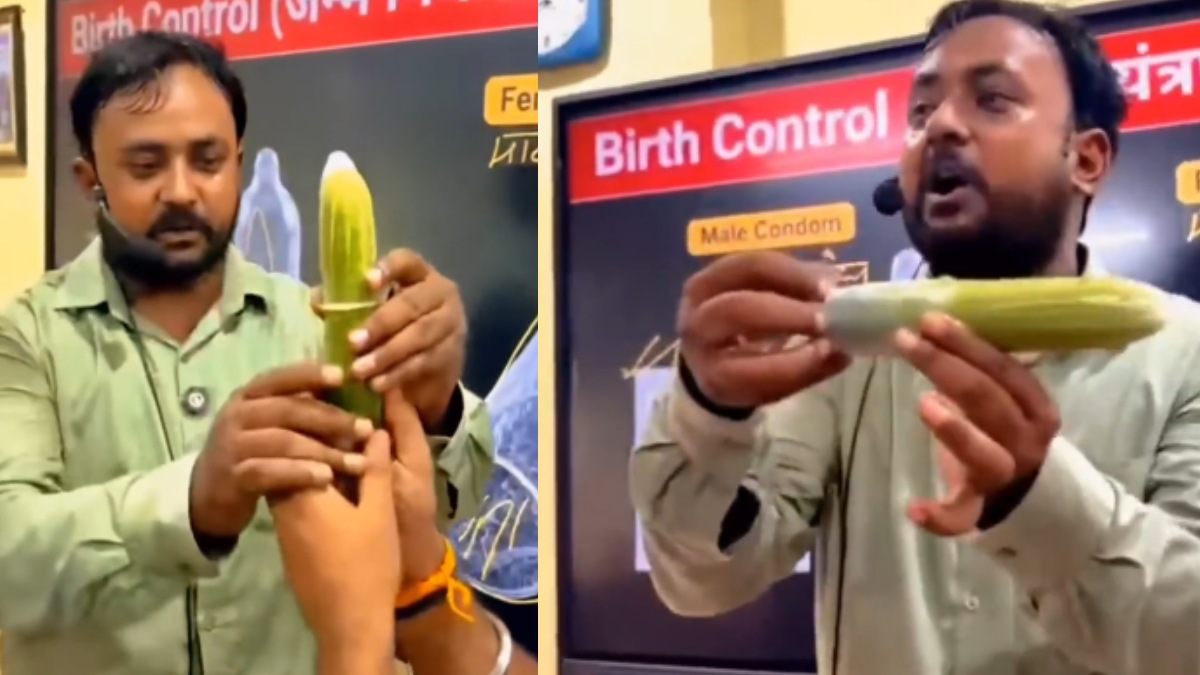
Chandan Kumar Pandit, the teacher, said using practical explanations helps students understand sensitive biological topics more easily and makes lessons more related to real-life situations. The video has now been viewed nearly 20 million times on social media.
Pandit, who describes himself on Instagram as “India’s Viral Biology Sir,” regularly shares educational content from his biology classes. In the viral classroom clip, he used a cucumber as a simple model to demonstrate the correct application of a condom while discussing its role in reproductive health. The lesson was part of a larger biology topic on human reproduction, health, and contraception.
The unusual classroom demonstration caught attention immediately because sex education is still a sensitive subject in many Indian classrooms. Pandit did not just make use of textbook diagrams and a written explanation but tried to put the biological concept into practice for students to understand. He said sensitive topics like reproductive health and birth control should be explained in a simple and understandable way.
The video has received considerable attention online, with views reported to be close to 20 million. Social media users have spoken differently about the teaching strategy; some say that the teacher has opened up on a very important topic and some say that such demonstrations aren’t appropriate for classroom environments. The discussion has extended beyond the video itself to broader questions about how reproductive health should be taught to young people.
Sex education generally covers a range of health and biological issues such as puberty, human reproduction, personal boundaries, contraception, sexually transmitted infections, and responsible decision-making. Age-appropriate education may help students acquire biological changes and health information with terminology that is correct, not fueled by rumors or misinformation.
Practical teaching methods may make difficult scientific concepts easier to remember. In biology, models, diagrams, laboratory demonstrations, and other visual aids are often used to explain processes that may be hard to understand from written descriptions alone. Students’ age, curriculum requirements, school policies, and the need to maintain a respectful classroom environment need to be taken into account when choosing a teaching approach.
The viral video has also highlighted the role social media now plays in amplifying classroom teaching methods. A lesson that might have been seen by students in one classroom can be seen by millions of people in seconds once a short clip is posted online. That can help to shine a light on emerging teaching strategies, but it can also strip away from the classroom context and give viewers information based on a quick view.
Pandit’s approach has since become part of a larger discussion on whether schools should address reproductive health more openly and scientifically. Supporters of comprehensive health education may say that students learn better from reliable information provided by trained teachers. In the same way, critics of particular teaching methods might argue whether demonstrations are appropriate for the age of the students and whether they follow institutional guidelines.
This is why reproductive-health education needs to be handled carefully. Teachers need to balance scientific accuracy with age-appropriate communication and sensitivity to students. Parents, schools, education staff, and teachers are also very instrumental in how these topics are presented and explained.
जनसंख्या नियंत्रण पर लगाम लगाने की जद्दोजहद करते बायोलॉजी के एक टीचर , बिहार के पूर्णिया के टीचर को अब ऑनलाइन वीडियो बनाकर बच्चो को समझा रहा है ,
— Nargis Bano (@Nargis_Bano78) September 23, 2026
लेकिन इसमें एक फायदा है बच्चे समझ भी जायेंगे और व्यूज अच्छे आने पर मोटी कमाई भी हो जाएगी ,
नोट : वीडियो एजुकेशनल उद्देश्य से बनाई… pic.twitter.com/HC39PRGUba
The viral video has brought millions of views, but the online reaction should not be taken as a formal assessment of the teacher’s classroom methods or the school’s policies. The clip represents one lesson, and a larger picture of the class, curriculum, and institutional guidelines may not be visible to viewers online.
For now, Chandan Kumar Pandit’s biology lesson has been widely discussed and illustrated how teachers are experimenting with practical methods of teaching sensitive scientific subjects. The attention surrounding the video also reopened a wider conversation about reproductive-health education, classroom communication, and the importance of providing students with accurate, age-appropriate information.