The Central Board of Secondary Education (CBSE) has released an important public notice announcing the official examination date for the 21st Edition of the Central Teacher Eligibility Test (CTET). The examination, which serves as a mandatory eligibility criterion for teaching jobs in central government schools, is scheduled to be held on Sunday, February 8, 2026.
Here’s a detailed look at what this means for aspirants, the key timelines, how to apply, exam structure, and how you should prepare.
Key Highlights & Timelines
- Exam Date: 8 February 2026 (Sunday).
- Number of exam cities: 132 across India.
- Languages: The exam will be offered in 20 languages to accommodate candidates from various regions.
- Notification/Information Bulletin: CBSE will soon release the detailed Information Bulletin containing eligibility criteria, application procedure, fee structure, exam centres, syllabus and pattern.
- Two Papers:
-
Paper I: For teaching Classes I to V (Primary level)
-
Paper II: For teaching Classes VI to VIII (Upper Primary level)
Candidates eligible can appear for one or both papers.
-
-
Mode: Offline (pen-and-paper) is expected as with previous sessions.
Who Should Appear & Eligibility Criteria (at a glance)
While full eligibility details will be in the Information Bulletin, key criteria include:
-
For Paper I: Senior Secondary (or equivalent) with at least 50% marks + 2-year Diploma in Elementary Education OR 4-year B.El.Ed. or equivalent.
-
For Paper II: Graduate (or appearing in final year) with at least 50% marks + 2-year B.Ed. or relevant qualification.
-
No upper age limit for CTET — as per past practice.
-
Candidates must check category-wise relaxation details once notified.
How to Apply – Step-By-Step
-
Visit the official CTET website: ctet.nic.in.
-
Wait for the “Apply Online for CTET 2026” link to become active.
-
Register with required personal details, educational qualifications, choice of Paper I or II (or both), preferred language, exam centre choice (4 optional cities).
-
Upload scanned photograph, signature and other documents as per specifications.
-
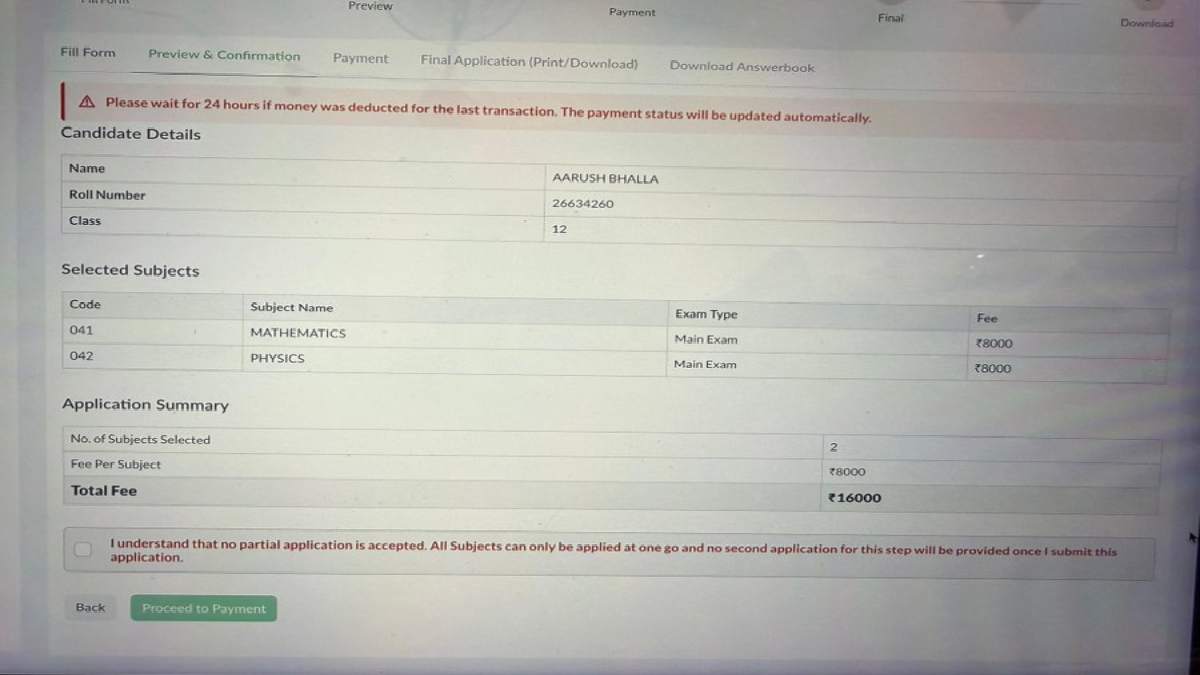
Pay the application fee online (General/OBC for one paper, both papers; SC/ST/Divyang etc. different fee) — past sessions: ₹1,000 for one paper, ₹1,200 for both papers (for General/OBC)
-
Submit the application and print/save the confirmation page for future reference.
-
Keep checking for Admit Card link, and download when released.
Exam Pattern & Syllabus Snapshot
- Duration: 2 hours 30 minutes per paper
- Total Marks: 150 (each MCQ worth 1 mark)
- No negative marking (as per past CTET rules)
- Paper I (Classes I-V): Child Development & Pedagogy; Language I; Language II; Mathematics; Environmental Studies.
- Paper II (Classes VI-VIII): Child Development & Pedagogy; Language I; Language II; Mathematics & Science OR Social Studies/Social Science (depending on subject).
Preparation Strategy: What to Do Now
- Create a study plan counting down to 8 February 2026. Allocate time for each section, especially pedagogical subjects and language parts.
- Download past year papers and sample papers of CTET to familiarise yourself with question types and difficulty level.
- Focus on key areas: Child Development & Pedagogy is common and critical; language proficiency in both languages (Indian/English) is essential.
- Practise time management: With 150 questions in 150 minutes (approx), you’ll need to maintain pace of about 1 minute per question.
- Mock tests & revision: Simulate exam-like conditions, practise without breaks, get used to the offline format.
- Stay updated: Monitor the official site (ctet.nic.in) for exact application dates, centres, admit card release, shifts, and any changes.
Important Reminders
- Only apply through the official website. Beware of third-party sites charging unofficial fees.
- Verify your eligibility carefully before applying — errors can lead to application rejection.
- Keep your documents ready (mark-sheets, diplomas, ID proof, category certificate if applicable).
- The CTET certificate once qualified holds lifetime validity, so taking it seriously is important.
- After clearing CTET, certification qualifies you for teacher recruitment in schools Covered under the RTE Act (Classes I-VIII) including Kendriya Vidyalayas, Navodaya Vidyalayas, etc.
If you’re planning a teaching career in India, the CTET 2026 is a key milestone. With the exam date of 8 February 2026 now confirmed, start your preparation in earnest. Once the Information Bulletin is out, complete your application early, capture your exam centre preferences, and gear up for a successful attempt.