The debate on the Centre's Anti-Paper Leak Bill was noisy in Lok Sabha on Tuesday. DMK MP Dayanidhi Maran was vocal about the proposed legislation and, as a whole, about the government's wider examination reforms.
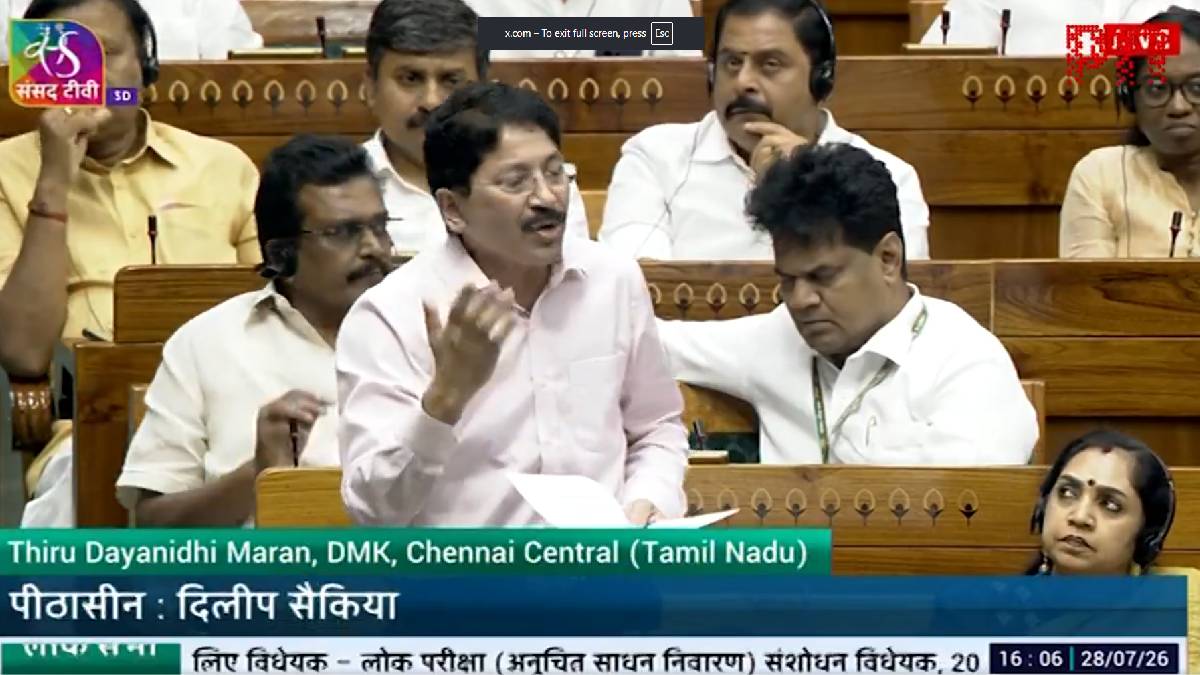
Maran, who participated in the debate, questioned the content of the Bill and the policy direction it represents. In a pointed comment, he said, “The only part of the Bill worth appreciating is that it is in English.”
VIDEO | Anti-paper leak bill debate in Parliament: "The only part of the Bill worth appreciating is that it is in English. 'One India, One Exam' is not the right approach; we are a diverse country. The Finance Minister's support for paper leaks as an excuse to give students extra… pic.twitter.com/IYgVCCHKWX
— Press Trust of India (@PTI_News) July 28, 2026
The DMK leader also opposed what he called the Centre’s “One India, One Exam” framework, arguing that it does not accurately reflect India’s diversity.
"One India, One Exam" is not the right approach; we are a diverse country," Maran said, saying that examination systems should take into account the country's linguistic, cultural, and educational diversity.
In his speech, Maran also criticised what he described as the Finance Minister's comments regarding examination delays and paper leaks. “The Finance Minister’s support for paper leaks as an excuse to give students extra time to prepare is condemnable.”
The remarks formed part of the debate in the parliament on the Anti-Paper Leak Bill, which the government says will enhance the integrity of public examinations by putting limits on paper leaks, organised cheating and examination fraud.
Hence, the bill aims to develop a stronger legal framework aimed at deterring individuals and organised networks involved in compromising recruitment exams and other public tests. The government has argued that repeated paper leak incidents have hurt millions of students and job aspirants, and strong legislation is necessary.
Opposition members were also concerned about some aspects of the proposed law during the debate. And while we appreciate that examination fraud needs to be stopped, some of our parliamentarians also felt the legislation does not address systemic issues like administrative failures, examination management and institutional accountability.
Maran's comments also added to the heated debate, and it was clear that the ruling alliance and the opposition have differences on the Centre’s educational reforms. His criticism of the “One India, One Exam” concept reflected the DMK’s long-standing stance of protecting the autonomy of states in education matters.
The parliamentary discussion comes at a time when national residents are concerned about paper leaks in various parts of the country and are not seeing paper leaks happening often either. Cancelling exams, taking longer recruitment processes, and uncertainty for students preparing for competitive exams all have consequences.
And Parliament will investigate the Bill’s provisions more thoroughly in the future before deciding on the passage of the Bill in detail. The outcome of these discussions could be the basis of future laws on public examinations and how to combat paper leaks in India.
The Anti-Paper Leak Bill is still under consideration, and it will be debated by ministers from the Treasury and Opposition before it is brought to a vote.
Note that Dayanidhi Maran's comments on the parliamentary debate are made by him not based on official facts unless independently verified.