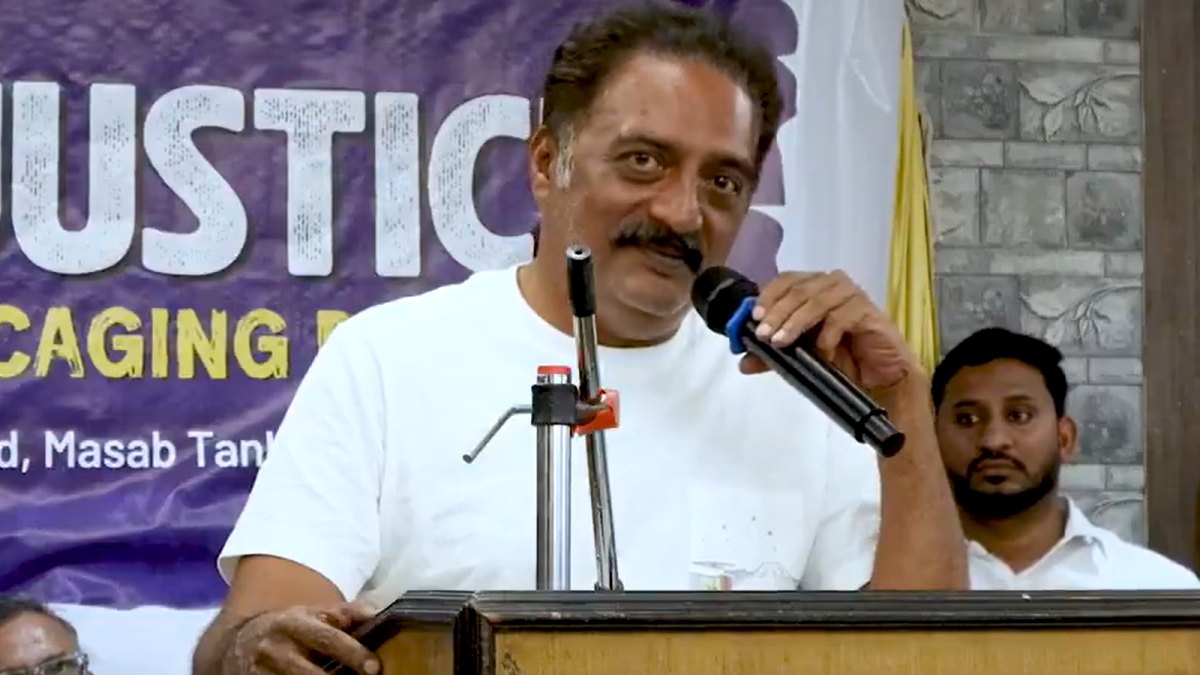
Actor-activist Prakash Raaj has been a polarizing figure in Indian public life for a long time. Best known for his "Just Asking" project, he often takes on the ruling establishment and right-wing ideologies. He is, for supporters, a fearless voice for dissent; for his opponents, a scariest person whose speech often spills into communal incitement and hate speech.
What Is Hate Speech According To Indian Law?
Indian law does not have a single legal meaning for hate speech. But there are several parts into which it is punished under different sections of the Bharatiya Nyaya Sanhita (BNS) (previously IPC), which contain:
- Section 196 (formerly 153A): Prohibits the promotion of hate against different groups due to religion, race, place of birth, place of residence, language, etc.
- Section 197 (formerly 153B): Imprisonment for imputing or making an imputation or assertion prejudicial to national integration.
- Section 299 (formerly 295A): Deliberate and malicious acts that attempt to outrage religious feelings.
Hello @AmitShahOffice
— Kashmiri Hindu (@BattaKashmiri) January 6, 2026
Is this not Hate speech?
Why should not @prakashraaj be behind the bars for inciting hate amongst communities?pic.twitter.com/a6CxauHpQn
Recent Controversies (2025–2026)
Several incidents during early 2026 and during 2025 have also led to calls for legal action against the actor:
- The “Ghuspathiya” (Intruder) Remark: Late in 2025, Raaj’s comment was that “no human is illegal on earth” and many people saw it as defense of illegal migration and a slur against national security.
- Sanatana Dharma Comments: Following a row of 2023–24, Raaj is not slowing down in his criticism of religious practices, which various Hindu organizations have called “anti-Hindu” and “hateful.”
- The Chandrayaan-3 Mockery: While older, his tweet — with a “tea-seller” cartoon showing him on the Moon mission — is still a burning rod, with critics claiming he was poking fun at Indian scientific accomplishments to score political points.
The Argument for "Behind Bars"
Those who think Prakash Raaj should go to imprisonment argue that:
- Regularity: They say the tone of him speaks very little from him directly, though they insist that the latter does in fact aim to demoralize individual communities or whole states.
- Unnecessarily provocative: But he risks inciting civil disorder and the collapse of the communal order by using disparaging language to put holy teachings into a derogatory context.
- Legal Equality: There is a growing outcry that when it comes to arresting others on charges of "harming sentiments," the same should be said for influential celebrities.
The Case for Freedom of Expression
As for those who do, legal experts and supporters say:
- Dissent is Not Hate: Critiquing a party (the BJP) or government is not hate against one specific community.
- Absence of Violence: For a speech to become criminalized as “incitement,” the Supreme Court of India has often said that there needs to be a direct connection with a “spark in a powder keg,” such as “actual violence” or a clear threat of violence.
- Targeting Dissent: Proponents argue that “hate speech” laws are becoming a weapon to silence a critic who’s literally “just asking” uncomfortable questions.